
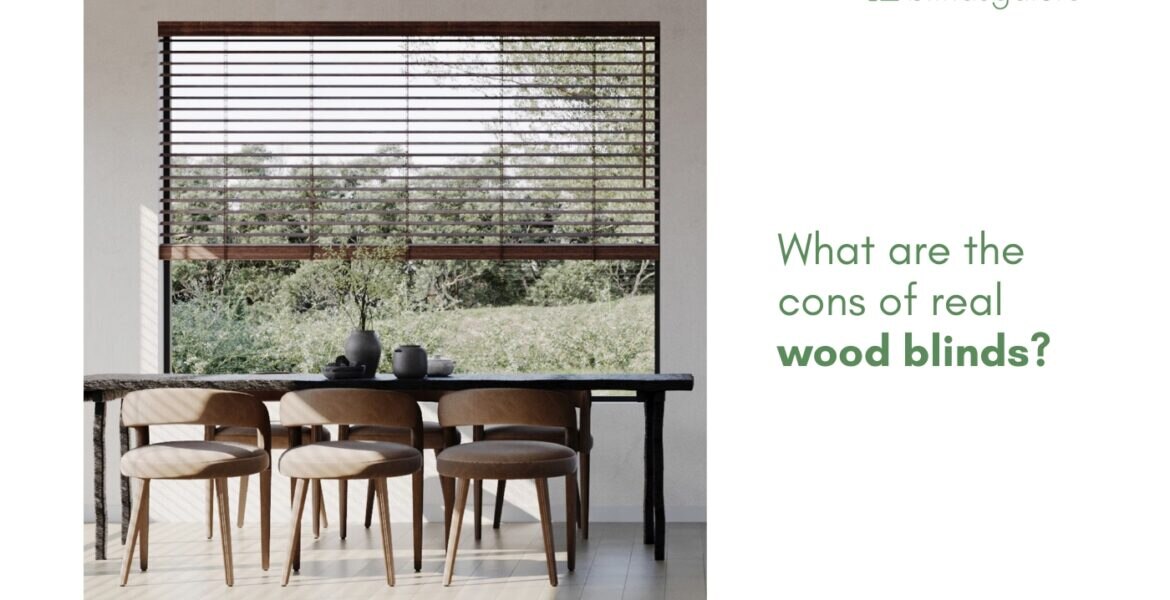
Real wood blinds are a beautiful window treatment, but they come with real trade-offs that don’t show up in catalog photos. Most only matter in specific rooms, and most have a clear workaround.
Do real wood blinds warp in humid rooms?
Yes, and this is the single biggest practical issue with real wood as a window treatment. Natural wood absorbs moisture from the air. Once the moisture content rises, slats can swell, cup, twist, or crack. Lift cords can also seize against swollen slats, making the blind hard to raise or lower. Bathrooms with showers, kitchens with stovetop steam, laundry rooms, and unventilated basements are the worst offenders.
The fix isn’t a sealant or a special finish; it’s a different material. Faux wood blinds are made from composite or PVC, which doesn’t react to humidity. The look mimics real wood closely (especially in the 2-inch and 2.5-inch slats), but the slats stay flat, and the mechanism keeps running through years of bathroom steam. Our Bamboo vs. Wood Blinds comparison covers a similar natural-material option for a wood-like look in a more humidity-tolerant package.
Does sunlight fade real wood blinds?
Over time, yes. UV exposure lightens and yellows wood finishes the same way it ages hardwood floors, leather furniture, and outdoor decking. The fading is gradual but cumulative, and it shows most on slats that catch direct afternoon sun while neighboring slats stay shaded. Our warranty (3-year limited, with a free upgrade to 5 years on Blindsgalore products) does not cover fading on any product, so a south- or west-facing window can show measurable color change within a few years.
A few mitigations help: UV-resistant finishes slow the change; thicker linings in adjacent drapery cut down peak sun on the slats; and rotating the tilt direction periodically spreads sun exposure across both sides of each slat. For sun-heavy rooms, our Hello, Sunshine, Goodbye, Glare guide explains how solar shades or layered treatments knock down UV before it reaches the wood.
How much more do real wood blinds cost than faux wood?
Real wood blinds typically cost noticeably more than comparable faux wood blinds in the same size and color. The exact gap depends on slat width, finish, and customization, but expect a meaningful step up at every comparable configuration. Custom orders widen it further, since hardwood lots have to be matched for color and grain consistency before milling.
The premium is worth it for the right room (a formal dining room, a study, a primary bedroom where the warmth of real wood plays against other natural materials). For utility spaces, kids’ rooms, rentals, or anywhere the blind takes daily abuse, faux wood gets you most of the visual benefit for a fraction of the budget. Savings are easier to justify when outfitting multiple windows at once.
Are real wood blinds too heavy for large windows?
Real wood is dense, and that density adds up across a wide blind. Slats wider than 60 inches can put strain on lift mechanisms, and slats at this length can bow under their own weight, leaving uneven spacing when the blind is fully lowered. For wider windows, we recommend using a 2 blinds or 3 blinds on one headrail, which can be customized while ordering. The cord tilt also gets harder to operate as the slats get longer.
For wide windows where you still want a wood look, shutters deliver the same warmth with a built-in frame that supports the weight, and the louvers stay aligned regardless of width. For sliding doors or picture windows over 72 inches, neither wood nor faux wood is the right call. Vertical blinds and custom drapery are built for that scale.
When are real wood blinds still the right choice?
The cons above are honest, but they don’t disqualify wood. Real wood blinds are the right call in three situations.
The first is rooms where the visual difference from faux wood actually matters. Primary living spaces, formal rooms, and studies where the blind sit next to hardwood floors and built-ins. Faux wood is good, but it isn’t the same up close.
The second is medium-sized windows in low-humidity, low-UV rooms. A bedroom on the shaded side of the house, a hallway, and an interior dining room. Those conditions don’t stress real wood, and the blind looks beautiful for decades. Our How Long Do Custom Blinds Last covers the realistic lifespan for both materials.
The third is when you want the variation that natural wood brings. Each slat has its own grain, and across a window, that variation reads as texture. Some buyers love it; others want every slat to match. Knowing which camp you’re in saves a return.
How do you decide between real and faux wood?
Start with samples and the room. Order up to 10 free samples in both materials, hold them side by side at the actual window, and check them at the times of day you’re in that room most. Pay attention to the finish in direct light. Differences are easier to see in your own space than in a catalog.
Our in-house experts are at (877) 702-5463 if you want to talk through trade-offs for your specific window. Most of the team has been doing this for 20-plus years and can usually steer you to the right material in one conversation. Custom orders ship free across the contiguous United States and Canada, and most ship within 5 to 7 business days. Our Ultimate Guide to Window Treatments is a useful primer if you’re early in the decision.
Frequently Asked Questions
Worth it in low-humidity, low-UV rooms where real wood materially upgrades the space (formal living rooms, primary bedrooms, studies, dining rooms). Less worth it in bathrooms, kitchens, kids’ rooms, rentals, or sun-heavy west-facing windows, where faux wood delivers most of the look at a much lower cost.
Not necessarily. Real wood can last decades in the right room (low humidity, moderate sun, gentle handling), but fails much faster than faux wood in humid or high-UV environments. Faux wood holds up consistently across all room types, which often makes it the longer-lasting choice in real-world conditions.
Not recommended. Even with a ventilation fan, steam from showers and tubs is enough to swell and warp natural wood slats over time. Faux wood is the standard answer for any bathroom, with the only exception being a powder room or half-bath that has no shower.
Three reasons. Real hardwood (typically basswood) costs more as a raw material than the composite or PVC used for faux wood. The slats have to be matched for color and grain across each blind, which adds labor and waste. And the finishing process for natural wood involves multiple coats of stain or paint with curing time between each.
Dust regularly with a soft microfiber cloth or a vacuum brush attachment on low suction. For deeper cleaning, use a barely-damp cloth with a wood-safe cleaner, then dry immediately. Never submerge real wood blinds in water, since soaking warps the slats and ruins the lift mechanism, and that damage is not covered under our warranty.
Wider 2.5-inch faux wood slats with embossed wood-grain texture and a true-wood color palette come closest. Hold a sample next to a real piece of hardwood furniture in your room, and the difference is usually smaller than you’d expect.