
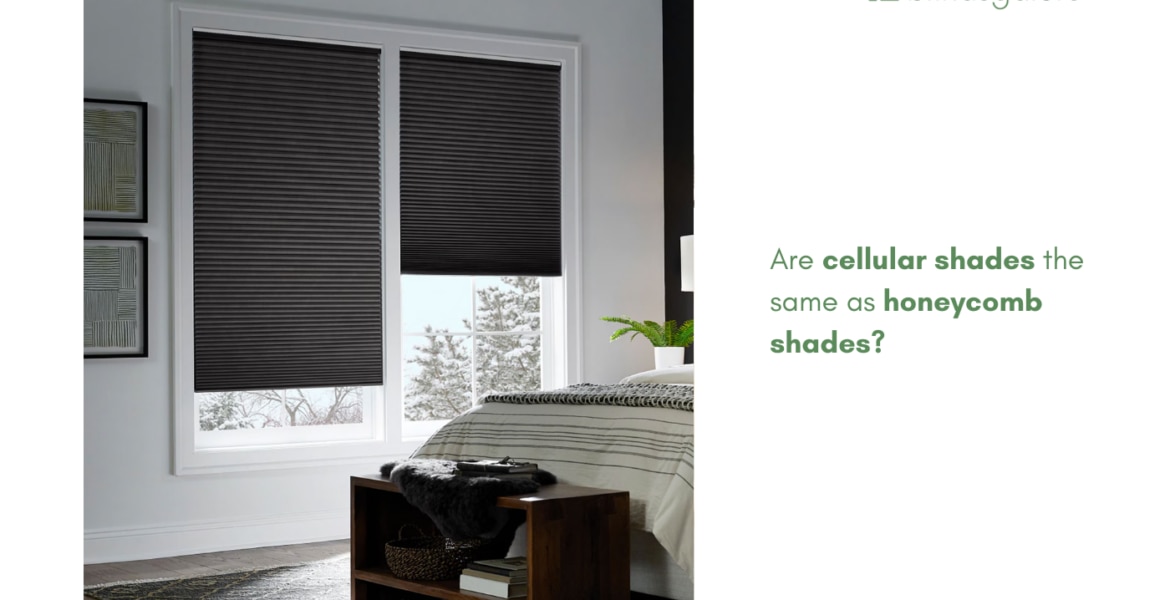
Yes. Cellular shades and honeycomb shades are the same product. Both names describe a shade made of pleated fabric folded into rows of air pockets, or cells, that look like a honeycomb when you view the shade from the side. The construction, performance, and options are identical whichever name is on the label.
Are cellular shades the same as honeycomb shades?
Yes, completely. The two names describe one construction from two angles:
- “Cellular” describes how the shade works. The fabric forms cells that trap air between the room and the glass.
- “Honeycomb” describes how the shade looks. Seen from the side, those cells form a hexagonal, beehive-like pattern.
The U.S. Department of Energy uses both ideas in a single sentence. Its fact sheet on interior cellular shades describes cellular shades as pleated fabric folded to create cells in a honeycomb design.
Where do the two names come from?
Both terms have been in technical use since the product first appeared. A 1986 patent filing titled “Expandable honeycomb structure for use as collapsible blinds” is classified under making articles of cellular structure with hexagonal cells for window coverings. In other words, the patent system files “honeycomb” and “cellular” under the same category.
Today the naming comes down to habit, not hardware:
- Spec sheets and energy research tend to say cellular.
- Many shoppers and retail listings say honeycomb.
- Plenty of brands, including us, use both.
Searching only one term can hide options, which is why our cellular and honeycomb shades live together in a single collection.
If the name doesn’t matter, what does?
Four choices change how a cellular shade performs. The name isn’t one of them.
| Choice | Your options | What it changes |
|---|---|---|
| Cell construction | Single-cell or double-cell | Double-cell adds a second layer of air pockets for more insulation |
| Pleat size | Smaller or larger pleats | How the shade looks in proportion to small, standard, and large windows |
| Fabric opacity | Light-filtering or blackout | How much light and privacy you get |
| Lift | Cordless, top-down/bottom-up, or motorized | How you operate the shade and how child-safe it is |
Four cellular shades cover most homes, whichever name you search for:
- Blindsgalore Classic cordless light-filtering cellular shades. A child-safe cordless lift on every shade and soft, diffused light for kitchens, family rooms, and offices.
- Blindsgalore cordless top-down/bottom-up cellular shade. Lowers from the top or rises from the bottom, in light-filtering or blackout fabric.
- Blindsgalore Harmony blackout cellular shades. Integrated blackout lining for bedrooms, nurseries, and home theaters, with optional Bluetooth motorization.
- Blindsgalore Select light-filtering cellular shades. Our most versatile cellular shade, with an extensive range of colors and custom options.
For the full single-cell vs. double-cell decision, room by room, see our in-depth guide, Cellular Shades vs. Honeycomb Shades: What’s the Difference and Which Should You Buy?
Frequently asked questions
No. A honeycomb shade and a cellular shade are the same product. Both names describe fabric folded into air-trapping cells with a honeycomb profile.
Yes. “Honeycomb shade” and “cellular shade” are interchangeable names for the same window treatment.
Naming habits vary. Energy research and spec sheets lean toward cellular, while many shoppers and retail listings say honeycomb. The construction and performance are identical under both names.
Yes. “Honeycomb blinds” and “cellular blinds” are common everyday names for the same fabric shade, even though it has no slats like a traditional blind.
Yes. Both trap air in their cells, which slows heat moving through the window. Double-cell versions insulate better than single-cell, whichever name the product uses.