
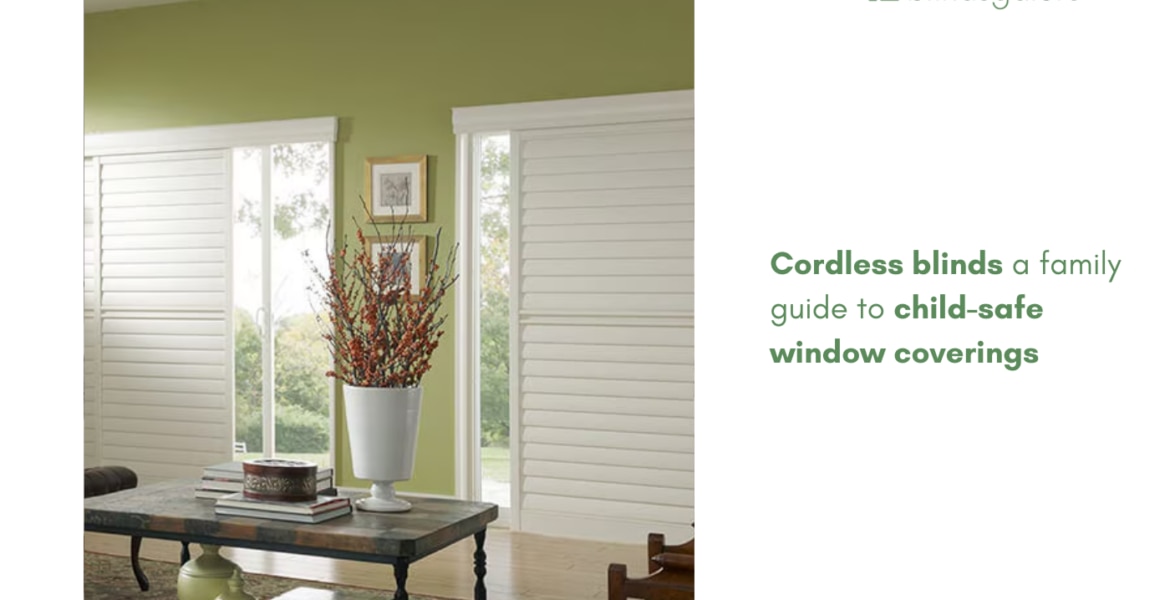
Cordless blinds are the safest choice for any home with young children. With no lift cord to pull, there’s no cord loop for a child to become caught in. The U.S. Consumer Product Safety Commission calls cordless window coverings the safest option for families; motorized lifts are cord-free too, and both are now the default across most custom window coverings.
October is National Window Covering Safety Month, and the timing fits. Many families are moving, setting up nurseries, or childproofing before the holidays, and window cords are one of the hazards that are easiest to miss. Here’s what changed in the safety rules, the cordless problems people actually run into, and how to choose the right lift for each room.
Are cordless blinds safe for kids?
Yes. Cordless blinds and shades are the safest window coverings for homes with young children, along with motorized styles. The risk they remove is real. According to the U.S. Consumer Product Safety Commission:
- About nine children under age 5 die every year from strangulation on window covering cords.
- More than 200 cord strangulation incidents involving children up to age 8 were reported from 2009 through 2021.
- A child died in 48% of those incidents.
A cordless lift takes the accessible cord out of the picture. Three things make a child-safe setup complete:
- A cordless or motorized lift on every window a child can reach.
- A product carrying the Window Covering Manufacturers Association’s Best for Kids certification where available.
- Smart placement, with cribs, beds, and climbable furniture moved away from windows.
Our child-safe window treatments collection gathers cordless, motorized, and Best for Kids certified styles in one place.
Why is cordless now the standard for family homes?
The safety rules tightened in two steps, and together they pushed the whole industry toward cordless.
- Canada. Health Canada’s Corded Window Coverings Regulations came into force on May 1, 2021, placing strict limits on cords for window coverings sold in Canada.
- United States. The revised ANSI/WCMA A100.1-2022 safety standard took effect on June 1, 2024, for products made on or after that date. According to the Window Covering Manufacturers Association, the standard covers both stock and custom products.
For custom window coverings in the U.S., the 2024 standard made three key changes:
- Free-hanging operating cords and tilt cords are eliminated.
- Continuous cord loops and bead chains are prohibited on horizontal slatted products like wood and faux wood blinds.
- The cord systems still allowed on other products, such as a continuous loop with a tension device or a rigid shroud, must meet tougher performance requirements.
So corded options haven’t disappeared from the market entirely. At Blindsgalore, every blind we sell is cordless. A few shade styles, such as some large roller shades, can still be ordered with a continuous cord loop that requires a mounted tensioner. For any room a child uses, the CPSC’s advice is simple: choose cordless.
What are the most common problems with cordless blinds?
Most cordless issues come from fit, bracket placement, or how the shade is operated, not from a defect. Here are the ones our in-house experts hear about most, with the usual fix.
- The shade drifts down after you raise it. The spring tension and the shade’s weight are out of balance. Bali’s cordless troubleshooting guide for cellular and pleated shades addresses creeping shades by adjusting the bottom rail weights. Call us before taking a shade apart.
- The shade feels stiff or won’t move. Give the bottom rail a gentle tug down, then push it back up, which usually resets the spring. If that doesn’t work, check the brackets. Bali’s guidance for its cordless cellular, pleated, and roman shades is to keep the end brackets at least 3 inches in from each end of the headrail (troubleshooting guide).
- The bottom rail sits crooked. Lift from the center or use both handles. Many wider cordless shades come with two handles so you can raise them evenly.
- The window is too tall to reach. A manual lift only works if you can reach the bottom rail comfortably from the floor. For high windows, motorized lifts are the better call.
- The window is very large. On oversized shades, size and weight can make a manual spring lift impractical. Motorization handles those windows better.
- The lift wears over time. The spring mechanism is the most common wear point, especially on very tall or wide shades. Blindsgalore brand products carry a 3-year limited warranty with the option to extend to five years.
Correct sizing prevents most of these problems. When the shade fits the window exactly, the spring tension stays balanced, which is one reason custom sizing matters more on a cordless lift than on a corded one. Cleaning matters too: dust regularly and never submerge any blind or shade in water, which damages the lift. Our material-by-material cleaning guide covers every style.
Which blinds and shades come in cordless?
Cordless lifts are standard across most of our lineup. Here’s how each style works without a cord.
| Style | How it operates |
|---|---|
| Cellular shades | Spring lift in the headrail; push up or pull down on the bottom rail |
| Roller shades | Spring lift; the shade stops wherever you let go |
| Roman shades | Spring lift matched to the weight of the fabric |
| Wood and faux wood blinds | Lift bar on the bottom rail raises the slats; a wand tilts them |
| Woven wood and sheer shades | Spring lift, with liners available on woven woods |
| Vertical blinds | One cordless wand rotates the vanes and slides the blind open |
| Shutters | No lift at all; louvers tilt with a tilt bar or lever |
A few specialty styles work better with motorization because their size, weight, or fabric makes a manual spring lift impractical. Our in-house experts can confirm cordless availability for any product before you order. The full cordless collection shows every option.
Cordless or motorized: which is better for families?
Both are safe for children and pets. The choice comes down to the window and how you want to use it.
| Features | Cordless | Motorized |
|---|---|---|
| How it works | Raise and lower by hand | Remote, app, wand button, or voice |
| Best for | Standard windows you can reach from the floor | Nurseries, tall windows, hard-to-reach glass |
| Smart home | No | Works with Alexa, Google Home, and more |
| Cost | The more affordable choice | A larger upgrade per window |
Two configurations add flexibility in kids’ rooms:
- Cordless top-down/bottom-up shades lower from the top to let light in while the bottom stays closed for privacy, with no cord on either rail.
- Motorized wands put a push-button control on a rigid wand, with no cord loop. Our motorized blinds and shades can also run a nap-time schedule through a compatible smart hub, so you never have to walk into the room.
A simple family setup works well: cordless in kids’ bedrooms and motorized in the nursery or on any window above easy reach. For a closer look at the trade-offs, see whether motorized blinds are worth it.
Are cordless blinds safe for pets?
Yes. Dangling cords are a strangulation hazard for pets as well as children, and cords are tempting to chew and swallow. Cats are especially drawn to string. Veterinarians at VCA Animal Hospitals describe swallowed string-like objects as an especially dangerous type of foreign body in cats. A cordless lift removes the temptation. Our guide to window treatments for pet owners covers which materials also stand up to claws and paws, and our cat-proof blinds post goes deeper for feline households.
How do you set up a child-safe room?
A cordless lift is the biggest step, and a few habits finish the job. The CPSC recommends:
- Move cribs, beds, furniture, and toys away from windows, ideally to another wall.
- Replace older corded window coverings in any room a child can access.
- Until you can replace them, keep pull cords as short as possible and out of reach.
- Anchor any continuous-loop cords to the floor or wall.
Frequently asked questions
Not by a single blanket ban. In Canada, the Corded Window Coverings Regulations have limited cords since May 1, 2021. In the U.S., the ANSI/WCMA A100.1-2022 safety standard, effective June 1, 2024, eliminated free-hanging cords on custom products and requires most window coverings to be cordless or have inaccessible or short cords. Cordless and motorized lifts meet both.
Not when they’re well built and sized correctly. Cordless lifts use a spring mechanism instead of a cord, and the spring is the part that wears over time, mostly on very large shades. An occasional reset with a gentle tug on the bottom rail is normal and doesn’t mean the shade is defective.
Yes. Cordless lifts remove the strangulation risk that dangling cords pose to pets, and they take away a cord that cats and dogs may chew or swallow.
Best for Kids is a certification program from the Window Covering Manufacturers Association. The label makes it easy to spot cordless window coverings that have passed independent third-party testing.
Pull the bottom rail down gently, then push it back up to reset the spring. If the shade still won’t move smoothly, call us at (877) 702-5463. Most issues are simple fixes we can walk you through by phone.
No. Cordless designs have made blinds and shades look cleaner than ever, with no cords hanging in front of the glass. Cellular shades, roller shades, and faux wood blinds remain staples in today’s homes, and all three come cordless.