
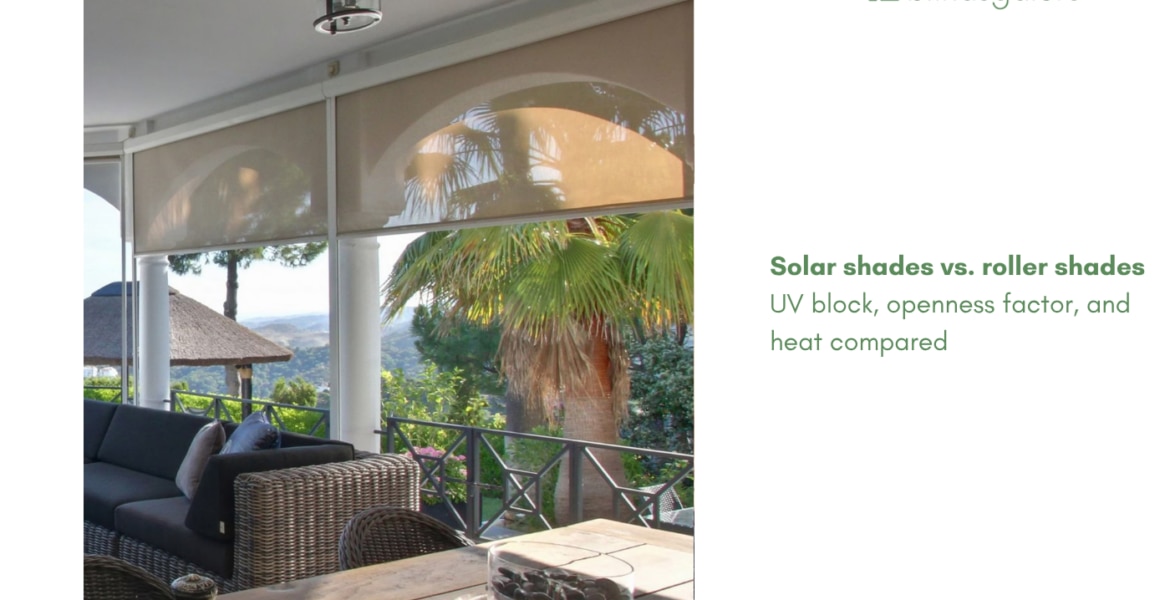
In the solar shades vs. roller shades question, the core difference is fabric. Solar shades are roller shades made with an open-weave screen that cuts UV, glare, and heat while keeping your view of the outdoors. Standard roller shades use solid light-filtering or blackout fabric, which gives you privacy and darkness but hides the view. On heat, a solar shade’s results depend less on the label and more on three specs: its openness factor, its fabric color, and whether it hangs inside or outside the glass.
Most comparisons stop at definitions. Here we work from the numbers, because the specs on a solar fabric tell you almost exactly how it will perform at your window.
What is the difference between solar shades and roller shades?
Both roll up onto a tube at the top of the window. The difference is the fabric.
| Features | Solar shades | Standard roller shades |
|---|---|---|
| Fabric | Open-weave screen rated by openness factor | Solid light-filtering or blackout fabric |
| View outside | Yes, during the day | No, when lowered |
| UV and glare | Cut most UV and glare, by openness level | Blackout fabric blocks nearly all light through the fabric |
| Nighttime privacy | No, with lights on inside | Yes |
| Best for | Sun-facing rooms, offices, media rooms, views | Bedrooms, nurseries, privacy, darkness |
Our solar shades note that they won’t provide complete privacy at night, which is why many people pair them with drapes. For the full side-by-side, including privacy and room fit, our earlier post on solar shade vs. roller shade covers the basics. Below, we go deeper on the specs.
How do UV block and openness factor work?
The openness factor is the percentage of open space in the weave. UV block is roughly the inverse. A 1% fabric has about 1% open space and blocks about 99% of UV. A 10% fabric blocks about 90%.
Manufacturer data bears this out. Phifer’s spec sheet for its SheerWeave Basic solar fabric lists approximately 99% UV blockage at 1% openness, 97% at 3%, and 95% at 5%.
| Openness | Approximate UV block | What you’ll see |
|---|---|---|
| 1% | 99% | The tightest weave; the least view and the most privacy by day |
| 3% | 97% | Strong glare control, with shapes visible outside |
| 5% | 95% | A balanced view and glare control for most rooms |
| 10% | 90% | A clear view, with lighter glare control |
Our guide to solar screen openness factors walks through what each level looks like in a real room.
Do solar shades block more heat than roller shades?
The answer depends on how the shade is specified, not just which kind it is. Three factors decide how much solar heat reaches the room.
- Placement. A shade outside the glass stops the sun before it heats the window. The South Carolina Energy Office advises that it’s always best to install exterior shades whenever possible. That’s where outdoor solar screens have the edge over any interior shade.
- Fabric color. Inside the window, color matters a lot. In the same Phifer spec sheet, a white 3% fabric mounted inside clear glass reflects 64% of solar energy, while a charcoal 3% fabric reflects just 4%. The white version lets through roughly half as much solar heat.
- Openness. A tighter weave lets less direct sun through, so 1% to 3% fabrics cut more heat and glare than 10%.
There’s a trade-off with color. Darker solar fabrics give a clearer view out, while lighter fabrics reflect more heat. The same Energy Office guidance recommends white window shades to reflect heat away from the house.
A blackout roller shade blocks more light than any solar shade, but it also blocks your view. If you want to cut heat and still see outside, choose a light-colored solar shade with a low openness factor, or mount a solar screen on the outside of the window.
Can solar shades go outside the window?
Yes. Outdoor solar shades are built for weather and mount outside the window or across a patio opening. That’s what makes them the strongest heat blockers of the options here.
- The Blindsgalore Classic outdoor solar screens use a PVC and fiberglass screen made for high-sun areas.
- Coolaroo outdoor sun shades use a knitted fabric that blocks up to 95% of UV rays.
- Tie-down brackets keep outdoor shades from flapping in the wind.
Our full outdoor shades collection covers patios, porches, and exterior windows, with openness levels for every balance of view and shade.
When should you choose a solar shade or a roller shade?
Choose by what the room needs most.
Choose a solar shade when:
- A west- or south-facing window brings hard afternoon sun.
- Screen glare is the problem, as in a home office or media room.
- The view is the reason the window is there, as in a sunroom or a waterfront home.
- You want to protect floors and furniture from UV while keeping the room bright.
Choose a standard roller shade when:
- The room needs darkness for sleep, such as a bedroom or nursery.
- You need privacy at night.
- You want a solid color or pattern rather than a screen texture.
Need both? Pair a solar shade with blackout drapery, so the solar shade handles daytime glare, and the drapery handles nighttime privacy. Our tips for cutting glare without losing daylight and choosing sunroom blinds cover more scenarios.
Frequently asked questions
Solar shades are roller shades made with an open-weave screen fabric that cuts UV, glare, and heat while keeping your view. Standard roller shades use solid light-filtering or blackout fabric for privacy and light control, but they hide the view when lowered.
A solar shade mounted outside the window blocks heat best, because it stops the sun before it reaches the glass. Indoors, a light-colored solar shade with low openness reflects much more heat than a dark one. A blackout roller blocks more light, but you lose the view.
Blackout roller shades block nearly all light that passes through the fabric. Solar shades are the option rated for UV by openness factor, so you can choose a precise level of UV block while keeping your view.
No. With lights on inside, people outside can see through solar shades at night. Layer them with drapery or a roller shade for nighttime privacy.
A 1% openness factor blocks the most, about 99% of UV. Higher openness levels let in more light and view, with UV block dropping to about 90% at 10%.
Yes. Outdoor solar shades are made for exterior use, and mounting them outside the window is the most effective way to block solar heat.