
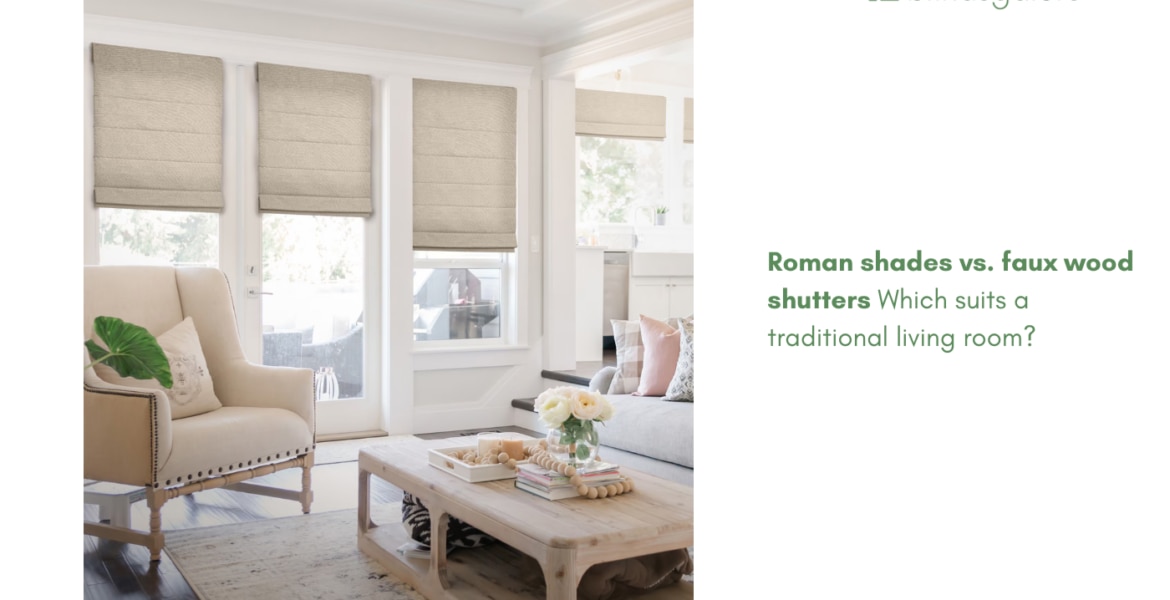
Both roman shades and faux wood shutters look right at home in a traditional living room, but they get there differently. Faux wood shutters offer a built-in, architectural look and louvers you can tilt to control light and privacy. Custom roman shades give you soft fabric, a wider range of colors and patterns, and a lower upfront cost that’s easier to update later. Choose shutters for permanence and precise light control, and roman shades for softness and flexibility.
Picture a room with crown molding, a fireplace, and a pair of armchairs facing the window. Either option can finish that window beautifully. The better choice depends on how long you plan to keep the look, how much you want to spend now, and how you use the light.
What is the core difference between roman shades and faux wood shutters?
Roman shades are soft, fabric window treatments that fold into horizontal pleats when raised. Faux wood shutters are hard, framed panels with louvers that tilt and panels that swing open on hinges.
| Features | Roman shades | Faux wood shutters |
|---|---|---|
| Material | Fabric, with optional liners | Composite or engineered materials made to look like painted wood |
| Look | Soft, tailored folds | Architectural, built-in |
| Light control | Raise or lower; fabric opacity sets the light | Tilt louvers to angle light; open panels for the full view |
| Privacy | Depends on fabric and liner | Adjustable by louver angle |
| Color and pattern | Dozens of fabrics, from solids to prints | Painted finishes, with whites and off-whites the most popular |
| Cost | Mid-range | Premium |
| Updating later | Easy to swap for a new fabric | A long-term fixture |
| 30-day exchange guarantee | Covered | Not covered |
Which looks more classic and architectural?
Faux wood shutters win on architecture. The frame mounts inside or around the window, so the shutter reads as part of the house rather than something hung on it. Smaller louvers lean traditional, and a center tilt bar down the front of each panel adds to the classic look. White and off-white finishes are the most popular because they match most trim.
Roman shades win on softness, and they can be just as classic. A traditional living room suits neutral fabrics, subtle patterns, or a damask, paired with a fold style that shows some structure. Our custom roman shades come in several folds, depending on the collection:
- Hobbled (or soft) fold: Cascading folds stay visible even when the shade is lowered. Of all the folds, hobbled is the most traditional and drapery-like.
- Knife pleat or plain fold: Crisp, evenly spaced pleats with a tailored, timeless look.
- Relaxed fold: A gentle curve at the bottom for a softer, more casual feel.
- Flat fold: A smooth face with no visible pleats, best for showing off a print.
If you want the full formal treatment, roman shades layer beautifully under drapery. Our roman shade fabrics coordinate with our custom drapery, so the two match across the room.
How do roman shades and faux wood shutters compare on cost?
Roman shades cost less upfront. Every product we sell is custom, so pricing depends on size and options, but the categories sit in different tiers. Roman shades land in the mid tier, and shutters sit in the premium tier with custom drapery. Shutters use more material per window and heavier hardware, which is why they cost more. Our guide to custom blinds pricing explains what moves the price for each category.
A few points shift the math:
- Fabric choice. Roman shade prices vary with the fabric and liner, so you can stay mid-range or step up to embroidered designer fabrics.
- Material. Among shutters, faux wood is usually the friendlier price point compared with real wood.
- How long you’ll keep it. Shutters are built as a long-term fixture. Our post on whether plantation shutters are worth the investment walks through that trade-off.
- Exchange coverage. Roman shades are covered by our 30-day exchange guarantee, for up to four window coverings per household. Shutters aren’t, so careful measuring matters more.
How do light control and privacy compare?
Shutters give you more ways to adjust the light. Roman shades give you more say over the kind of light you get.
With faux wood shutters, you can:
- Tilt the louvers to let in daylight while blocking the view in from the street.
- Angle the louvers up to bounce sun toward the ceiling.
- Add a divider rail to tilt the top and bottom louvers separately.
- Swing the panels fully open for the whole view.
Closed shutters darken a room well, but they aren’t blackout. Expect thin lines of light around the panels.
With roman shades, the fabric decides the light:
- Light-filtering fabrics soften the sun and give daytime privacy, though silhouettes can show at night with the lights on.
- Room-darkening fabrics block most light.
- Blackout fabrics and liners block nearly all of it, with a little light possible at the edges.
The trade-off is that a roman shade controls light by raising and lowering, rather than tilting. For a living room where you want daylight and privacy at the same time, shutters have the edge. For a living room that doubles as a TV room, a blackout roman shade darkens the space more completely than shutters can. For more privacy ideas, see our living room window treatments.
Both are child-safe choices. Shutters have no lift cords at all, and our roman shades come with cordless and motorized lifts.
Which is easier to update if your style changes?
Roman shades, by a wide margin. Fabric is the easiest part of a room to change, and a new roman shade can replace the old one in a different color, pattern, or fold. The lower cost makes a refresh realistic when you repaint or bring in new furniture.
Shutters are built to stay. The frame becomes part of the window, and the clean white finish is meant to work through many rounds of redecorating. If you love the look now and expect to keep it for the long run, that permanence is the point. If your style tends to shift every few years, roman shades keep your options open.
Which should you choose for your living room?
Go with faux wood shutters if you want a permanent, architectural look, adjustable light through the day, and no cords. Go with roman shades if you want softness, color, or pattern, a lower upfront cost, and the freedom to change the look later.
Roman shades we love for traditional living rooms:
- Classic Roman Shades: Four fold styles, including hobbled, with light-filtering or blackout liners.
- Luxera Roman Shades: A step up in fabrics, in the same four fold styles.
- Boutique Embroidered Roman Shades: Embroidered fabrics on a fabric-wrapped wood headrail, from our premium line.
Faux wood shutters for a classic look:
- Faux wood shutters with 2 1/2-inch louvers: The most traditional louver size, suited to smaller windows.
- Faux wood shutters with 3 1/2-inch louvers: A balanced choice for standard living room windows.
Browse the full range of faux wood shutters, and use our measuring guide before you order. Still deciding? Order up to 10 free samples and see how each fabric looks against your trim and furniture.
Frequently asked questions
Get faux wood shutters if you want a permanent, architectural look and louvers you can tilt for light and privacy. Get roman shades if you want soft fabric, more color and pattern choices, a lower upfront cost, and an easy way to update the look later.
Both read as classic. Plantation shutters look more architectural because the frame becomes part of the window. Roman shades look softer and more tailored, and a hobbled fold in a neutral or damask fabric is about as traditional as window treatments get.
Yes, in most cases. Roman shades sit in a mid-range price tier, while shutters are a premium category. Because every product is custom, your price depends on window size, fabric or material, and options.
You can mix them across a home, such as shutters in a living room and roman shades in a dining room or bedroom. Within one room, we suggest sticking with one style so the windows look intentional together.
Both can give full privacy. Shutters let you adjust privacy by tilting the louvers, so you can keep daylight and still block the view in. Roman shades give privacy based on the fabric, and room-darkening or blackout options give complete privacy at night.
Faux wood shutters are designed as a long-term fixture. The frame mounts inside or around the window, so they’re meant to stay through many redecorating cycles rather than be swapped often.