
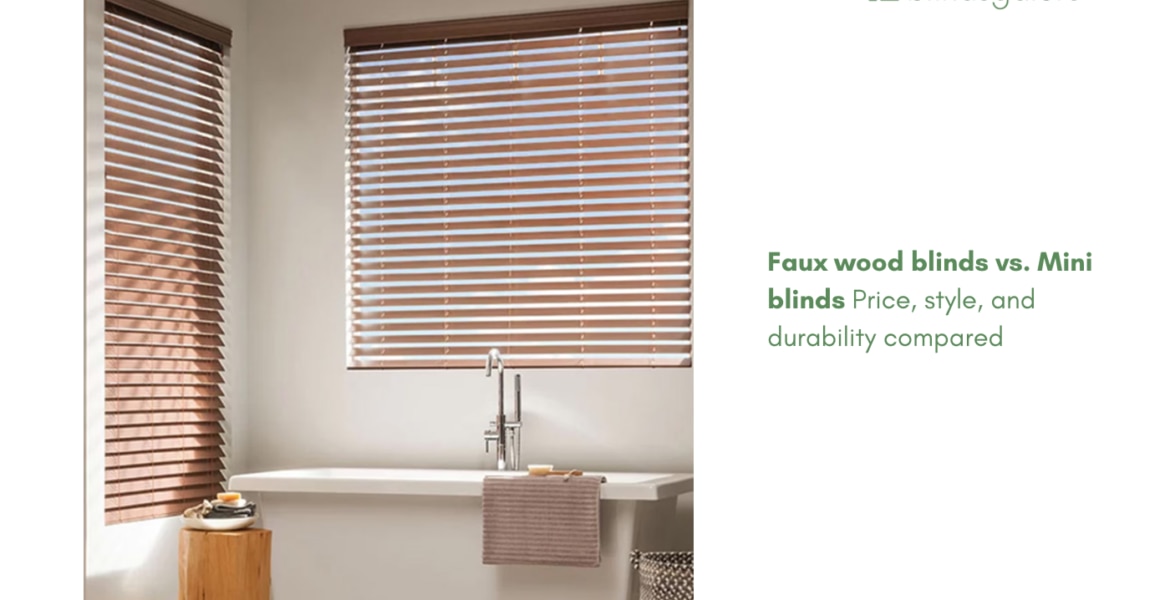
Get mini blinds when you want the lowest cost per window, a slim profile, and a lightweight blind that’s easy to replace. Get faux wood blinds when you want a warmer, wood-look style and sturdier slats that stand up to bumps and daily use. Both handle humidity well, both tilt for privacy, and both come cordless, so the choice mostly comes down to budget and the look you want.
Mini blinds and faux wood blinds are two of the most practical window treatments you can buy, which is exactly why so many people compare them. Here’s how they stack up on the three things that matter most: Price, style, and durability.
What is the quick answer on faux wood blinds vs. mini blinds?
Mini blinds are the value and slim-profile pick. Faux wood blinds are the heavier, more upscale pick.
| Features | Mini blinds | Faux wood blinds |
|---|---|---|
| Material | Aluminum or vinyl | PVC or composite |
| Slat width | Mostly 1 inch, with 1/2-inch and 2-inch options | 2 inches is most popular, with wider options |
| Look | Slim, clean, minimal | Warm, substantial, wood-look |
| Price | Lowest cost per window | Entry-level, but more than mini blinds |
| Weight | Light | Heavier |
| Dents and bends | Aluminum can dent; vinyl resists dents | Thick slats resist bending and denting |
| Moisture | Handles humidity well | Handles humidity well |
| Best for | Rentals, offices, budget refreshes, small windows | Living spaces, bedrooms, kitchens, bathrooms |
How do faux wood blinds and mini blinds compare on price?
Mini blinds cost less. Every blind we make is custom, so your price depends on size, material, and lift, but both products sit at the entry level of what we sell. Mini blinds generally come in at a lower cost per window than faux wood blinds, and that gap grows when you’re covering a lot of windows at once.
Within each category, a few choices move the price:
- Material. Aluminum and vinyl mini blinds sit at different price points, and so do our Essential, Signature, and Boutique faux wood lines.
- Slat size. Wider slats use more material.
- Upgrades. Cloth tapes on faux wood blinds, or motorization on faux wood, add to the cost. Motorized mini blinds aren’t currently available.
For a closer look at what drives the price across every category, see our guide to custom blinds pricing.
How do style and slat width compare?
Slat width changes the whole look of the window.
Our mini blinds use mostly 1-inch slats. Narrow slats give a slim, tidy profile and stack tightly at the top of the window when raised. Aluminum comes in a range of colors, from classic white to darker tones that coordinate with trim. Vinyl offers a softer, less metallic look.
Our faux wood blinds start at 2-inch slats, the most popular size for standard windows. A wider slat looks more substantial and gives a clearer view when tilted open. Wood-tone finishes like honey, walnut, and espresso mimic real hardwood, while whites and creams read clean and classic. On bigger windows, 2 1/2-inch and 3-inch slats keep the blind from looking busy.
Here’s a simple way to choose by style:
- Traditional, transitional, or cozy rooms: Faux wood blinds, for warmth and a more finished look.
- Modern or minimal rooms: Mini blinds, especially in a metallic or dark aluminum finish.
- Small windows or shallow frames: Mini blinds, since the slim headrail and tight stack take up less space.
- Rooms where the window is a focal point: Faux wood blinds, which read more like furniture than hardware.
Which holds up better in high-moisture or high-traffic rooms?
Both handle moisture. Faux wood handles bumps better.
Aluminum and vinyl mini blinds resist moisture and work well in kitchens, bathrooms, and other humid spaces. Faux wood blinds do the same, since PVC and composite slats resist humidity and won’t warp the way real wood can. For a bathroom or laundry room, either one is a safe choice.
High traffic is where they split. Aluminum slats are thin and light, so they can dent or bend if a kid, a pet, or a laundry basket bumps them. A bent slat usually means replacing the blind. Vinyl mini blinds resist denting better than aluminum. Faux wood slats are thicker and harder to bend, which makes them the sturdier pick for busy rooms.
Weight is the one place faux wood can lose. Faux wood blinds get heavy on very wide windows (over about 6 feet), which can make them hard to raise. Lightweight aluminum mini blinds don’t carry that extra weight.
Cleaning is simple for both:
- Dust regularly with a microfiber cloth or a vacuum brush.
- Spot clean with a damp cloth and mild soap, then dry.
- Never submerge either type in water. Water damages the headrail and lift, and it can rust metal parts.
Which is better for rentals and multi-window projects?
For most rentals, the answer depends on how hard the unit is on window coverings.
Mini blinds make sense when:
- You’re covering many windows on a tight budget.
- You want a blind that’s quick and inexpensive to replace after a move-out.
- The unit is an office, studio, or spare room where looks matter less than function.
Faux wood blinds make sense when:
- Tenants have kids or pets and bent slats are a recurring cost.
- You want the unit to look more finished at showings.
- You’d rather replace blinds less often.
Whichever you pick, consistency saves money. Choose one product, one color, and one slat size per unit type, keep a spec sheet, and order a room at a time. Our guide to the best blinds for rental properties walks through that system, and our property management program offers bulk pricing and priority service for qualified managers.
Which faux wood blinds and mini blinds should you choose?
Here are a few of our favorites from each line.
Mini blinds:
- Blindsgalore 1″ Aluminum Blinds: Heavy-duty aluminum slats with a cordless lift and wand tilt.
- Blindsgalore 1″ Vinyl Blinds: Moisture-resistant vinyl slats with a cordless lift, a good fit for kitchens and bathrooms.
Faux wood blinds:
- Privacy Faux Wood Blinds: Routeless 2-inch PVC slats for better privacy, with a cordless lift.
- Essential Faux Wood Blinds: Foamed PVC slats that resist heat and humidity, at our value price point.
If you’re weighing aluminum specifically, our comparison of faux wood blinds vs. aluminum blinds goes deeper. Still deciding? Order up to 10 free samples and compare the slats side by side in your own window.
Frequently asked questions
Get mini blinds for the lowest cost per window, a slim profile, and easy replacement. Get faux wood blinds for a warmer, wood-look style and sturdier slats in rooms you use every day. Both handle humidity and come with cordless lifts.
Not in high-traffic rooms. Aluminum mini blind slats are thin and can dent or bend when bumped, while faux wood slats are thicker and harder to damage. Both resist moisture, and vinyl mini blinds resist dents better than aluminum.
Yes, generally. Both are entry-level window treatments, but mini blinds usually cost less per window. Your exact price depends on size, material, and options.
Yes. Aluminum and vinyl mini blinds resist moisture and work well in bathrooms and kitchens. Wipe them with a damp cloth and never submerge them in water.
Mini blinds are lightweight aluminum or vinyl blinds, mostly with 1-inch slats. Faux wood blinds use PVC or composite slats, usually 2 inches or wider, made to look like real wood.
Faux wood blinds can be on very wide windows, roughly over 6 feet, where the weight makes them harder to raise. Our in-house experts can suggest the right product for your size at (877) 702-5463.