
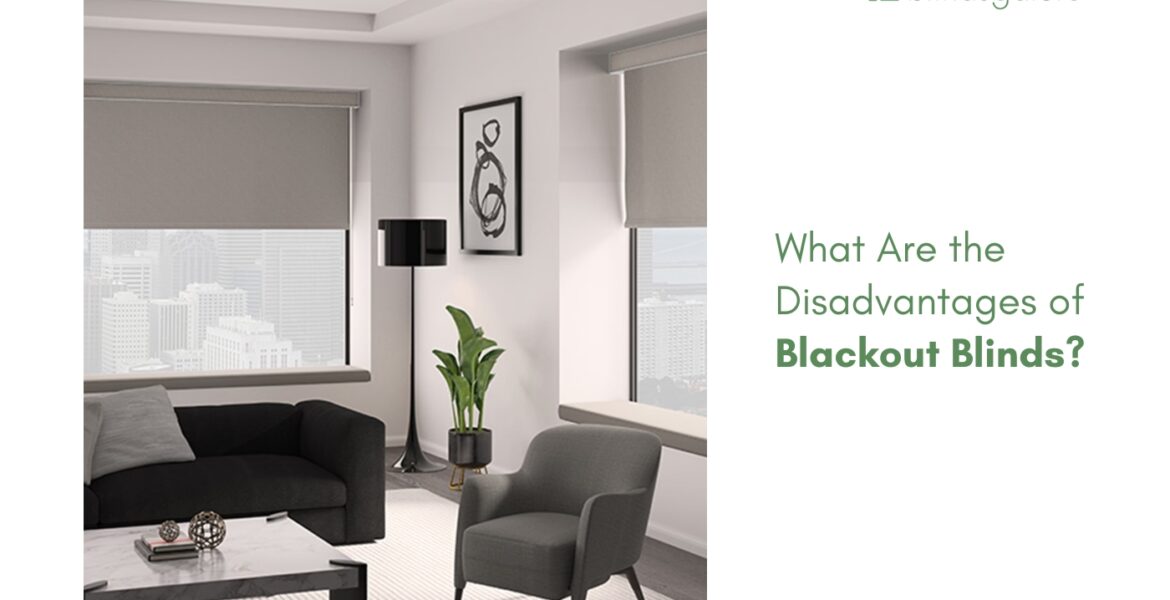
Blackout blinds carry five honest disadvantages: rooms feel too dark during the day, light still slips through gaps along the edges, the lift is all-or-nothing with no partial light control, the look reads heavier than fabric alternatives, and they trade away the soft daylight that lighter treatments preserve. None of this makes blackout blinds a bad choice. The trade-off simply means they are the right answer in specific rooms like bedrooms, nurseries, and media rooms, and the wrong one in many others.
The clearest way to think about blackout blinds is to match each con to the alternative that solves it. Every disadvantage has a fix, and in most cases, the fix is a different product entirely. Here is the straight version of the downsides, paired with the treatments worth considering instead.
Shop Custom Blackout Window Blinds and Shades
What are the disadvantages of blackout blinds?
Blackout blinds are designed to block as close to 100% of light as possible, and that single design goal is both their main strength and the root of every disadvantage that follows. Five drawbacks come up most.
- A room can feel too dark during the day. The same fabric that protects sleep at night turns a daytime room dim and enclosed.
- Light still leaks at the edges. Without side channels, slivers of daylight slip between the shade and the frame.
- Light control is all-or-nothing. Most blackout treatments are open or closed, with no halfway position for soft ambient light.
- The look is heavier and less versatile. Opaque, multi-layer fabric reads denser than lighter treatments.
- Lost natural daylight and view. A closed blackout shade gives up the diffused light and outside view that lighter fabrics keep.
Each of these has a real workaround. The right blackout shade in the right room remains a strong choice, but the wrong fit in the wrong room is easy to avoid once you know what to swap for.
Too dark during the day
The first complaint about a blackout shade is also the most common: a closed shade keeps the room as dark at noon as at midnight. For a bedroom or nursery, that is the point. For a living room or kitchen, it is a problem.
The fix is a softer fabric in the rooms that should breathe in daylight. A light-filtering shade diffuses sunlight into a gentle, even glow that warms a room without the glare, and keeps the space feeling open. Light-filtering fabric still buys privacy and softens harsh light, just without the heavy darkness blackout was built to deliver.
Light gaps at the edges
Blackout fabric blocks light through the panel itself, but daylight is sneaky and finds any gap around it. Standard blackout shades almost always leak a thin halo of light along the sides, top, and bottom of the frame.
The honest mitigation is side channels or a generous outside mount, both of which seal the edges far better than a tight inside mount. Anyone who needs true sleep-in-on-Saturday darkness should plan for one of those, since the fabric alone will not deliver it.
All-or-nothing light control
Blackout treatments do one job extremely well, and only one job. Most are either fully raised or fully lowered, with no in-between for a soft, ambient daytime feel.
For homes that want both, a dual-purpose fabric is the answer. A dual sheer shade, sometimes called a zebra or banded shade, layers alternating sheer and opaque bands that align to filter light or stack to block it, giving sun-dappled daylight and darker evenings on a single panel.
For rooms where blackout is essential at night but daylight matters in the morning, a day/night cellular shade carries a light-filtering fabric and a blackout fabric on the same headrail. The cellular construction adds insulation as a bonus, which a flat blackout panel does not.
A heavier, less versatile look
Blackout fabrics are built dense by design, and the multi-layer construction reads heavier than a lighter shade, which can feel out of place in an airy or minimal room.
If style and a lighter mood matter, a sheer shade is the opposite end of the same spectrum. Sheer fabric floats light across the room, preserves the view, and adds softness that opaque blackout fabric cannot. For a living room or any space designed around natural light, a sheer is often the closest match.
Lost daylight and view
The hidden cost of a true blackout is what you give up: the diffused daylight that makes a room feel alive, and the view outside. For some rooms, that trade is fair, for others it is the wrong call entirely. The easiest fix is choosing blackout only where the function is essential (bedrooms, nurseries, theaters) and using lighter treatments in rooms that benefit from daylight. Mixing treatments across a home is normal and smart, not a sign of indecision.
Where blackout blinds still win
The disadvantages are real, but blackout blinds are the right answer in specific situations. A bedroom for a shift worker or anyone sensitive to early sunrise, a nursery at nap time, a home theater, and a street-facing room with intrusive nighttime light all benefit from what blackout was built to do. In those rooms, the darkness is the feature, not the bug.
Match the room to the right fabric
Blackout shades earn their place when total darkness is the goal, and step out of the way when daylight should win. Ordering up to 10 free swatches makes the fabric and finish real against the wall before any commitment, and the in-house experts at (877) 702-5463 can help match the right opacity to each room. All Blindsgalore brand shades carry a 3-year limited warranty, upgradeable to five years, against defects in materials and workmanship when properly installed.
Love your view at every light level.
Frequently Asked Questions
A closed blackout shade makes a room as dark in the middle of the day as at night. That is ideal for sleep, but a problem in a living room or kitchen where natural light matters. Light-filtering shades solve this in rooms that should stay bright.
Blackout fabric blocks close to 100% of the light passing through the panel, but most installations still leak a thin halo of light at the edges of the window. Side channels and a generous outside mount seal those gaps and deliver the truest darkness.
For most people, they improve their sleep. For some, total darkness around the clock can disrupt the natural daylight cues that wake the body in the morning. A day/night cellular shade or a top-down/bottom-up lift keeps blackout for sleep while letting daylight in when you wake.
A light-filtering shade or sheer shade is usually the better living room choice, since both preserve natural light. A dual sheer or zebra shade is another option, layering sheer and opaque bands for daytime softness and evening privacy.
A closed blackout shade can restrict airflow against the window, which matters in humid or poorly ventilated rooms. Raising the shade or pairing it with a lighter daytime treatment keeps air moving when full darkness is not needed.
Blindsgalore brand blackout shades carry a 3-year limited warranty with a free upgrade to a 5-year warranty, covering defects in materials and workmanship when the product is properly installed and operated. Boutique products include a free 5-year extended warranty. Fading is not covered.