
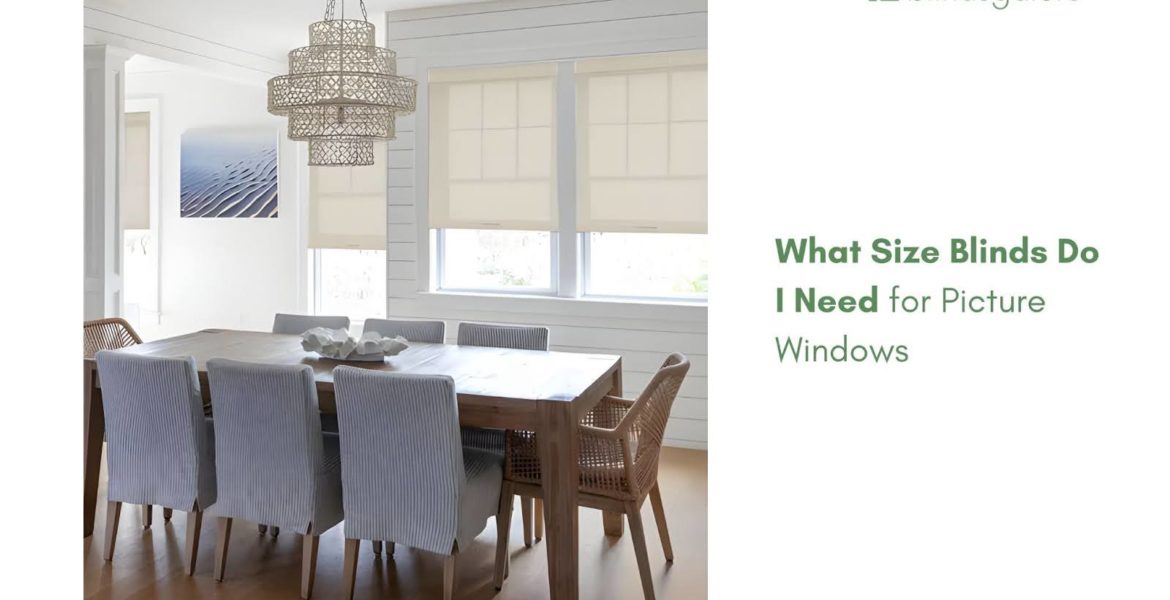
Picture windows give big views and lots of light. Getting the blind size right keeps the view intact and prevents light leaks, rubbing, or broken hardware. The short version is: measure carefully with a steel tape, pick inside mount for a built-in look when your frame is deep and square, pick outside mount for maximum coverage or imperfect openings, and choose a blind type that matches the span and how you use the window.
What counts as a picture window size?
Most picture windows fall between about 24 x 36 inches and 72 x 60 inches. There is technically no standardized size range that defines a picture window. Typical examples include:
- 24 x 36 inches for small accent windows
- 48 x 48 inches for medium-sized rooms
- 60 x 48 inches for living areas
- 72 x 60 inches for large openings
Windows wider than 8 to 10 feet often require custom solutions or multiple shades working together. Use the measurement ranges above to tell whether you are in the normal custom range or approaching a span that needs splicing or panel track systems. For more measuring tips across common window sizes, see Blinds and Shades for Common Window Sizes: Measuring Tips.
How do I measure a picture window for blinds?
Prepare: use a steel tape, record numbers to the nearest 1/8 inch, and measure each window separately, even if they look identical.
How to measure for an inside mount
How do I measure if I want the blind inside the frame?
- Measure the width at the top, middle, and bottom of the window opening.
- Use the smallest width measurement.
- Measure the height at the left, center, and right.
- Use the tallest height measurement for full coverage.
- Check frame depth. Most products need at least 1 inch of flat depth to mount and operate without rubbing.
Inside mount gives a clean, built-in look. Use an inside mount if the frame is square, deep enough, and you want a minimal reveal.
How to measure for an outside mount
How do I measure when the blind will sit outside the frame to block more light?
- Decide how much overlap you want each side to have. A common guide is 1.5 to 3 inches per side.
- Position the headrail 1.5 to 3 inches above the trim to give a natural visual buffer and better light control.
- Extend the length past the sill if you need stronger light blocking.
Outside mount hides uneven frames and enlarges the perceived window size. If you are removing existing blinds before measuring, these steps pair well with How to Take Down Blinds. For large openings like sliding doors, measurements and mounting ideas overlap with How to Install Blinds on a Sliding Glass Door.
What blind types work best for large picture windows?
Large windows need treatments that handle width, weight, and user habits. Short reviews and when to pick each follow.
Cellular Shades
Why consider them: Cellular shades stay relatively lightweight as the width increases and add real insulation because of their honeycomb structure. Use them when energy efficiency and smooth operation are priorities. Browse options like Blindsgalore Gallery Cellular Shades with Blackout for heavier coverage or select light-filtering versions if you want some view retention.
Roller Shades
Why consider them: Roller shades provide wide, seamless coverage and roll up compactly to preserve the view. Choose roller shades for a clean, modern look, and when you want large, uninterrupted fabric spans. See the Blindsgalore Envision Light Filtering Roller Shades if you want a product example.
Solar Shades
Why consider them: Solar shades reduce glare and UV without completely blocking the view. Pick solar shades when preserving the view is the highest priority, and you need glare control.
Woven Wood Shades
Why consider them: Woven wood shades add texture and scale well on big windows if you want a natural look. Line them for privacy or darkening when needed.
If you want a quick primer on the difference between soft shades and slatted blinds, check Shades vs. Blinds: What’s the Difference?.
What if my picture window is extra wide?
Single-wide shades hit limits because of weight and headrail strength. These are the common, practical solutions.
Motorization
Why choose it: Motorized shades remove the need to lift heavy fabric manually and keep control simple for tall or hard-to-reach windows. Motorization also eliminates dangling cords and improves safety. Explore motorized options on the Motorized Products page.
Multiple Headrails (2-on-1 or 3-on-1 headrails)
Why choose them: Splicing lets multiple shade sections operate and look like one continuous treatment. Use Multiple Headrails when you want full-width coverage but prefer to keep hardware and fabric sections within recommended size limits.
Panel Track Systems
Why choose them: Panel track systems slide side to side and work best for very wide spans and floor-to-ceiling glass. Panels stack neatly and feel intentional rather than oversized. Panel tracks are a top pick for openings far beyond 120 inches.
If you want motorized cellular options for skylights or wide spans, see examples like Blindsgalore Select Motorized Cellular Shades.
How do I choose the right setup for my home?
Ask these practical questions and make decisions from the answers:
- Do you need privacy at night? If yes, choose blackout fabrics or add drapery. Consider Blackout Curtains or blackout cellular options.
- Does glare interfere with screens? If yes, choose solar or light-filtering shades with the right openness level.
- Will you open and close the shades daily? If daily operation is expected and spans are wide, consider motorization.
- Are pets or kids a concern? Cordless or motorized systems increase safety. See Cat-Proof Blinds for related tips.
- Do you want a layered look? Pairing blinds with drapery can improve light control and style. See Modern Window Curtains for Your Living Room for layering ideas.
Order fabric samples and test them in the actual room light before buying. Samples make a practical difference in choosing openness, texture, and color for a large expanse.
FAQs
Most treatments accommodate widths up to 120 inches. For windows beyond that, Multiple Headrails or panel track systems work seamlessly. Call (877) 702-5463 to discuss your specific window.
Inside mount looks cleaner and is less intrusive. Outside mount provides better light blocking and makes windows appear larger. Check your frame depth first; if it’s less than 1 inch, you’ll need an outside mount.
Not required, but highly recommended. Large shades get heavy. Motorization prevents strain on the hardware and your arm, plus eliminates cords.
Measure twice. Use a steel tape measure. If you’re unsure, take photos of your window from the front and side, and our team can review them before you order. We want your blinds to fit perfectly the first time.
No. Blinds come sized specifically for your measurements. Ordering larger and trimming causes operational issues. Always measure accurately, or call for help.