
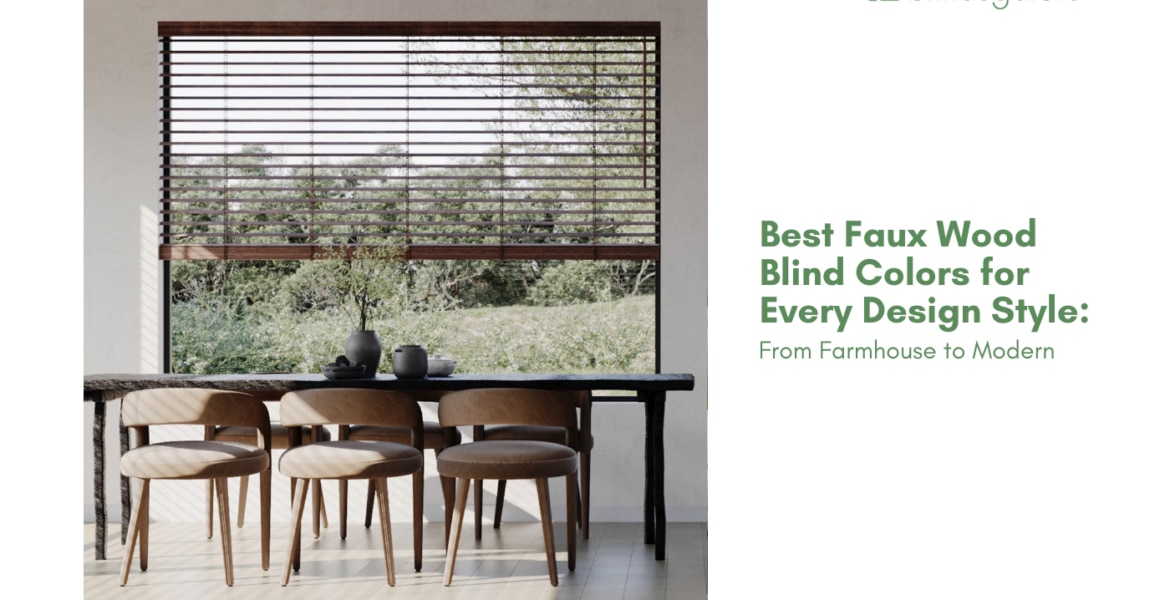
The right faux wood blind color does two things at once. The blind reads as part of the room, not a piece of hardware bolted to a window. And the finish you pick today still works in five years, after you have changed the paint or the sofa.
Faux wood blinds come in three core finish families: bright whites and off-whites, natural wood-tone stains, and cooler grays. The trick is matching the family to the design style you already live with. Below is the short list of finishes that fit each major home style, plus a few rules of thumb for choosing without overthinking it.
How to choose a faux wood blind color
Start with what is already in the room. Walls, floor, cabinetry, and large furniture set the palette. The blind either echoes one of those tones or quietly contrasts with it. Three working rules:
- Match undertone, not exact color. Warm walls take warm wood blinds. Cool gray walls take cool gray blinds.
- Aim for soft contrast over perfect match. A wood blind that exactly matches the floor often looks flat.
- Pick the long-view finish. Trends shift, but white, soft gray, and natural mid-tone wood read well across decades.
Order free samples before committing. Faux wood stains read very differently in a sunlit room than they do on a screen.
Best Faux wood blind colors by design style
The right color depends on the look you’re already building. Here is how each major design style pairs with faux wood finishes.
Farmhouse and modern farmhouse
White and off-white are the default for farmhouse rooms. Crisp white reads modern farmhouse. Soft cream or warm white leans more traditional farmhouse. Skip heavy distressing if the rest of the room already leans rustic.
Light natural wood tones, like pale oak or honey, also work well in farmhouse kitchens with butcher-block counters or open shelving. Skip anything too dark or too glossy.
Modern and contemporary
Modern rooms favor clean, low-contrast finishes. Pure white blinds against white walls give a quiet, gallery-like effect. Soft gray blinds work in cooler-toned modern rooms with concrete floors, matte black accents, or steel finishes.
For a high-contrast modern look, black or near-black faux wood blinds against white walls create a graphic punch. Use this only in rooms where the rest of the design commits to that contrast.
Traditional and classic
Traditional rooms call for richer wood-tone stains. Walnut, mahogany, and espresso pair naturally with hardwood floors, wainscoting, and built-in bookcases. The blind should read as a slightly different wood tone than the floor, not a perfect match.
Cloth tape upgrades add a tailored finish to traditional faux wood blinds, covering the route holes on the slat fronts.
Coastal
Coastal rooms favor whites and weathered wood looks. Pure white blinds work in classic coastal interiors with shiplap walls and navy accents. Driftwood-toned or whitewashed wood finishes lean more relaxed coastal, working alongside woven wood textures.
Skip dark stains. Espresso and walnut feel out of place in a beach-leaning room.
Mid-century modern
Mid-century rooms favor warm wood tones with visible grain. Natural oak, light walnut, and teak-inspired stains pair with the era’s signature low-profile furniture and tapered legs. The finish should feel intentional and slightly warmer than the floor.
A 2-inch slat with a matte natural wood stain hits the look better than wider slats or high-gloss finishes.
Transitional
Transitional rooms blend traditional and modern. Soft gray, greige, and mid-tone neutral woods are the safe picks. Off-white works when the rest of the room leans contemporary. Warm wood tones in the medium range work when the room leans traditional.
The transitional rule is to pick the finish that bridges, never one that commits hard to either side.
White vs natural wood vs gray
The three most-ordered faux wood blind finishes are white, natural wood, and gray.
- White faux wood blinds brighten rooms, work with almost every style, and make small spaces feel larger. Best in kitchens, bathrooms, farmhouse, and coastal rooms.
- Natural wood faux wood blinds add warmth, pair with hardwood floors, and read as more upscale at a glance. Best in living rooms, bedrooms, and traditional or mid-century rooms.
- Gray faux wood blinds work in modern and transitional homes with cooler color palettes. Best in rooms with concrete floors, matte black hardware, or cool-toned wall paint.
What are the other Faux wood blinds to consider
Three faux wood blind lines cover most home scenarios. Each is custom-made to your exact opening and available with a cordless or motorized lift.
Boutique Faux Wood Blinds
The Boutique Faux Wood Blinds are our premium BG Boutique line, with the widest finish range and the most refined embossed grain. Best for traditional, transitional, and design-forward rooms where the blind reads as a finished design element.
Blindsgalore Faux Wood Blinds
The Blindsgalore Faux Wood Blinds are our signature line and the everyday workhorse. Multiple slat sizes, a strong neutral and wood-tone color range, and the option to add cloth tapes make this the default starting point for most homes.
Blindsgalore Essential Faux Wood Blinds
The Blindsgalore Essential Faux Wood Blinds offer the most accessible entry point in the lineup. Good for outfitting multiple rooms, rental properties, or secondary spaces where you want the faux wood look at a friendlier price.
See the finish in your own light
Faux wood stains and whites look one way on a screen and another way against your actual wall. Order up to 15 swatches and hold them up next to your floor and trim before placing the order. For a second opinion, our in-house experts answer at (877) 702-5463.
Love your view, in the finish you actually want.
Frequently asked questions
White is the most popular faux wood blind color. White faux wood blinds brighten rooms, work with most design styles, and pair easily with white or off-white walls and trim.
White, off-white, and light natural wood tones work best for farmhouse homes. Soft cream and warm white lean traditional farmhouse. Crisp white leans modern farmhouse. Skip overly distressed or glossy finishes.
Faux wood blinds usually match the trim more than the floor. Matching the trim creates a cohesive frame around each window. Matching the floor exactly often looks flat. A subtle contrast with the floor reads as more intentional.
Quality faux wood blinds resist yellowing, but lower-grade PVC blinds can yellow with prolonged direct UV exposure. Custom faux wood blinds with UV-resistant finishes hold their color longer than budget pre-made options.
White and very light natural wood faux wood blinds make a small room look larger. Light finishes reflect more natural light and visually expand the wall plane. Darker finishes can make compact spaces feel smaller.
Blindsgalore brand faux wood blinds carry a 3-year limited warranty with a free upgrade to a 5-year warranty. BG Boutique faux wood blinds include a free 5-year extended warranty. Coverage applies to defects in materials and workmanship when the product is properly installed and operated. Fading is not covered.