
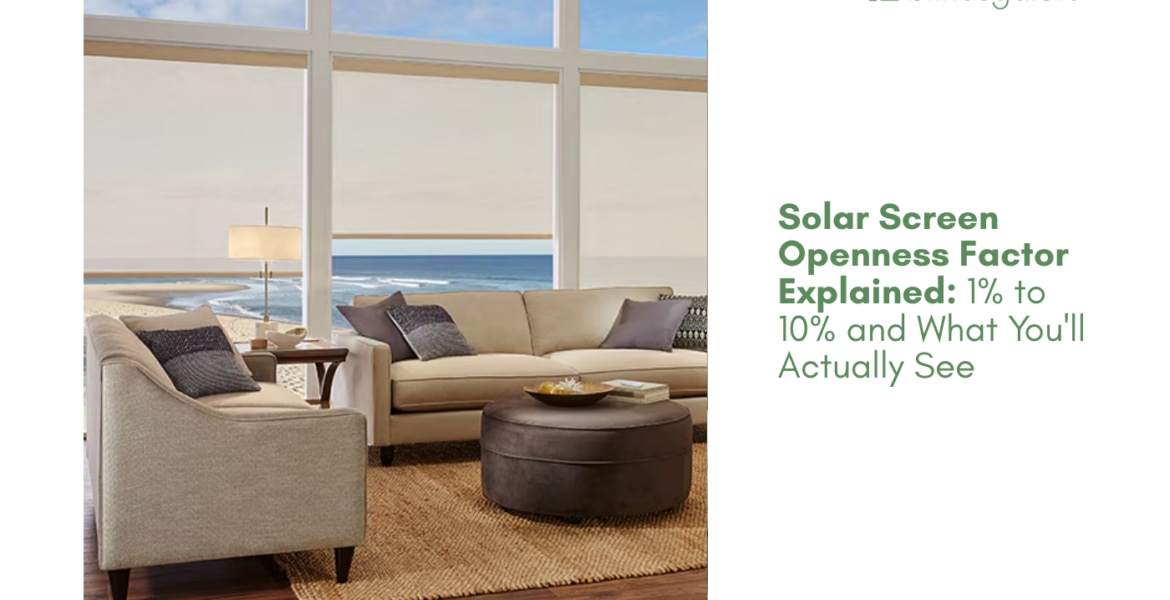
The number on a solar shade fabric, 1%, 3%, 4%, 5%, 7%, 8%, 10%, or 14%, is the openness factor. The number tells you how tightly the fabric is woven, how much light passes through, and how clearly you can see out. Lower numbers mean a tighter weave, a darker room, more privacy, and less view. Higher numbers mean the opposite.
That is the whole framework. The harder part is matching the right number to the right window. A 1% solar shade in a kitchen feels like a cave. A 14% shade in a west-facing media room does almost nothing for glare. Below is what each openness level actually delivers, plus how fabric color changes what you see and how to match the right percentage to the right room.
What is the solar shade openness factor?
Solar shades, also called solar screens, are the same product. We use “solar shade” throughout the rest of this guide.
Solar shade openness factor is the percentage of open space in the woven fabric. A 5% openness shade has 5% open space and 95% solid fabric. The opacity is the inverse: a 5% openness shade has 95% opacity and blocks roughly 95% of UV rays.
The openness factor controls four things at once:
- View through the shade to the outdoors
- Glare reduction during direct sun
- Daytime privacy from outside
- UV protection for floors, art, and furniture
According to the U.S. Department of Energy, in cooling seasons, about 76% of sunlight falling on standard double-pane windows enters as heat. A solar shade with the right openness can cut a meaningful portion of that.
One important caveat: solar shades give daytime privacy only. At night, with interior lights on, the effect reverses. For nighttime privacy, layer with drapery or a blackout shade.
What you’ll actually see at each openness level
Here is what each openness factor in the 1% to 14% range delivers in a real room. Every level is available in cordless or motorized lift across our solar shades collection.
1% openness factor
A 1% solar shade has the tightest weave in the standard range. The room reads as significantly darker with the shade closed. Silhouettes outside are hard to make out. UV protection is the highest available short of full blackout.
Best for: west-facing media rooms, home offices with screen glare, ground-floor street-facing windows, and rooms with art that fades in the sun.
3% openness factor
A 3% solar shade still cuts most of the glare and most UV, but the weave is loose enough to see general shapes outside. The room stays calm and slightly dim.
Best for: home offices with monitors, daytime bedrooms, and rooms where reducing eye strain matters more than a sharp view.
5% openness factor
A 5% solar shade is the most common all-around choice. The view is clear enough to recognize people and movement outside, the room stays bright, and glare is meaningfully reduced.
Best for: living rooms, dining rooms, kitchens, and most general-purpose windows.
7% openness factor
A 7% solar shade leans toward view and brightness. Glare control is moderate, daytime privacy is lighter than 5%, and the outside reads almost as if the shade were not there.
Best for: rooms with great views, north-facing windows, and second-story windows.
10% openness factor
A 10% solar shade has the loosest weave in the common range. The view is nearly unobstructed. UV protection drops to roughly 90%. The room feels close to having no shade at all when the light is even.
Best for: sunrooms, large picture windows facing a yard or view, and rooms where preserving the outdoor connection is the entire point.
How fabric color changes the view
Openness factor is half the equation. Fabric color does the other half.
Darker fabrics like charcoal, bronze, and graphite absorb light, which makes the view through the shade clearer. Lighter fabrics like white, cream, and silver reflect more sunlight, which keeps the room cooler but slightly blurs the outside view.
Practical takeaway: pick a darker fabric for the clearest view-through, or a lighter fabric for the strongest heat reduction. A dark 5% shade and a light 5% shade behave like two different products.
Matching openness to your room
Room use dictates the openness number more than personal taste does. A simple guide:
- West-facing or south-facing rooms with hard afternoon sun: 1% to 3%
- Home offices, screens, and reading areas: 3%
- Living rooms, dining rooms, kitchens: 5%
- Daytime bedrooms: 3% to 5% (pair with blackout drapery for sleep)
- Sunrooms and view-facing rooms: 7% to 14%
- North-facing windows with even, soft light: 7% to 14%
Two windows in the same house can have different openness factors. Standardizing one number across an entire home rarely produces the best result.
Solar shades to consider
Three solar shade lines cover most home scenarios. Each is custom-made to your exact opening and available with a cordless or motorized lift.
Blindsgalore Envision Solar Shades
The Blindsgalore Envision Solar Shades are our most popular signature solar shade. Multiple openness factors and a wide neutral color range make this the default starting point for living rooms, kitchens, and home offices.
Blindsgalore Classic Solar Shades
The Blindsgalore Classic Solar Shades offer a more budget-friendly entry point with the openness range most people need. Good for outfitting multiple rooms in one order.
Blindsgalore Harmony Solar Shades
The Blindsgalore Harmony Solar Shades round out the lineup with a refined fabric finish. Use these in spaces where the shade itself becomes part of the room’s design.
Get a feel for the fabric before you commit
Openness numbers are easier to picture once you hold the actual fabric against your window. Order up to 10 free samples so you can compare a 1%, 3%, 5%, and 10% side by side in the room they are headed for. For a second opinion before placing the order, our in-house experts answer at (877) 702-5463.
Love your view, exactly as you want to see it.
Frequently asked questions
5% openness is the most common choice. The 5% level balances view, glare reduction, and daytime privacy well enough to work in most living rooms, dining rooms, and kitchens.
A 1% solar shade has a tight weave, blocks roughly 99% of UV, gives strong glare reduction, and limits the view outside. A 14% solar shade has a loose weave, blocks roughly 90% of UV, gives mild glare reduction, and preserves a clear outside view.
No. Solar shades give privacy during the day only. At night, with interior lights on, people outside can see in through any openness factor. For nighttime privacy, layer the solar shade with drapery or a blackout shade.
Yes. Darker solar shade fabrics absorb light and produce a clearer view through the shade. Lighter fabrics reflect more sunlight and keep the room cooler, but slightly blur the outside view. Two shades with the same openness factor can perform differently if the colors differ.
1% to 3% openness is best for a west-facing window. Direct afternoon sun creates the worst glare and heat gain, and the tighter weave handles both. Pair with a darker fabric for the clearest view-through.
You can, but you usually should not. A 5% works for most living spaces but is too open for a media room and too dark for a sunroom. Matching openness to the specific room and window direction produces a better result.