
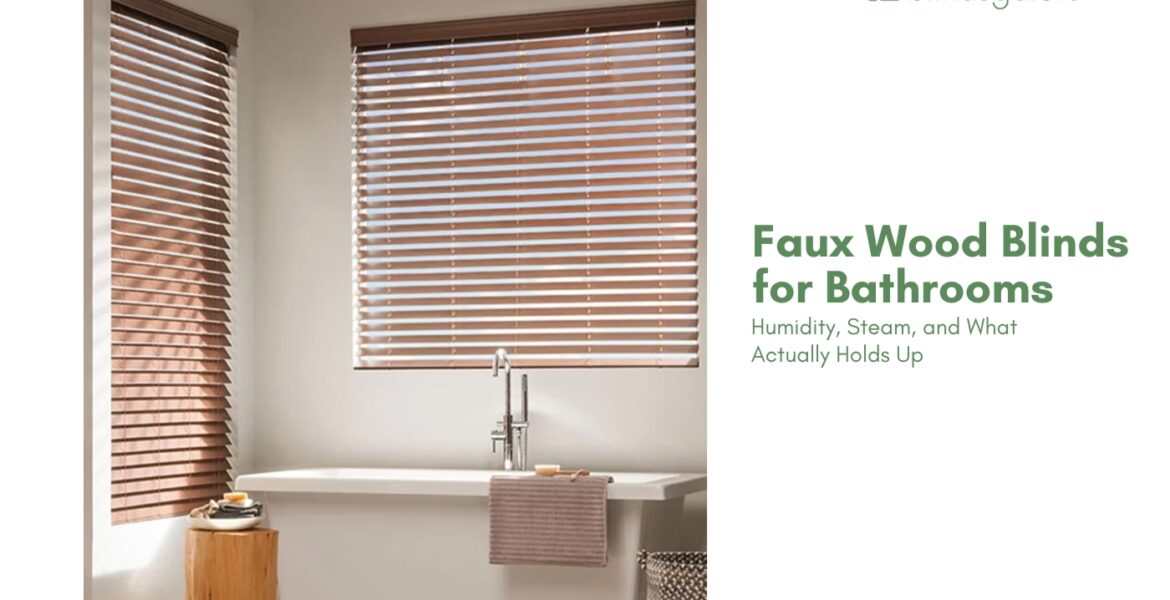
Bathrooms are the hardest room in the house for a window treatment. Hot showers spike humidity past 80%, steam settles on every surface, and the window often sits within splash range of the sink or tub. Real wood blinds warp and crack within months. Fabric shades grow mildew. Faux wood blinds are the category that actually holds up.
Below is a clear walk-through of what humidity and steam do to faux wood, the difference between PVC and composite construction, how to install for the bathroom, and how to clean without damaging the slats.
Are faux wood blinds OK for bathrooms?
Faux wood blinds are one of the best window treatments for bathrooms. The synthetic core, PVC or PVC-wood composite, does not absorb moisture, does not warp under temperature swings, and does not grow mildew the way fabric does.
The U.S. Environmental Protection Agency recommends keeping indoor relative humidity between 30 and 50 percent to prevent mold. Bathrooms routinely spike above that range during showers, which is why a moisture-resistant material matters.
Faux wood is moisture-resistant, not strictly waterproof. Our faux wood blinds handle steam, humidity, and the occasional splash. Direct, prolonged water contact, like a slat sitting in standing water, is still a problem.
What humidity, steam, and direct water do to faux wood blinds
Each challenge affects a faux wood blind differently. Knowing the difference helps you choose, install, and clean correctly.
Humidity is ambient airborne moisture. Faux wood blinds handle high humidity well because the synthetic core does not absorb water vapor the way wood fibers do. The slats stay flat through years of bathroom use.
Steam is concentrated moisture during and after showers. Steam settles on slats as condensation but evaporates as the room cools and ventilates. Faux wood handles steam without warping. Running the exhaust fan during and for 20 to 30 minutes after a shower reduces how much condensation lands on the slats.
Direct water contact is the one challenge faux wood does not handle indefinitely. Splashes and the occasional wipe-down are fine. A slat that sits in standing water can let water seep into the headrail and damage the lift mechanism over time.
What actually holds up: PVC vs composite faux wood
Faux wood blinds use one of two core materials. Both are moisture-resistant, but they perform slightly differently in a bathroom.
PVC slats are 100% synthetic polyvinyl chloride. The slats are the most moisture resistant in the category, hold their finish well, and resist mildew. PVC is the safest pick for a primary bathroom with a daily shower.
Composite slats blend wood fibers with polymers. The look and feel are closer to real wood, with embossed grain and a warmer surface texture. Composite handles bathroom humidity well but is less indifferent to direct water than pure PVC. Composite is the better pick for a powder room or any bathroom without a shower.
Both materials carry UV inhibitors that resist yellowing under sunlight, and both handle daily wipe-downs without losing their finish.
Installing faux wood blinds in a bathroom
Bathroom installation has a few requirements that drier rooms do not.
- Measure the window opening at the narrowest and longest points to account for any frame distortion from past humidity.
- Choose an inside mount when the frame is at least 2 inches deep. Inside mount looks cleaner and keeps the headrail tucked away from the splash range.
- Choose an outside mount if the window is narrow, shallow, or right above the tub. Mounting outside the trim moves the headrail away from direct water contact.
- Position the bottom rail at least an inch above the windowsill so condensation on the sill does not wick up into the lowest slat.
- Run the exhaust fan during and after every shower. Ventilation is the single biggest factor in how long any bathroom window treatment lasts.
Cleaning faux wood blinds in a humid bathroom
Faux wood blinds clean easily, but the rules in a humid bathroom matter more than in a dry room.
Dust the slats weekly with a microfiber cloth, a feather duster, or a vacuum brush attachment on low suction. Wipe spots with a barely damp cloth and a drop of mild dish soap. Dry the slats immediately so water does not pool on the surface.
Never submerge faux wood blinds in water. Submerging the slats lets water seep into the headrail and damage the lift mechanism. The “drop them in the tub” cleaning method circulating online does not apply to any custom blind.
For a deeper clean, take the blinds down, wipe each slat individually with a damp cloth, and let the blinds air-dry fully before reinstalling.
Faux wood blinds to consider
Three faux wood blind lines work well for bathroom windows. Each is custom-made to your exact opening and available with a cordless or motorized lift.
Blindsgalore Privacy Faux Wood Blinds
The Blindsgalore Privacy Faux Wood Blinds close more tightly than standard faux wood, with no route holes through the slats. Best for ground-floor bathrooms, street-facing windows, and any bathroom where privacy is the top priority.
Blindsgalore Cordless Faux Wood Blinds
The Blindsgalore Cordless Faux Wood Blinds are the safest pick for bathrooms with kids or pets. The cordless lift removes any dangling cord and gives the blind a cleaner, more modern profile.
Blindsgalore Faux Wood Blinds
The Blindsgalore Faux Wood Blinds are the everyday workhorse. Multiple slat sizes, a strong color range, and a price point that works when outfitting more than one bathroom.
Make the bathroom window the easy decision
The bathroom is the room most people put off updating, and the window is usually the last thing to get attention. Order up to 10 free swatches so you can see how the slat color reads against your tile and trim. For a second opinion, our in-house experts answer at (877) 702-5463.
Love your view, even on the steamy mornings.
Frequently asked questions
Faux wood blinds are moisture-resistant, not strictly waterproof. The slats handle steam, ambient humidity, and occasional splashes. Direct, prolonged water contact can still seep into the headrail and damage the lift mechanism.
Faux wood blinds are better for bathrooms. Real wood absorbs moisture and warps in high humidity. Faux wood, made from PVC or PVC-wood composite, does not absorb water and stays dimensionally stable.
Faux wood blinds resist mold and mildew because the synthetic surface does not absorb moisture. Mildew can still grow on dust or soap residue that builds up on slats, so weekly dusting and regular wipe-downs prevent buildup.
No. Never put faux wood blinds in the shower or submerge them in water. Submersion lets water seep into the headrail and damages the lift mechanism. Spot clean with a barely damp cloth and dry immediately.
Faux wood blinds work in a bathroom without a fan, but ventilation extends the life of any window treatment. Open the bathroom window or door after showers to let humidity escape.
Blindsgalore brand faux wood blinds carry a 3-year limited warranty with a free upgrade to a 5-year warranty. Coverage applies to defects in materials and workmanship when the product is properly installed and operated. Fading is not covered.