
Coastal homes are hard on window treatments, but not in the way most people assume. Salt air gets the blame for warped wood blinds. The real culprit for the wood is humidity, and in particular the swing between a humid off-season and a dry, air-conditioned summer. Salt does its damage elsewhere, on the metal parts.
That distinction decides what to buy. The best coastal window treatments are chosen for the room’s actual conditions first and the coastal look second.
Why do coastal climates break down standard wood blinds?
Two separate forces are at work, and they attack different parts of a blind.
Humidity warps the wood
Wood is hygroscopic, meaning it absorbs moisture from the air around it. The USDA Forest Products Laboratory’s Wood Handbook explains that wood takes on moisture from the surrounding environment, and the amount depends on the air’s relative humidity and temperature. As wood gains and loses moisture, it swells and shrinks.
The Wood Handbook also notes that daily humidity changes are small and usually of no consequence, while seasonal changes are of more concern, and that protective coatings slow these dimensional changes without preventing them. A sealed finish on a real wood blind buys time, but does not make the blind coastal-proof.
That is why a beach house is harder on wood than a home that sits at the same humidity all year. A house run on air conditioning in summer and closed up damp for the winter puts real wood slats through the largest possible swings.
Salt corrodes the metal
Salt is a threat to metal, not wood. FEMA’s technical bulletin on coastal corrosion states that salt spray from breaking waves and onshore winds significantly accelerates the rate of corrosion of metal connectors and fasteners, and that salt on a surface combined with high humidity accelerates it further. Salt spray is heaviest in the first 300 to 3,000 feet from the shoreline, though FEMA notes accelerated corrosion has been recorded as far as 5 to 10 miles inland.
On a blind, the metal is the headrail, brackets, and hardware.
The room matters more than the distance
The same FEMA bulletin draws a distinction most coastal buyers never hear. Living spaces that are heated or air-conditioned are sealed from most salt spray, and their humidity control generally keeps moisture below the level that speeds corrosion.
So the risk depends on how each room is used:
- Lower risk: closed, air-conditioned rooms that stay at steady humidity year-round.
- Higher risk: rooms where windows stay open to the sea breeze, letting salt air and moisture in.
- Highest risk: seasonal homes closed up without climate control, plus sunrooms, screened porches, and enclosed lanais. FEMA notes that sheltered spots never get rinsed by rain, so salt builds up and surfaces stay damp longer.
What blinds hold up near the ocean?
Faux wood and vinyl, because neither absorbs moisture, which makes them the most dependable moisture-resistant window treatments for a coastal home.
Faux wood blinds
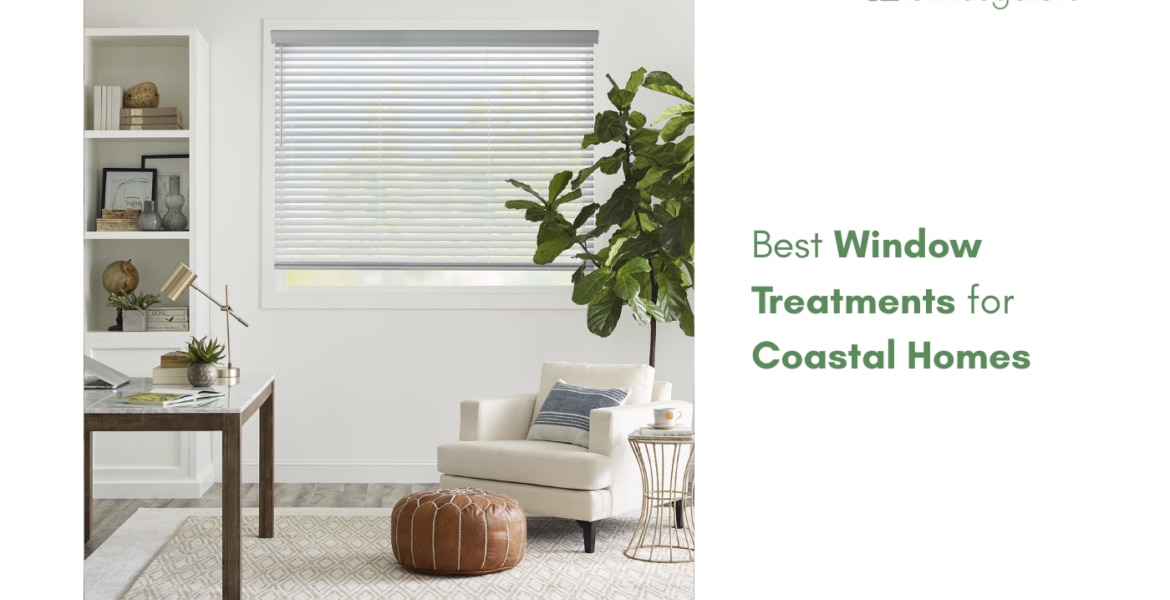
Faux wood blinds give the look of painted wood without the swelling. The Blindsgalore faux wood blinds use an engineered polymer that resists warping, cracking, and bending, with fully moisture-resistant construction. Slats come in a classic 2-inch width or a wider 2 1/2-inch slat for a more shutter-like look, which suits living rooms, bedrooms, and anywhere the blind is part of the design.
Vinyl blinds
Vinyl blinds are moisture-resistant and easy to clean, which makes them the practical, budget-friendly choice for kitchens, bathrooms, mudrooms, and rental units. The 1-inch slats filter light rather than darkening a room fully.
Sliding doors to the deck
For patio and sliding doors, vinyl vertical blinds stack to the side to clear the opening and handle humidity well.
One honest note on all three: the slats resist moisture, but the headrails use steel. In a closed, air-conditioned room, that is not a concern. In a room left open to the sea breeze, wipe salt film off the headrail and brackets as part of regular cleaning.
What are the best window treatments for ocean-view rooms?
Light-filtering and solar shades, because the problem in an ocean-view room is usually glare rather than privacy.
Water is less of a UV mirror than people think. The World Health Organization reports that water reflects less than 10 percent of UV radiation, dry sand about 15 percent, and sea foam about 25 percent. The larger issues are direct sun, heat, and the bright visible glare off the water, which is what makes a view room hard to use at midday.
- Light filtering shades diffuse sunlight into even, soft light and cut glare while keeping the room bright. The Classic light filtering roller shades use polyester fabric that resists fading and cleans easily. The full range is in the light filtering shades collection.
- Solar shades use an open-weave fabric that cuts glare and UV while keeping the view visible through the shade. The Classic solar shades are the starting point. Solar shades give daytime privacy but not night privacy, so pair them with drapery in rooms used after dark.
Coastal sun fades fabric over time, and fading is not covered under warranty. Lighter colors show fading least, and lowering the shade during the strongest afternoon sun protects both the shade and the furniture behind it. The guide to managing glare covers daytime light control in more detail.
How do you get coastal style blinds without sacrificing durability?
Choose the coastal look in materials that match the room’s conditions.
- White, sand, and driftwood tones in faux wood give the classic beach house look with none of the swelling. Faux wood shutters with 3 1/2-inch louvers create the plantation-shutter look many coastal homes are built around.
- Woven wood shades bring the natural texture that defines coastal style. Bamboo and reeds handle humidity better than milled wood, and a liner extends their life. Keep them in air-conditioned rooms rather than rooms left open to the breeze or houses closed up for the season, since natural fibers absorb moisture.
- Screened porches and lanais need products made for outdoor exposure. The outdoor shades range is built for those spaces.
The full coastal homes collection groups these by room.
How do you care for window treatments in a beach house?
A little routine care matters more near the coast than inland.
- Wipe off salt. Dust with a microfiber cloth and wipe slats and hardware with a barely damp cloth, especially in rooms with open windows or on sheltered porches where rain never rinses salt away.
- Never submerge. Do not soak any blind or shade in water, including faux wood and vinyl. Water trapped in the headrail mechanism is the fastest way to rust it.
- Control indoor humidity. The EPA recommends keeping indoor humidity below 60 percent, ideally between 30 and 50 percent. That protects wood, fabric, and hardware, and it guards against mildew.
- Plan for the off-season. A seasonal home left closed without air conditioning or a dehumidifier sees the damp conditions that warp wood and grow mildew on fabric. Keeping humidity controlled while you are away does more for your window treatments than any product choice.
For rental owners, the guide to the best blinds for Airbnb and vacation rentals covers durable picks for high-turnover homes, and the guide on how long custom blinds last covers what shortens or extends their life.
How should you choose coastal window treatments?
Start with how each room is used. For rooms open to the breeze, sunrooms, and homes closed up for the season, choose faux wood, vinyl, and synthetic fabrics. For ocean-view rooms, choose light filtering or solar shades to cut the glare. Save natural woven textures for rooms that stay air-conditioned.
Every Blindsgalore treatment is made to your exact measurements, and over 99% of our customers measure and install their own. Blindsgalore brand products carry a 3-year limited warranty with the option to extend to five years, and shipping is free across the contiguous United States and Canada.
Browse our full shades collection, or order up to 10 free samples to see fabrics and finishes in your coastal light before you buy.
Frequently Asked Questions
Over time, often yes. Wood absorbs moisture from the air and swells and shrinks as humidity changes season to season, and protective coatings slow this without stopping it. Faux wood or vinyl holds up better. Salt air is harder on metal hardware than on the wood itself.
Faux wood blinds, vinyl blinds, and synthetic light filtering or solar shades, since none of them absorb moisture. In rooms open to sea air, wipe salt from the headrail and brackets regularly.
Yes, in rooms that stay air-conditioned. Bamboo and reeds handle humidity better than milled wood, and a liner extends their life. Avoid them in sunrooms, rooms left open to the breeze, and homes closed up without climate control.
Salt spray is heaviest within the first 300 to 3,000 feet of the shoreline, according to FEMA, but accelerated corrosion has been recorded as far as 5 to 10 miles inland. How the room is used matters as much as distance.
Solar shades reduce the sunlight and UV reaching furniture while keeping the view, which slows fading, though not entirely, and the shade fabric can fade too, which is not covered under warranty.
Choose moisture-resistant materials, wipe salt film off hardware regularly, never submerge blinds in water, and keep indoor humidity below 60 percent, including while the home is closed up for the season.