
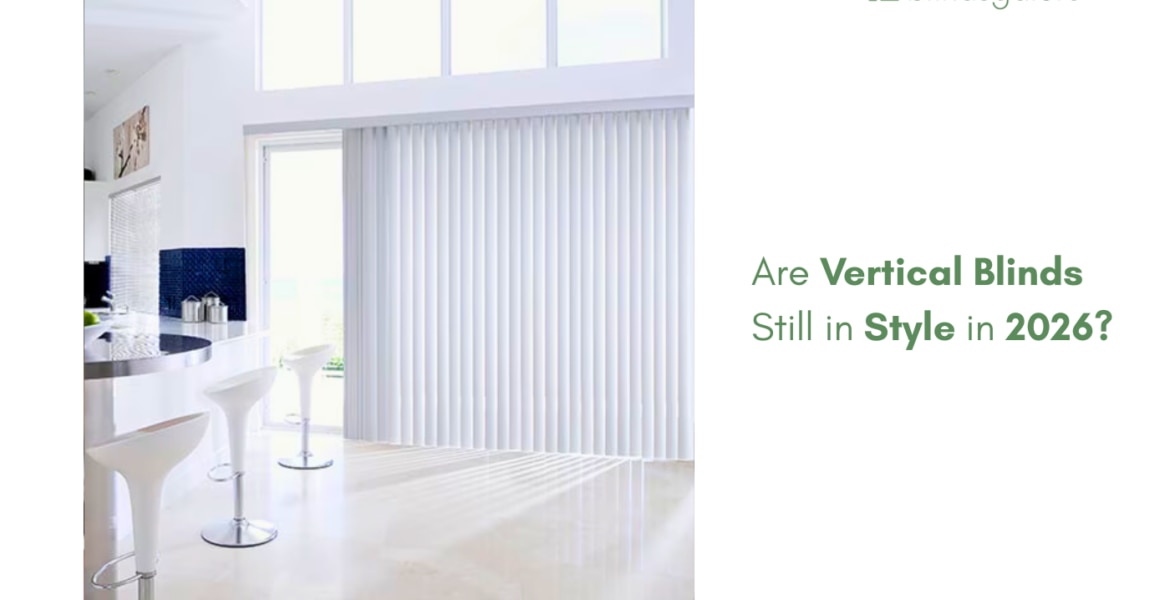
The vertical blind is two things at once, and the style question only applies to one of them.
There is the mechanism: vanes that stack sideways to clear a doorway. And there is the 1990s execution of that mechanism: narrow beige PVC vanes, a rattling bead chain, an exposed white track. The execution is genuinely dated. The mechanism is not going anywhere, because nothing else moves the way a sliding door moves.
What actually happened to this category is not decline but speciation. The side-stacking principle survived and threw off descendants with better materials, and most of what gets sold as an alternative to vertical blinds is mechanically the same idea wearing different clothes.
Are vertical blinds out of style in 2026?
The old ones, yes. The idea, no.
Four specific markers date a vertical blind, and every one of them is a materials or hardware choice rather than a flaw in the concept:
- Narrow PVC vanes in beige or off-white, the default specification in rental housing and offices for two decades
- A visible bead chain and cord loop running down one side
- An exposed, unfinished headrail with no valance or fascia
- Vanes that clatter against each other in a breeze or when the door opens
Change those four things and the same mechanism reads as current. That is precisely what panel track systems and vertical cellular shades did, which is why they now occupy the shelf space the old vertical blind used to hold.
Why has nothing replaced the side-stacking mechanism?
Because the physics of a sliding door leaves no alternative, and because verticals carry a performance advantage on large glass that is not widely known.
A sliding door moves horizontally. A treatment that raises and lowers has to be lifted clear every time you use the door, which fails within a week of daily use. A treatment that stacks to the side clears the opening in the same motion the door itself makes. That is not a style preference; it is a geometry requirement.
The performance point is more interesting. Research from Lawrence Berkeley National Laboratory on residential window attachments found that louvered blinds deliver cooling-season savings that scale with material reflectivity, and noted slightly greater cooling savings for vertical blinds specifically, because vertical orientation blocks more solar radiation.
On a large west-facing slider, which is exactly where verticals are usually installed, that is a real and measurable argument that has nothing to do with fashion.
What are modern vertical blinds made of?
The category splits into two material paths, and they suit different rooms.
Vinyl vertical blinds
Vinyl remains the workhorse. Moisture-proof, wipes clean, handles direct sun without the fading concerns that fabric carries, and costs the least per square foot of coverage on a wide opening. Vinyl vertical blinds in a current neutral, with a finished valance and a wand rather than a chain, look nothing like the rental-grade version most people picture.
Best for: patio doors off a kitchen, pool-facing sliders, rental properties, and any opening where durability outranks softness.
Fabric vertical blinds
Fabric is the update that addresses the two most common complaints at once. Textile vanes absorb sound rather than clattering, and they read as soft goods rather than as hardware. Fabric vertical blinds sit much closer to drapery visually while keeping the side-stacking function.
Best for: living rooms and bedrooms with sliders, and any room where the door treatment sits in the same sightline as upholstery.
The full vertical blinds range covers both paths in current colorways.
Which descendant of the vertical blind should you choose?
If the vane format itself is the sticking point, three successor systems keep the mechanism and change the form entirely. Blindsgalore groups them under vertical blind alternatives.
- Panel track. Wide fabric panels sliding on a track instead of many narrow vanes. Fewer vertical lines, a calmer surface, and the most contemporary read of the three. Panel track blinds are the strongest choice for a modern room with a large slider.
- Vertical cellular. The same side-stacking motion with honeycomb cells that insulate the glass. The right answer when the slider is also the biggest thermal weak point in the room.
- Drapery on a track. The softest option, and the one that layers best over a functional treatment behind it.
None of these replaced the vertical blind. All three are vertical blinds that stopped looking like vertical blinds.
When are vertical blinds still the right answer?
Several cases where the original format remains the better specification rather than a compromise.
- Very wide openings, where panel track needs more stacking depth than the wall allows
- Rooms where you want tilt control, since vanes rotate to angle light while panels only open or close
- High-traffic and rental properties, where individual vane replacement is far cheaper than replacing a whole panel system, a point the guide on the best blinds for Airbnb and vacation rentals covers across a full property
- Humid and poolside rooms, where vinyl outlasts fabric alternatives
- Budget-sensitive whole-property projects covering many wide openings
The tilt point deserves emphasis. A panel track is open or closed. Vertical vanes rotate through a full range, letting you hold privacy and daylight at the same time, which on a street-facing slider is a meaningful daily difference.
For the mechanical comparison against horizontal treatments on the same opening, Blindsgalore covers it in Vertical Blinds vs Horizontal Blinds, and the patio and sliding doors collection filters every treatment that suits the opening.
How do you make vertical blinds look current?
Five specification choices separate a vertical blind that looks considered from one that looks inherited.
- Choose a wand instead of a chain, removing the most dated visual element and the cord safety concern with it. The CPSC advises that cordless window coverings are the only option that eliminates the strangulation hazard in homes with young children.
- Add a fabric-wrapped valance or fascia so the headrail reads as finished rather than industrial.
- Match the vane color to the wall or trim rather than defaulting to off-white, so the treatment recedes.
- Choose wider vanes where available, which reduces the number of vertical lines across the glass.
- Consider fabric over vinyl in any room where the door is in the same view as soft furnishings.
For how these treatments hold up across years of daily use on a door that gets opened constantly, the guide on how long custom blinds last covers the maintenance picture, and the Ultimate Guide to Window Treatments maps the wider category.
How should you choose for your sliding door?
Start from the opening rather than the trend. Measure the width, check the stacking depth available on the wall beside the door, and decide whether you need tilt control or only open and closed. Those three answers narrow the field faster than any style question.
Then choose materials by room. Vinyl where it gets wet or heavily used, fabric where it sits in a designed room, panel track where the wall can take the stack and the room is modern, vertical cellular where the slider is costing you money in heating and cooling.
Every Blindsgalore treatment is made to order to your exact dimensions, and over 99% of our customers measure and install their own. Order up to 10 free samples to compare vane materials against your own floor and wall, or call the in-house team at (877) 702-5463 to talk through stacking on a specific door. Every Blindsgalore product carries a 3-year limited warranty with the option to extend to five years, and shipping is free across the contiguous United States and Canada.
Browse vertical blinds or order free samples to see the current range in your own light.
Frequently asked questions
The 1990s execution is dated: narrow beige PVC vanes, visible bead chains, and exposed headrails. The side-stacking mechanism is not, because nothing else clears a sliding door in the same motion the door makes.
Panel track blinds, vertical cellular shades, and track-mounted drapery. All three keep the side-stacking mechanism and replace the narrow vane format with wider panels or fabric.
Yes, and they remain among the few treatments suited to them. Side-stacking clears the doorway without lifting anything, and vertical orientation blocks more solar radiation than horizontal slats on large glass.
Wand controls have largely replaced chains on modern verticals. A wand removes the most dated visual element and addresses the cord safety issue the CPSC identifies in homes with young children.
Vinyl for moisture, durability, and cost on heavily used or poolside doors. Fabric for sound absorption and a softer look in living rooms and bedrooms where the door sits in a designed sightline.
Yes, with a wand instead of a chain, a finished valance, vane color matched to the wall rather than default off-white, and wider vanes to reduce the number of vertical lines across the glass.