
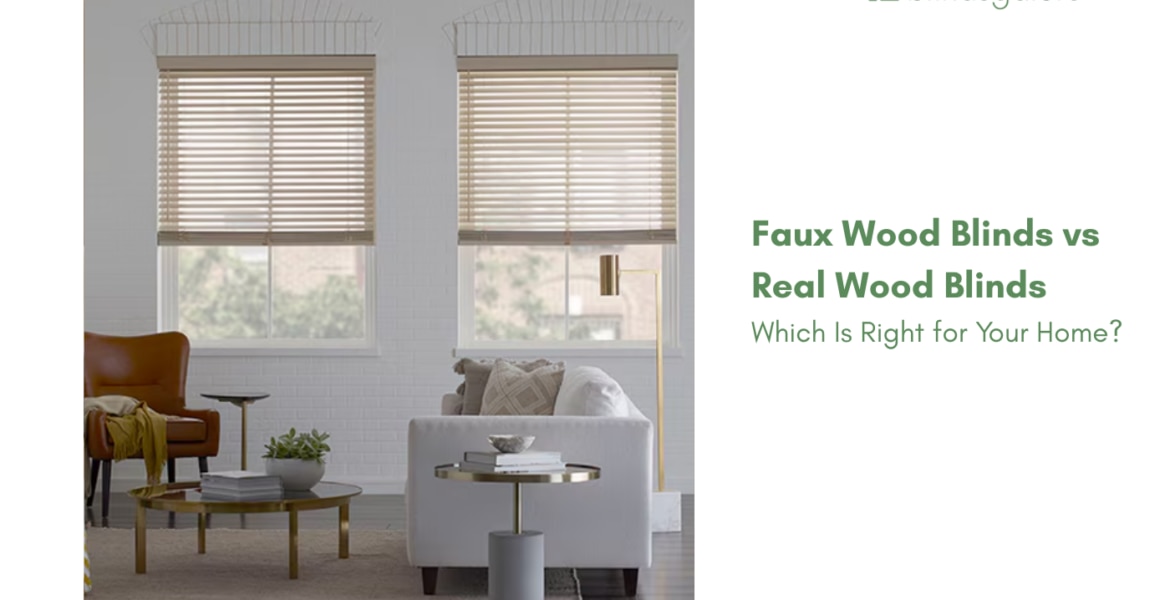
The usual framing of this comparison is looks against cost. Real wood is prettier; faux wood is cheaper; choose according to budget.
That framing is incomplete in a way that produces returns. Two variables settle this decision before appearance is even relevant, and both are physical rather than aesthetic. The first is how wide the window is. The second is how humid the room is. Get those right, and the aesthetic question becomes a genuinely free choice.
What is the real difference between faux wood and real wood blinds?
Material, and everything downstream of it.
- Real wood blinds are milled from hardwood, usually basswood. Light, warm, and available in stains that show natural grain.
- Faux wood blinds are composite or PVC, engineered to look like wood. Moisture-proof, dimensionally stable, and heavier.
The counterintuitive part is the weight. Faux wood is denser than basswood, so a faux wood blind weighs more than a real wood blind of identical size. That single fact drives the width constraint that most buyers never hear about.
Why does window width decide this?
Because weight scales with area, and a slatted blind is lifted by a cord or spring mechanism sized to the load.
On a narrow or standard window, neither material presents a problem. As width increases, the faux wood blind gets heavy faster than the real wood equivalent. Three consequences follow:
- Operation gets harder. A wide faux wood blind takes noticeable effort to raise and lowers with more momentum.
- Slat deflection becomes visible. Wide spans can bow slightly in the middle without a center support.
- Manufacturers cap faux wood widths lower than real wood widths, which is why a wide window sometimes shows real wood as an option when faux wood is not.
Real wood is the better engineering answer on wide windows for exactly this reason, not because it looks better. On a wide living room window, choosing wood blinds is a weight decision that happens to also give you grain.
Why does room humidity decide the rest?
Because wood is hygroscopic and composite is not.
Real wood absorbs and releases moisture from the air. In a stable, climate-controlled room, that is harmless. In a bathroom with a working shower, a kitchen with daily steam, or a laundry room, repeated swelling cycles warp slats, lift finish, and eventually cup the wood permanently. No finish fully prevents this.
Faux wood does not care. That is the entire reason the material exists.
- Bathrooms, kitchens, laundry rooms, basements, and coastal homes: faux wood blinds, without debate
- Living rooms, bedrooms, dining rooms, and offices in a climate-controlled home: either material
- Any room where you want a stain rather than a paint finish: real wood, since composite grain printing is convincing on painted finishes and less so on deep stains
Which faux wood blind should you choose?
Two specifications cover most rooms, and they differ on light control rather than appearance.
The Blindsgalore faux wood blinds are the standard specification, covering the main colors and finishes across typical window sizes.
The Privacy faux wood blinds close tighter. Standard slatted blinds are routed with holes for the lift cords, and those holes admit pinpoints of light and sightlines when closed. A privacy construction removes them, which matters on street-facing windows and in bedrooms far more than it does in a hallway.
If light leaks through cord holes is a concern, that is the upgrade to make. Slat color is not what fixes it.
Which real wood blind should you choose?
Also two, separated by finish depth and range.
The Signature wood blinds cover the core stain and paint range in genuine hardwood.
The Premium wood blinds extend the finish palette and construction quality for rooms where the blind sits in the same sightline as furniture and floors, and where matching an existing wood tone matters.
The practical guidance on stains: match the blind to the room’s dominant wood rather than to the floor specifically. Floors are usually the largest wood surface and the hardest to match exactly, and a near-miss on a large surface reads worse than a deliberate contrast.
How do the two compare on care and lifespan?
Faux wood is the lower-maintenance material by a clear margin. A damp cloth handles everything, and the finish resists UV fading, scratching, and moisture.
Real wood needs a drier touch. Dust with a dry cloth, use minimal moisture on marks and dry immediately, and avoid all-purpose sprays, which strip the finish. Neither material should ever be submerged in water, regardless of what most cleaning guides suggest, because the headrail mechanism holds water that cannot be dried out. The material-by-material approach is covered in the guide on how to clean blinds without removing them.
On lifespan, both last well when specified for the right room. What shortens either is putting real wood somewhere humid or putting a very wide faux wood blind on a window that has to be operated several times a day. The guide on how long custom blinds last covers the wider set of factors, and for natural material comparisons, the guide on Bamboo vs Wood Blinds covers how other plant materials behave.
Can you mix both in the same home?
Yes, and it is the normal answer rather than a compromise.
Painted faux wood and painted real wood in the same color are difficult to tell apart from across a room. That makes the sensible specification straightforward: faux wood in wet rooms and on standard windows, real wood on wide openings and anywhere you want a visible stain. The house reads consistent, each room gets the material suited to its conditions, and nobody notices the difference except the person who paid for it.
Where mixing does show is in stains. A stained real wood blind and a wood-grain-printed faux wood blind in adjacent rooms with a clear sightline between them will not match convincingly. Keep stains to one material within a sightline.
How should you choose?
Answer three questions in order, and the decision resolves itself.
- How wide is the window? Wide favors real wood on weight grounds.
- How humid is the room? Humid means faux wood, with no exceptions worth making.
- Do you want a stain or a paint finish? Stain favors real wood; paint is a genuine tie.
Only if all three come back neutral does the comparison become about looks and budget, and at that point either answer is defensible. For planning treatments across a whole property at once, the guide on the best blinds for Airbnb and vacation rentals covers the material math at scale.
Every Blindsgalore blind is made to order to your exact dimensions, and over 99% of our customers measure and install their own. Order up to 10 free samples to compare a real wood stain against a faux wood finish in your own light, since this is a comparison that photographs poorly and resolves instantly in person. Every Blindsgalore product carries a 3-year limited warranty with the option to extend to five years, and shipping is free across the contiguous United States and Canada. Fading is not covered.
Browse faux wood blinds, browse real wood blinds, or order free samples to compare them side by side.
Love your view.
Frequently asked questions
Yes. Composite is denser than basswood, so a faux wood blind weighs more than a real wood blind of the same size. That is why manufacturers cap faux wood widths lower and why wide windows often favor real wood.
Not one with a working shower. Wood absorbs ambient moisture, and repeated swelling cycles warp slats and lift finish over time. Faux wood is the correct specification for bathrooms, kitchens, and laundry rooms.
On painted finishes, the two are difficult to distinguish. The difference shows on deep stains, where genuine grain reads as natural and printed grain does not. For white and painted blinds, faux wood is not a visual compromise.
Limits vary by product, but faux wood is consistently capped narrower than real wood because of weight. On very wide windows, either split the opening into two blinds or specify real wood.
Blinds built without the routed cord holes found in standard slats. Removing those holes eliminates the pinpoints of light and sightlines that show when a standard blind is closed, which matters most on street-facing windows and in bedrooms.
Only sparingly. Use a dry cloth for dust and a barely damp cloth for marks, drying immediately. Never submerge any blind, since water enters the headrail mechanism and cannot be dried out.