
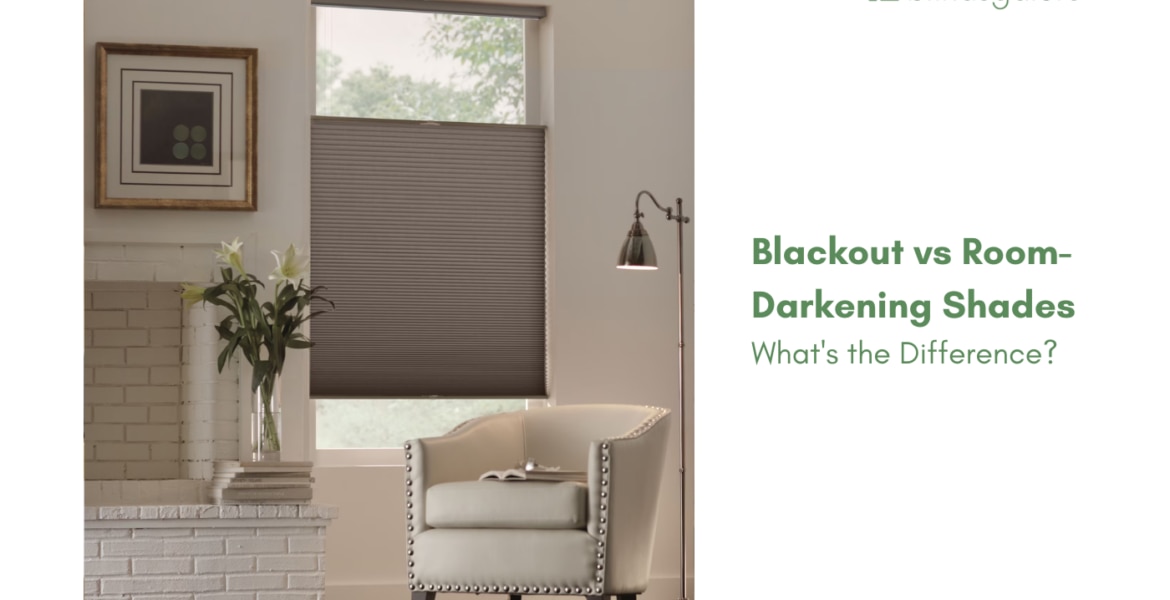
Blackout fabric contains an opaque layer, usually a foil or vinyl core, that stops light from passing through the panel. Room-darkening fabric is dense and tightly woven but has no opaque core, so a small amount of light still transmits and the fabric shows a faint glow when backlit.
That is the honest technical distinction. What follows from it is less comfortable: neither term is defined by any standards body, and the numbers attached to them are set by whoever is writing the product page.
What is the difference between blackout and room-darkening shades?
Construction and one specific layer.
- Blackout fabric is built in multiple layers with an opaque core. Light does not pass through the fabric itself. Held up to a window, it reads as solid black.
- Room-darkening fabric is a dense single layer or a coated fabric without an opaque core. Held up to a window, it reads as very dark with a visible glow.
- Light-filtering fabric is woven to diffuse rather than block. Held up to a window, it glows evenly.
The backlit test is the most reliable one available to a buyer. Hold a sample against a bright window. If you see any light through the fabric at all, it is not blackout, regardless of what the label says.
Is there an industry standard for these terms?
No, and this is the part worth knowing before you spend money.
There is no regulatory or standards-body definition of blackout or room-darkening in window coverings. Published definitions differ substantially from one retailer to the next, and the same phrase is routinely applied to fabrics of noticeably different opacity. A shade sold as room-darkening by one company can be denser than a shade sold as blackout by another.
That leaves the label doing very little work. What does exist is a measured value.
The Attachments Energy Rating Council, an independent nonprofit established with support from the Department of Energy’s Building Technologies Office and Lawrence Berkeley National Laboratory, certifies window attachments and publishes visible transmittance among its rated values. The Department of Energy maintains an overview of the AERC program.
Visible transmittance is the share of visible light that passes through. Lower means darker. The value is a number rather than an adjective, and it compares across products in a way that “room-darkening” does not.
How do you compare two shades objectively?
Three questions cut through the labels.
- What is the visible transmittance or light transmission percentage of this fabric? A specific number should be available. If the answer is only a category name, the category name is all there is.
- Does the fabric have an opaque core layer? That single construction detail is what separates blackout from everything else.
- What does it look like backlit? Order the sample and hold it against a window at midday. Ten seconds settles the question.
Ordering samples is not a courtesy step in this category. Samples are the only reliable verification available, because the label is inconsistent and the photograph is meaningless.
What does each one actually deliver in a room?
Assuming a competent installation, here is the practical difference.
Blackout
Genuine darkness. No visible glow through the fabric, no readable light in the room with the shade fully lowered and the door closed. The right specification for bedrooms where sleep timing matters, nurseries at nap time, media rooms, and any room used for daytime sleeping.
Blindsgalore blackout options span both major formats. The Classic vinyl blackout roller shades give the slimmest profile and the simplest surface. The Essential blackout single cellular shades and Classic cordless blackout cellular shades add honeycomb insulation and run their lift cords inside the cells so there are no routing holes punched through the fabric to leak light.
Room-darkening
Substantial darkening with a soft residual glow. A room you would call dark but could still move through without turning on a light. The right specification for living rooms, dining rooms, guest rooms used occasionally, and home offices where a fully dark room would create screen contrast problems.
The practical advantage is that room-darkening fabric usually comes in a wider color and texture range, because it does not need to accommodate an opaque core layer.
Why does the same shade perform differently in two homes?
Because fabric is only half of the result, and this catches people who did everything else right.
An inside-mounted shade is deliberately built narrower than the opening so it can operate freely. That leaves a gap on both sides. A genuine blackout fabric on an inside mount will still admit a visible outline of light around the perimeter, which in a dark room reads as bright.
Three specification choices decide whether the fabric gets to do its job:
- Outside mount, extending past the frame onto the wall, rather than inside mount
- Generous overlap, roughly two inches beyond the frame on each side and above
- Side channels where the product offers them, sealing the vertical edges
The measuring guide covers both mount types. Ordering blackout fabric on an inside mount and expecting a dark room is the most common disappointment in this category, and it is a specification issue rather than a product one.
Which one should you choose?
Match the label to the room’s actual requirement rather than to the strongest-sounding word.
- Bedroom for a shift worker, a light sleeper, or anyone waking with the sun: blackout, outside mount
- Nursery: blackout, cordless, outside mount
- Media room or home theater: blackout, matte fabric, side channels
- Living or dining room: room-darkening, since full blackout makes a social room feel closed
- Home office: room-darkening or light-filtering, because a bright screen in a fully dark room creates its own contrast strain
- Guest room used a few times a year: room-darkening is usually sufficient
For a wider view across formats, the blackout collection covers both cellular and roller construction, and the roller shades range carries fabrics at every opacity level. The Ultimate Guide to Window Treatments maps how opacity choices interact with the rest of the category, and the guide on Dual Sheer Shades covers treatments that carry two opacities on one headrail.
Can you get both from one window?
Yes, through three configurations rather than through a compromise fabric.
A top-down/bottom-up blackout shade lowers from the top for daylight and privacy at once, then closes fully at night. A dual-fabric or day/night shade carries a light-filtering and a blackout fabric on the same headrail. Layering puts a light-filtering shade at the glass with blackout drapery over it.
All three beat choosing a middle-opacity fabric and being mildly dissatisfied in both directions, which is what most people do.
How should you order?
Order samples first and run the backlit test. Then decide the mount, because on this particular product the mount determines whether the fabric matters at all. Then choose the format, cellular if the room has a temperature problem and roller if it does not.
Every Blindsgalore shade is made to order to your exact dimensions, and over 99% of our customers measure and install their own. Order up to 10 free samples to hold blackout and room-darkening fabrics against your own window in daylight, or call the in-house team at (877) 702-5463 to confirm a mount before ordering. Every Blindsgalore product carries a 3-year limited warranty with the option to extend to five years, and shipping is free across the contiguous United States and Canada. For care guidance once installed, the guide on how long custom blinds last covers what affects lifespan, and the guide on cleaning honeycomb blinds without removing them covers upkeep on cellular blackout fabrics.
Browse blackout and room-darkening shades or order free samples to compare them in your own light.
Frequently asked questions
Blackout fabric has an opaque core layer that stops light from passing through. Room-darkening fabric is dense but has no opaque core, so a faint glow shows when backlit. Blackout produces genuine darkness; room-darkening produces a dark room with residual light.
No. Neither term is defined by a standards body, and definitions vary between retailers. The measurable alternative is visible transmittance, a rated value published for products certified by the Attachments Energy Rating Council.
Hold a fabric sample against a bright window at midday. Blackout fabric shows no light through the panel at all. If you can see any glow, the fabric is room-darkening regardless of how it is labelled.
For some sleepers, yes. For anyone waking with sunrise, working night shifts, or settling a baby during daylight, blackout is the correct specification. Room-darkening leaves enough light to read the room.
Almost always the mount rather than the fabric. Inside-mounted shades are built narrower than the opening so they can operate, leaving gaps at the sides. An outside mount with generous overlap, plus side channels, closes them.
Blackout fabric blocks some solar gain, but blocking light and insulating are different jobs. A blackout cellular shade does both, because the honeycomb structure traps air. A blackout roller blocks light without meaningful insulation.