
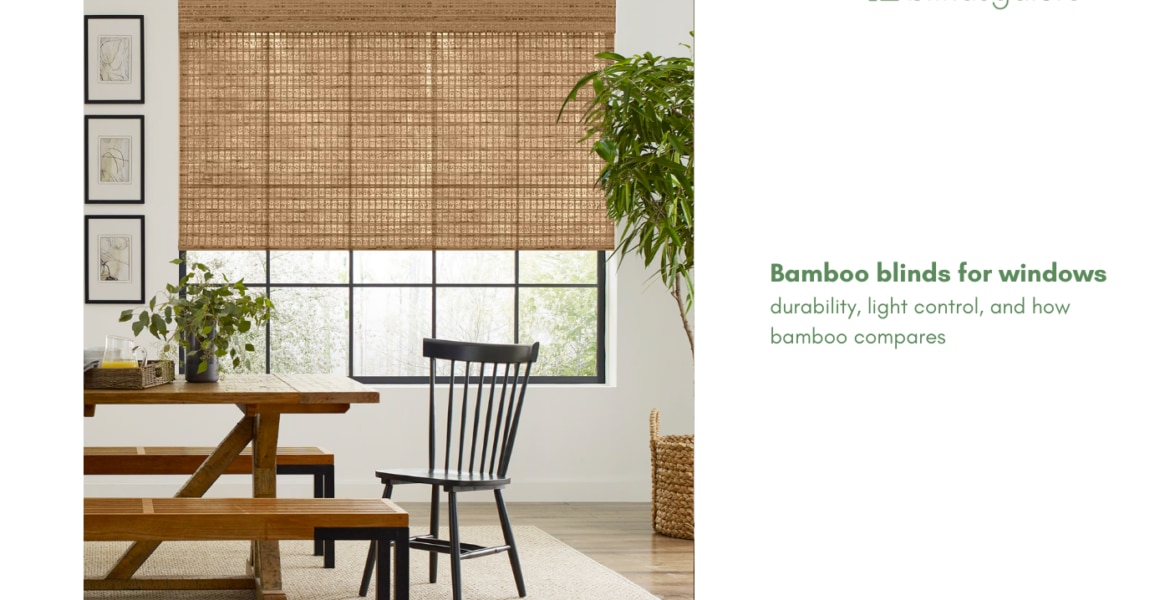
Bamboo blinds are woven shades made from strips of natural bamboo, often blended with jute, grasses, or reeds. Instead of slats that tilt, the woven panel raises and lowers in soft folds. Bamboo shades are durable for everyday indoor use, filter light on their own, and can block nearly all light with an added blackout liner.
Woven natural shades have been around for centuries, and they’re firmly back in American homes for a simple reason. Designers want texture, and buyers want materials that grow back. Bamboo delivers both, which is why it shows up in nearly every style in our woven wood shades collection.
What are bamboo blinds, exactly?
Bamboo blinds are a style of woven wood shade, not a separate product category. Strips of bamboo are woven together, often with other natural fibers, and finished with a headrail, a bottom bar, and an optional liner. Our bamboo shades collection gathers every style where bamboo is a primary material, and the full woven wood shades collection covers every natural weave.
Our Classic and Boutique woven styles fall into four material groups:
| Material group | What’s in it | What it looks like |
|---|---|---|
| 100% bamboo | Bamboo, with one style blending bamboo and cypress | Crisp, defined weave with natural grain |
| Bamboo blends | 50% to 85% bamboo with other natural fibers, such as sisal | Bamboo structure with softer, mixed texture |
| Wood and raffia | 60% to 100% wood fiber with raffia | Flat, ribbon-like texture |
| Paper and reed blends | 50% to 60% paper and natural reed | Lighter, more uniform modern look |
Our Boutique line adds specialty fibers like Manila hemp and ramie for a richer, more tailored hand. Whatever the mix, each shade is handcrafted from natural fibers, so slight variations in color, grain, and texture are part of the material, not flaws.
How are bamboo shades different from regular blinds?
Regular blinds and bamboo shades solve the same problem in different ways. Here’s how they compare.
- How they move. Blinds use slats that tilt open and closed. Bamboo shades are a single woven panel that stacks into folds as you raise it.
- How they control light. Blinds control light by tilting. Bamboo shades control light through the tightness of the weave, plus an optional liner.
- How they look. Blinds read as clean and linear. Bamboo adds texture and warmth, with no two shades exactly alike.
- How much privacy they give. Closed blinds block most views. An unlined bamboo shade has small natural gaps in the weave, so add a liner for full privacy.
If you’re weighing bamboo against classic wood slats, our post on bamboo vs. wood blinds goes deeper.
Are bamboo blinds durable enough for everyday use?
Yes, indoors and with basic care. Bamboo is strong and light, and a well-made bamboo shade handles daily raising and lowering for years. Three things decide how long yours lasts.
- Moisture. Bamboo does well in dry rooms and with ordinary kitchen humidity. Constant wetness is its weak point. A peer-reviewed study in the journal Forests notes that bamboo is more susceptible to decay than wood because it lacks wood’s natural toxins. For a window right next to a shower, faux wood blinds are the safer pick.
- Sun. Like other natural materials, bamboo can shift in color over time in strong, direct sun. That gradual change is part of the material’s character. Note that our warranty covers defects in materials and workmanship, not fading.
- Cleaning. Bamboo blinds for windows need very little upkeep. Dust weekly with a microfiber cloth or a vacuum brush attachment, and blot spots with a barely damp cloth and mild soap. Never submerge a bamboo shade in water. Soaking damages the fibers, the adhesives, and the lift. Our cleaning guide by material covers woven shades step by step.
Blindsgalore brand woven shades carry a 3-year limited warranty with the option to extend to five years, and BG Boutique woven shades include a free 5-year extended warranty.
Bamboo vs. other natural fibers: how do you choose?
Most woven shades mix several fibers, and each one changes the look and feel. Here’s what each brings.
| Fiber | What it is | What it adds to a shade |
|---|---|---|
| Bamboo | A fast-growing woody grass | Structure, crisp lines, and visible grain |
| Jute and sisal | Plant fibers spun into strands | Softer, rustic texture in blended weaves |
| Grasses and reeds | Thin natural stalks | A finer, more delicate weave |
| Raffia | Ribbon-like palm fiber | A flat, relaxed texture |
| Manila hemp and ramie | Specialty plant fibers | A refined, drapey hand in our Boutique line |
On sustainability, bamboo stands out. According to the Food and Agriculture Organization of the United Nations, bamboo is perhaps the fastest-growing plant on earth, and commercially important species mature in four to five years.
A quick way to choose:
- Want structure and the classic bamboo look? Go 100% bamboo.
- Want softer texture and a casual feel? Choose a bamboo blend with jute or sisal.
- Want something lighter and more modern? Try a paper and reed blend.
- Decorating a beach house? Bamboo’s relaxed texture suits coastal homes well, as long as the shade stays clear of direct spray.
Our post on why woven wood shades are a designer favorite has more styling ideas.
What light control options do bamboo shades have?
Unlined bamboo filters light, and the warm glow through the weave is half the appeal. When you need more control, add a liner.
| Option | What it does | Best for |
|---|---|---|
| No liner | Filters light; shows the full weave; small gaps let some light and views through | Living rooms, sunrooms, kitchens |
| Light-filtering liner | Softens light and adds daytime privacy while keeping the room bright | Dining rooms, home offices |
| Blackout liner | Blocks nearly all light, with a neutral white or off-white street side | Bedrooms, nurseries, media rooms |
On our Classic and Boutique styles, liners are stitched directly to the back of the shade, so the bamboo texture still shows from inside the room. Keep in mind that, like any unlined woven shade, bamboo shows silhouettes at night when the lights are on inside. A liner fixes that.
For lifts, cordless is the most popular choice and the one our design experts recommend for homes with children or pets. Top-down/bottom-up and motorized options are available on many styles.
Which bamboo shades should you consider?
Four collections cover most rooms and budgets, and all of them weave in bamboo.
- The Blindsgalore Essential Woven Wood Shades are our best value woven wood, handcrafted from bamboo, reeds, and jute, with a cordless lift included.
- The Blindsgalore Classic Natural Woven Shades bring hand-sewn bamboo and grasses at a budget-friendly price, with optional light-filtering or blackout liners.
- The Blindsgalore Luxera Natural Woven Shades step up to elevated weaves and intricate textures, with a fabric-wrapped bottom bar and matching valance.
- The Boutique Serenity Natural Woven Shades pair bamboo with specialty fibers like Manila hemp and ramie for a richer, designer finish.
Measuring is the same as for any custom shade. Our measuring guide walks you through inside and outside mounts in a few minutes with a steel tape measure.
Frequently asked questions
Yes, bamboo blinds are a type of woven wood shade. Bamboo is one of several natural materials used in the woven wood line, alongside jute, grasses, reeds, and other fibers.
Yes. Bamboo shades hold up well to daily use indoors. Keep them out of constant moisture, dust them regularly, and never submerge them in water.
Bamboo can change color gradually with long exposure to strong sun, as natural materials do. That shift is part of the material’s character rather than a defect, and our warranty does not cover fading.
Yes. Add a blackout liner, which blocks nearly all light while keeping the bamboo texture visible from inside the room.
Unlined bamboo shades can show silhouettes at night with interior lights on, because natural weaves have small gaps. A light-filtering liner increases nighttime privacy, while a blackout liner provides the most complete privacy.
Bamboo handles ordinary humidity, but it isn’t the best choice for a window right next to a shower or tub, where it would stay damp. Faux wood blinds hold up better in steamy, splash-prone spots.