
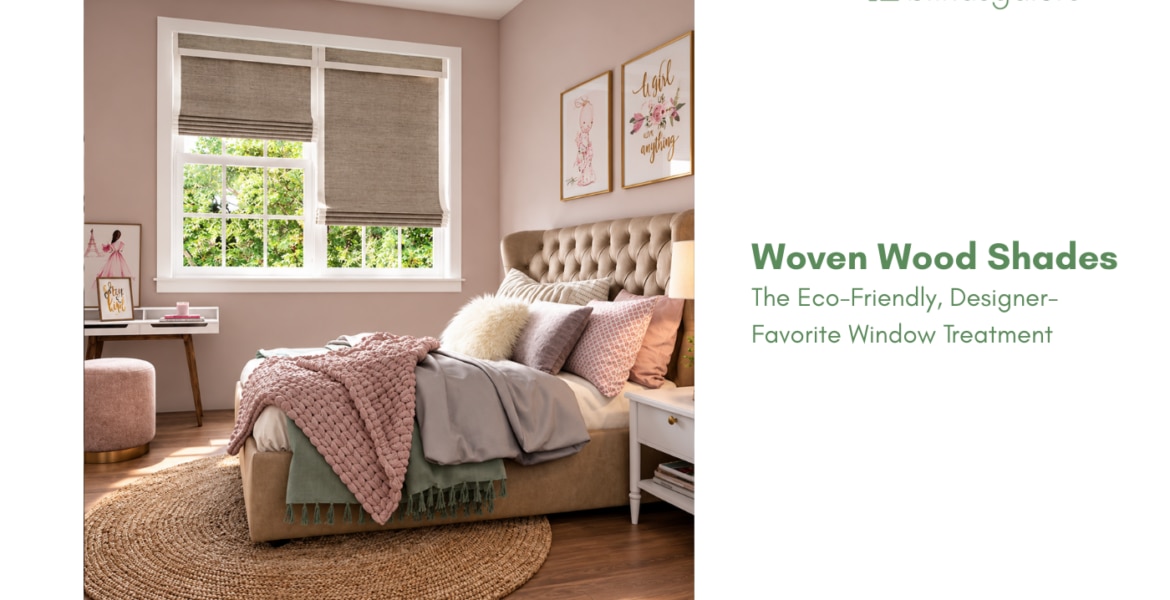
Woven wood shades are made from rapidly renewable plant materials, mostly bamboo, jute, reed, rattan, and grasses, hand-woven into panels that filter daylight rather than block it. That construction is the reason designers reach for them and the reason they behave differently from every fabric shade on the market.
Two things about this category deserve more precision than they usually get. The environmental claim attached to them is real but narrower than the marketing suggests. And the weave that makes them beautiful is also the thing that limits their privacy, which is a solvable problem if you know about it before ordering rather than after.
What are woven wood shades made of?
Woven wood shades are built from plant fibers rather than milled lumber or synthetic fabric. The category covers several material families, often blended in a single weave.
- Bamboo, technically a grass rather than a wood, is the most common and most durable component
- Jute and hemp add softer texture and warmer tone
- Reed, rattan, and dried grasses create the loosest, most organic weaves
- Some weaves add a fine wood slat for structure and a more tailored line
Because the inputs are natural, no two panels are identical. Tonal variation between slats is a property of the material, not a defect, and it is the reason a woven wood shade reads as handmade next to a printed fabric.
Blindsgalore carries the category as woven wood shades and files the bamboo-dominant weaves under bamboo shades. The Classic natural woven shades cover the core weave range, the Luxera natural woven shades sit at the finer end of the weave and finish spectrum, and the natural woven shades line covers the broader tonal palette.
Are woven wood shades actually eco-friendly?
Worth answering carefully, because “eco-friendly” is not a casual word in the United States. The phrase carries regulatory weight.
The Federal Trade Commission’s Green Guides advise marketers not to make broad, unqualified general environmental benefit claims like “green” or “eco-friendly”, on the basis that such claims are difficult to substantiate and open to too many consumer interpretations. The guidance is that marketers should qualify general claims with the specific benefit they can actually support.
The FTC’s own worked example in 16 CFR Part 260 happens to use bamboo, and it is a useful template for how to think about this category honestly. A qualified claim looks like: made from bamboo, which grows at the same rate or faster than it is used.
So here is the sustainable version rather than the marketing version.
- The raw materials are rapidly renewable. Bamboo regenerates from the existing root system after cutting rather than requiring replanting.
- The materials are plant-based, which displaces the PVC and petroleum-derived fabrics used in most other shade categories.
- Processing is minimal. A woven wood shade is cut, woven, and finished rather than extruded or chemically manufactured.
- The panel is largely biodegradable at end of life, unlike vinyl.
What none of that establishes is a total environmental footprint. Shipping distance, adhesives, liner materials, and finish treatments all carry impact that a “natural materials” claim does not account for. Anyone who tells you a window shade is unambiguously good for the planet is skipping the arithmetic.
The honest position: woven wood is the lower-impact material choice in the window covering category, for specific and stateable reasons, and that is a meaningful thing without needing to be a bigger thing.
How much privacy do woven wood shades give?
Less than most buyers expect, and this is the single most common source of disappointment with the category.
An unlined woven wood shade filters light through the gaps in the weave. During the day, that produces the warm, dappled quality the category is loved for, and it gives reasonable privacy because the exterior is brighter than the interior. After dark, that reverses. With interior lights on, an unlined weave shows silhouettes clearly from outside.
The fix is a liner, chosen deliberately.
- No liner: maximum texture and glow, daytime privacy only. Suits sunrooms, high windows, and rooms with no sightline from outside.
- Privacy liner: blocks the view while still letting diffused daylight through. The correct default for living rooms, dining rooms, and anything at street level.
- Blackout liner: blocks light almost entirely. The bedroom and media room specification.
A liner changes the appearance from the outside of the house and adds weight to the panel, both worth knowing before ordering. For a fuller breakdown of how liner choice affects light and privacy across shade types, the Hello Sunshine, Goodbye Glare guide covers the wider picture.
Why do designers specify woven wood shades?
Because they solve a texture problem that paint and fabric cannot.
Most interiors in 2026 are working with warm neutrals, matte finishes, and layered natural materials. In that palette, a flat roller shade reads as a blank. A woven wood panel introduces irregularity, shadow, and depth at the window, which is usually the largest uninterrupted surface in the room after the floor.
Three practical reasons the specification keeps recurring:
- The weave adds visual warmth without adding color, so it does not compete with a considered palette.
- Natural variation reads as handmade in rooms otherwise full of machine-made surfaces.
- Woven wood layers well under drapery, giving a designer two textures at one window rather than one.
For the broader material comparison against milled wood blinds, the guide on Bamboo vs Wood Blinds covers how the two behave differently over time.
Where do woven wood shades not work?
Three limits, and the moisture one deserves precision because the category gets loose treatment on it.
High-moisture rooms
Natural plant fibers are hygroscopic, meaning they absorb and release ambient moisture. Bamboo handles humidity better than milled hardwood, which is why woven wood is a reasonable choice for a well-ventilated powder room or a sunroom. Sustained wet conditions are a different matter. A full bathroom with a shower in regular use puts fibers through repeated swelling cycles that eventually cause warping and, in poorly ventilated rooms, mildew. For that room, a faux wood blind or a roller shade is the safer specification.
True blackout without a liner
An unlined weave will never be a blackout treatment. Ordering one and expecting a dark bedroom is a specification error rather than a product fault. Add the blackout liner or choose a cellular shade instead.
Very wide openings
Woven panels get heavy as they get wide, and a wide unlined weave can sag over time. Past a certain width, splitting into two panels or moving to a track-based system is the better engineering answer.
Arched windows carry a separate limit worth checking early. Blindsgalore covers perfect arches only, so an irregular or eyebrow arch will need a different approach.
Which woven wood shade should you choose?
Work from the room’s light and privacy requirement first, then the weave.
- Living rooms at street level: privacy liner, medium weave, mid-tone
- Sunrooms and high windows: unlined, loose weave, lightest tone for maximum glow
- Bedrooms: blackout liner, tighter weave, and expect a heavier panel
- Rooms layered with drapery: looser weave, no liner, letting the drapery carry the privacy
- Kitchens and powder rooms with good ventilation: tighter weave, and keep the panel clear of the sink line
Tone matters more than most buyers expect. Light natural tones keep a room airy and recede into pale walls. Deeper caramel and espresso weaves read as a deliberate design feature and hold their own against darker palettes. Ordering samples is genuinely necessary here, because weave and tone photograph poorly and change substantially between daylight and lamplight.
For how the category fits alongside every other treatment, the Ultimate Guide to Window Treatments maps the full set, and the guide on how long custom blinds last covers what to expect from natural materials over time.
How should you order woven wood shades?
Decide the liner before the weave. The liner determines whether the shade works in the room; weave and tone determine how it looks. Buyers who reverse that order are the ones who end up with a beautiful shade that does not give them privacy at night.
Every Blindsgalore woven wood shade is made to order to your exact window dimensions, and over 99% of our customers measure and install their own. Order up to 10 free samples to see how a weave behaves against your own light at the hour that matters, or call the in-house team at (877) 702-5463 to talk through liner options for a specific room. Every Blindsgalore product carries a 3-year limited warranty with the option to extend to five years, and shipping is free across the contiguous United States and Canada.
Browse the woven wood collection or order free samples to compare weaves in your own room.
Frequently asked questions
The materials are rapidly renewable, plant-based, minimally processed, and largely biodegradable. The FTC advises against unqualified “eco-friendly” claims, so the accurate statement is specific: bamboo and grasses regrow faster than they are harvested and displace petroleum-derived alternatives.
Not without a liner. An unlined weave shows silhouettes once interior lights are on. A privacy liner solves this while keeping diffused daylight, and a blackout liner blocks light almost entirely.
A well-ventilated powder room is usually fine. A full bathroom with a shower in regular use is not recommended, because repeated moisture cycles cause natural fibers to swell, warp, and, in poorly ventilated rooms, develop mildew.
Bamboo shades are a subset of woven wood shades. Woven wood covers all natural fiber weaves including jute, reed, rattan, and grasses. Bamboo is simply the most common and most durable material within that category.
Woven wood filters light rather than insulating. An unlined weave offers modest thermal benefit. Adding a liner improves it. For meaningful insulation, a cellular shade is the stronger choice.
Natural fibers lighten with prolonged direct sun exposure, and tonal variation between slats is inherent to the material. Fading is not covered under warranty, so south- and west-facing windows benefit from a liner or layered drapery.