
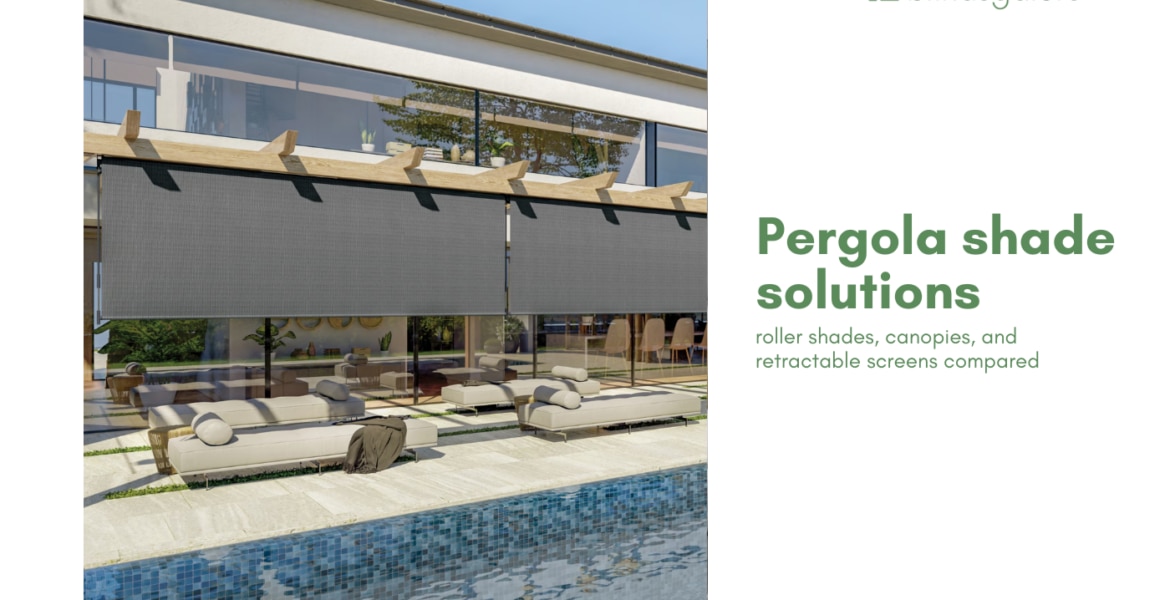
A pergola adds structure and visual weight to a patio, but the open slats don’t block much sun on their own. The fix is adding a shade layer, and the three most common options are outdoor roller shades, retractable canopies, and retractable screens.
Each handles sun, wind, and privacy differently. Here’s an honest comparison so you can pick the right setup for how you actually use your pergola.
Pergola Shade Ideas: Quick Comparison
All three options mount to an existing pergola frame, but they serve different purposes and cover different angles of sun exposure.
| Outdoor Roller Shades | Retractable Canopies | Retractable Screens | |
|---|---|---|---|
| Mounting position | Vertical (sides of pergola) | Horizontal (top of pergola) | Vertical (sides of pergola) |
| Sun protection | Blocks low-angle sun from the sides | Blocks the overhead sun from above | Blocks the side sun with mesh or fabric |
| UV blocking | Up to 95%, depending on openness | Varies by fabric | Up to 95%, depending on openness |
| Wind resistance | Good with tie-down hardware | Moderate (must retract in high wind) | Good with track systems |
| Privacy | Yes, when lowered | Minimal (overhead only) | Yes, when deployed |
| Airflow | Maintains airflow through the mesh | Open sides allow full airflow | Mesh options maintain airflow |
| Best for | Side sun, glare, privacy, UV | Overhead shade, rain protection | Side sun, bugs, privacy |
For more pergola and patio ideas beyond these three, see creative patio shade ideas for every style and budget.
Outdoor Roller Shades for Pergolas
Outdoor roller shades mount to the top beam of a pergola and roll down vertically to cover the open sides. When the sun shifts or the temperature drops, roll them back up, and the pergola feels open again. The shade material is engineered for weather exposure, UV resistance, and repeated daily use.
How they work on a pergola
The shade mounts to the header beam with brackets, just like an interior roller shade mounts inside a window frame. A manual cord loop, crank, or motorized lift controls the height. Bungee tie-downs at the bottom rail keep the shade taut in wind.
Blindsgalore Classic Outdoor Solar Screens are built from PVC-coated fiberglass that handles direct sun, rain, and humidity without warping or fading. Custom widths range from 15 to 96 inches, and heights from 24 to 96 inches. For larger pergola openings or hands-free operation, Blindsgalore Signature Motorized Outdoor Solar Shades raise and lower with a remote control.
Why roller shades work well for pergolas
Roller shades handle the problem most pergola owners actually have: low-angle afternoon sun streaming in from the sides. A pergola’s overhead slats help with midday sun, but the morning and late-afternoon rays come in at a sharp angle that the roof can’t block. Mounting roller shades on the south or west-facing sides solves that gap. For materials and motorization details, see the outdoor roller shades sun protection guide.
Retractable Canopies for Pergolas
A retractable canopy is a fabric panel that slides along tracks mounted to the top of the pergola beams. When extended, the canopy creates overhead shade similar to a solid roof. When retracted, the canopy bunches at one end and the pergola opens back up to the sky.
What canopies do well
Canopies provide overhead coverage that roller shades and screens don’t. On a pergola that faces straight up into a high midday sun, a canopy blocks heat and UV from directly above. Some canopy fabrics are also water-resistant, which means light rain won’t send everyone inside.
What can’t canopies do?
Canopies only shade from above. Low-angle sun still enters from the sides, which is often the bigger comfort problem. Canopies also need to be retracted in high winds because the fabric acts like a sail.
We don’t sell pergola canopies at Blindsgalore, but we included them here for a fair comparison. If overhead coverage is your priority, pairing a canopy with side-mounted outdoor solar shades provides the most complete pergola shade setup.
Retractable Screens for Pergolas
Retractable screens are mesh or fabric panels that mount to the sides of a pergola, similar to roller shades but often with a track or zip system that holds the fabric tighter against the frame. Screens block sun, wind, and insects while maintaining airflow.
Screens vs. roller shades
The distinction is mostly about the mounting system. Track-guided screens sit inside channels that prevent the fabric from flapping, making them more effective in windy locations. Standard roller shades use bungee tie-downs to achieve a similar result. Both block UV and glare. Both roll up when not needed.
Blindsgalore Signature Outdoor Solar Shades function as a retractable screen when mounted to a pergola frame. The PVC-coated material resists weather and fading, and the openness factor lets you choose how much light and visibility pass through. The blog post on how outdoor shades block wind, rain, and sun covers weather performance in more detail.
How to Choose the Right Pergola Shade Solution
The best option depends on where the sun hits your pergola and what problem you’re solving. Here are four common scenarios and the shade type that fits each.
Scenario 1: Harsh afternoon sun from the west
Mount outdoor roller shades on the west-facing side of the pergola. A low openness factor (3% to 5%) blocks the most heat while still allowing a view through the mesh. The Skin Cancer Foundation notes that UV radiation is a primary risk factor for skin cancer, making shade in outdoor living areas a genuine health measure, not just a comfort one.
Scenario 2: Full overhead sun with no tree cover
A retractable canopy on top paired with roller shades on the exposed sides gives you the most complete coverage. The canopy handles midday sun from above while the roller shades manage low-angle morning and evening exposure.
Scenario 3: Bugs and privacy as much as the sun
Retractable screens with a tighter mesh keep insects out while also blocking UV and reducing glare. A 1% to 3% openness factor provides strong privacy from neighbors while still allowing enough airflow to keep the space comfortable.
Scenario 4: Windy location near the coast or open land
Roller shades with bungee tie-down hardware or track-guided screens handle wind better than canopies. Avoid fabric canopies in consistently gusty locations. For more on securing shades in the wind, see outdoor shades for screened porches.
Make Your Pergola the Best Spot in the Yard
A bare pergola is just a frame. Adding the right shade layer turns the space into a room you’ll actually want to spend time in, from morning coffee through late evening. Order up to 15 free samples to see outdoor shade fabrics in your own light, or call our team at (877) 702-5463 for help choosing the right openness, color, and mounting setup for your pergola. Love your view.
Frequently Asked Questions
Outdoor roller shades are the most versatile option for most pergolas. Mounted on the sides, they block low-angle sun, UV rays, and glare while allowing you to roll them up when not needed.
Yes. Outdoor roller shades mount to the header beam of a pergola with standard brackets. Manual and motorized lift options are available, and bungee tie-downs keep the shade secure in the wind.
Not reliably. Canopies need to be retracted in high winds because the overhead fabric catches gusts. Roller shades and track-guided screens handle wind better due to their vertical orientation and tie-down hardware.
A 3% to 5% openness blocks the most heat and UV while still allowing a view through the mesh. A 10% or higher openness allows more light and visibility but provides less heat reduction.
Outdoor solar shades are water-resistant and handle light rain well, but the woven mesh allows heavy rain to pass through. A retractable canopy provides better overhead rain protection.
Yes. Motorized outdoor solar shades raise and lower with a remote control, making daily adjustments easy. Motorized operation is especially practical for large or hard-to-reach pergola openings.