
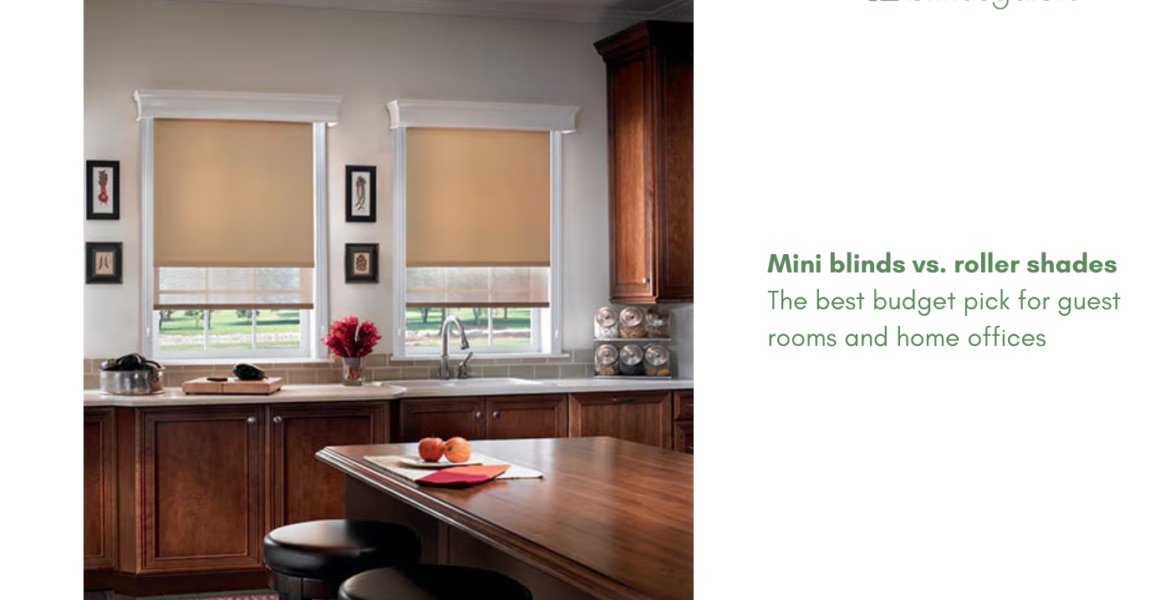
For a guest room, a blackout roller shade is usually the better pick, because it darkens the room for sleep and is simple for any visitor to use. For a home office, mini blinds often win, since tilting the slats lets you aim daylight and cut screen glare without losing the light. Both are budget-friendly, both come cordless, and both handle spare rooms well, so the right choice depends on what the room is for.
Not every window needs a statement piece. Guest rooms, offices, laundry rooms, and spare bedrooms just need something that works, looks tidy, and doesn’t strain the budget. Mini blinds and roller shades are the two most common answers.
What is the core difference between mini blinds and roller shades?
Mini blinds are rows of narrow slats that tilt and lift. Roller shades are a single piece of fabric or vinyl that rolls up and down.
| Features | Mini blinds | Roller shades |
|---|---|---|
| Construction | Aluminum or vinyl slats, mostly 1 inch | One continuous piece of fabric or vinyl |
| Light control | Tilt slats to angle light; raise for the full view | Raise or lower; fabric opacity sets the light |
| Darkness | Dim when closed, with light through slat gaps | Blackout fabrics block the most light |
| Look | Slim and practical | Clean, flat, nearly invisible when raised |
| Cleaning | Dust and wipe each slat | Dust and spot clean one flat surface |
| Wear | Aluminum slats can dent or bend | No slats to bend or break |
| Lifts | Cordless with a wand tilt | Cordless, beaded chain, or motorized |
Which costs less for multiple rooms?
Both are among the most affordable window treatments we make, so either one keeps a multi-room project on budget. Every product is custom, which means your price depends on window size, material, and lift, not just the category. Neither one is cheaper in every situation.
A few things move the price:
- Material and fabric. Aluminum vs. vinyl mini blinds, or a basic light-filtering roller fabric vs. a textured or premium one.
- Lift. Cordless lifts are standard. Motorization is available on roller shades and adds to the cost, while motorized mini blinds aren’t currently offered.
- Size. Larger windows use more material either way.
When you’re covering several rooms, the bigger savings come from consistency. Pick one product and color for each type of room, order the rooms together, and keep your order details so a replacement matches later. Our guide to custom blinds pricing explains what drives cost across categories, and property managers can find more in our guide to the best blinds for rental properties.
Which is easier to clean and maintain?
Roller shades are easier. A roller shade is one flat surface, and much of the dust simply falls away from it. Mini blinds have dozens of slats, each with a top and bottom, so they take longer to clean.
Cleaning roller shades:
- Dust softly with a cloth or duster.
- Spot clean with water and a mild detergent, blotting gently.
- For the easiest wipe-downs, choose a vinyl fabric like our Classic Vinyl Blackout Roller Shades.
Cleaning mini blinds:
- Close the slats and dust with a microfiber cloth or a vacuum brush, working top to bottom.
- Flip the slats the other way and repeat.
- Wipe slats with a damp cloth and mild soap, then dry right away.
Never submerge either one in water. Water damages the lift, and it can rust metal parts on mini blinds.
Durability favors roller shades in busy rooms, too. With no slats, there’s nothing to bend if a suitcase or a vacuum bumps the window. Aluminum mini blind slats can dent, though vinyl mini blinds resist dents better.
How does light control differ?
Mini blinds give you more in-between settings. Roller shades give you a cleaner, darker result.
With mini blinds, a twist of the wand tilts the slats, so you can:
- Angle the slats up to bounce daylight toward the ceiling and away from a screen.
- Keep privacy while letting light in.
- Close them for a dim room.
Closed mini blinds still let light through small gaps between slats. Vinyl mini blinds aren’t as room-darkening as aluminum.
With roller shades, the fabric does the work:
- Light-filtering fabrics soften the sun and give daytime privacy, though silhouettes can show at night with the lights on.
- Blackout fabrics block the most light and give full privacy day and night.
- Solar fabrics cut glare while keeping your view out. Our comparison of solar shades vs. roller shades explains the difference.
The trade-off is that a roller shade is either up or down, with no tilt. Light can also slip around the edges, which a snug inside mount helps reduce.
Which is the best pick for a guest room vs. a home office?
Here’s how we’d match each one to the room.
| Room | Best pick | Why |
|---|---|---|
| Guest room | Blackout roller shade | Darkest result for sleep, and a simple cordless lift any guest can use |
| Home office | Mini blinds | Tilt to redirect glare and keep daylight on the desk |
| Home office with a view | Solar roller shade | Cuts glare while keeping the view |
| Laundry room or mudroom | Vinyl mini blinds or vinyl roller shade | Both wipe clean and handle humidity |
| Rental or spare bedroom | Either, matched across the unit | Consistency makes replacements easy |
For a guest room, our Essential Blackout Roller Shades keep things simple and dark. For an office, our Blindsgalore 1″ Aluminum Blinds pair a cordless lift with a wand tilt for quick glare control. If you’d rather not drill, no-drill roller shades press into the window frame with a tension headrail.
Still deciding? Browse our mini blinds collection and compare them side by side with roller shades in your own light.
Frequently asked questions
A blackout roller shade is the better pick for most guest rooms. A blackout roller darkens the room more completely than mini blinds, and a cordless roller shade is simple for any visitor to use. Mini blinds work well if you’d rather let guests tilt in some light while keeping privacy.
Mini blinds and roller shades are both strong budget picks. Choose mini blinds if you want to tilt for light and privacy, and choose roller shades if you want a cleaner look, easier cleaning, or a darker room with blackout fabric.
Not always. Both are among our most affordable window treatments, and your price depends on window size, material or fabric, and lift. Comparing the two for your actual window sizes gives the clearest answer.
Yes. Roller shades are one flat surface you can dust and spot clean, while mini blinds have many slats to wipe one by one. Never submerge either type in water.
Mini blinds are better if glare on your screen is the main issue, since tilting the slats redirects sunlight. A solar roller shade is a good alternative if you want to cut glare and keep your view.
Blackout roller shades block the most light of any roller fabric, but a little light can come in around the edges. A snug, custom-sized inside mount helps reduce those gaps.