
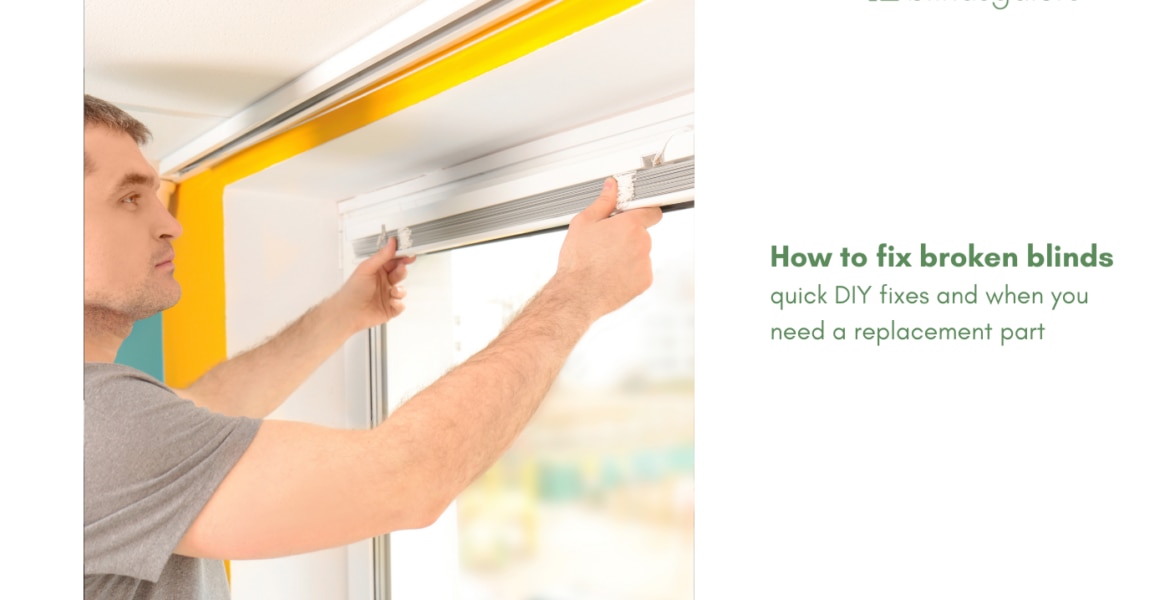
Most broken blinds aren’t really broken. A stuck lift, a valance that won’t stay put, or a tilt wand that slips off usually takes a few minutes and no new parts. The fixes that do need a part, like a cracked slat or a worn-out tilt mechanism, are easy to order once you know your product and what to ask for.
Before you search for blind repair near you, start here. Over 99% of our customers install their own window treatments, and the same hands can handle most repairs. We sort the five-minute fixes from the jobs that need a part, and show you how to get the right one from our in-house team.
Which blind problems can you fix yourself?
Knowing how to fix broken blinds starts with a quick triage. Match your symptom, then check whether it’s a DIY fix or a parts request.
| Problem | Likely cause | DIY fix or part? |
|---|---|---|
| Cordless shade won’t move or feels stiff | Spring mechanism needs a reset | DIY fix |
| Corded blind won’t lower | Cord lock roller has shifted | DIY fix |
| Valance keeps falling off | Valance not seated on its clips | DIY fix, or a new clip |
| Tilt wand fell off | Wand detached from the tilt stem | DIY fix |
| Slats won’t tilt at all | Worn or stripped tilt mechanism | Replacement part |
| Bent slat on aluminum blinds | Impact or pressure | DIY for minor bends; part for creases |
| Cracked faux wood or wood slat | Impact | Replacement part |
| Broken vertical vane | Vane snapped or torn | Replacement part |
| Motorized shade won’t respond | Low battery or lost pairing | DIY fix |
If your problem isn’t listed, or a fix doesn’t work, call our customer care team at (877) 702-5463. Most issues are simple fixes we can walk you through over the phone.
How do you fix a stuck or tangled lift cord?
The fix depends on whether your blind is cordless or corded.
Cordless shades that won’t raise or lower
A stiff cordless shade is usually a tension-spring issue, not a broken part. Try this first:
- Pull the bottom rail gently downward.
- Push it back up. That usually resets the spring mechanism.
- If it still sticks, check the brackets. Bali’s cordless troubleshooting guide for its cellular, pleated, and roman shades recommends keeping the end brackets at least 3 inches in from each end of the headrail.
Corded blinds that won’t lower
When a corded blind won’t come down, the cord lock in the headrail is usually holding on. Bali’s cord lock release guide for its aluminum blinds suggests:
- Lift the bottom rail slightly with one hand.
- Operate the cord with the other hand to lower the blind.
- If that doesn’t work, take the blind down and use a small flathead screwdriver to nudge the serrated roller in the cord lock back to center.
Tangled cords
Untangle cords by lowering the blind fully, then evening out the cords before you raise it again. Never knot or tie cords together to shorten them. If children live in or visit your home, the U.S. Consumer Product Safety Commission recommends replacing corded window coverings with cordless ones. A repair visit is a good moment to make the switch to a cordless blind.
How do you replace a loose or broken valance clip?
Valances on horizontal blinds attach to small clips on the front of the headrail. When a valance keeps falling, the fix is usually a few seconds’ work.
- Check that each clip is pushed fully onto the headrail.
- Press the valance back onto the clips until it seats firmly along its whole length.
- If a clip is cracked or missing, request a replacement clip, which is a small part our team can match to your blind.
Wider blinds usually use several clips spaced across the headrail, so a single missing clip can make the whole valance sag.
How do you fix a tilt wand that won’t turn?
First, figure out whether the wand has come off or the mechanism inside the headrail has failed.
- The wand fell off. Reattach it to the tilter stem at the end of the headrail. Depending on the blind, the wand hooks on or clips onto the stem.
- The wand turns, but the slats don’t move. The tilt mechanism inside the headrail is likely worn or stripped. Bali’s guides show the tilter replacement takes a screwdriver, needle-nose pliers, and a new tilter, so order the part first.
- The wand is hard to turn. Make sure nothing is caught in the slats or the headrail, and that the blind is level in its brackets.
On vertical blinds, a single wand both rotates and slides the vanes. If the vanes rotate unevenly, check for a vane that has slipped off its carrier before assuming the headrail is the problem.
When do you need a replacement part instead of a fix?
Order a part when something is physically broken, cracked, or worn. Common examples:
- A cracked faux wood or wood slat
- A broken or torn vertical blind vane
- A stripped tilt mechanism
- A missing valance clip or bracket
- A damaged bottom rail or end cap
Vertical blinds are among the easiest to repair, because each vane hangs independently from its own carrier on the headrail. Replacing one vane doesn’t mean replacing the whole blind. Our vertical vs. horizontal blinds comparison covers more of the practical differences.
How to order the right replacement part
Replacement parts are ordered through our customer care team rather than online, so a person matches the exact part to your blind. Have these details ready when you call (877) 702-5463:
- Your order number, or the email and name on the order.
- The product name and brand, such as Blindsgalore, Bali, or Levolor.
- The color and the width and height of the blind.
- Which part you need, plus a photo of the damage if you can take one.
Our team will locate your order, identify the exact product, and find the parts your blind needs. Repairs that fall outside the warranty are paid by card.
Is the repair covered by warranty?
Possibly. Blindsgalore brand products carry a 3-year limited warranty with the option to extend to five years, covering defects in materials and workmanship when the product was installed and operated correctly. Partner brand warranties vary, so check our brand warranties page. If a new order arrives damaged or defective, contact us within seven days of delivery.
How do you keep blinds from breaking again?
A little routine care prevents most repairs.
- Raise blinds fully before opening windows on windy days.
- If pets keep bending slats, our guide to window treatments for pet owners covers sturdier options.
- Lift cordless roller shades, cellular shades, and roman shades from the center of the bottom rail so the lift wears evenly.
- Dust regularly, and never submerge any blind or shade in water. Our cleaning guide and our material-by-material cleaning tips cover every style.
- Recharge motorized shades when they slow down. Rechargeable motors typically last months between charges.
Even well-cared-for blinds reach the end of their life eventually. Our post on how long custom blinds last helps you decide when a repair still makes sense.
Frequently asked questions
Replacement parts are ordered by phone. Call our customer care team at (877) 702-5463 with your order details, and we’ll find the exact part for your blind.
A stuck cord is usually a cord lock issue. Lift the bottom rail slightly while you pull the cord, or recenter the cord lock roller. A frayed or snapped lift cord is a bigger repair, and replacing the blind with a cordless one is often the safer choice, especially in homes with children.
No. Vertical blinds are among the easiest to repair, because each vane hangs from its own carrier. A broken vane can be replaced on its own.
A stuck cordless blind is most often a tension-spring issue rather than a broken part. A gentle tug down on the bottom rail, then a push back up, usually resets it.
The battery is the most common cause. Recharge the motor, then test it with the remote. If it still won’t respond, call our team, and we’ll walk you through re-pairing the remote.
Repair when a single part has failed, and the rest of the blind is in good shape. Replace when several parts are worn, the blind has a corded lift in a home with young children, or you’re ready for a new look.