
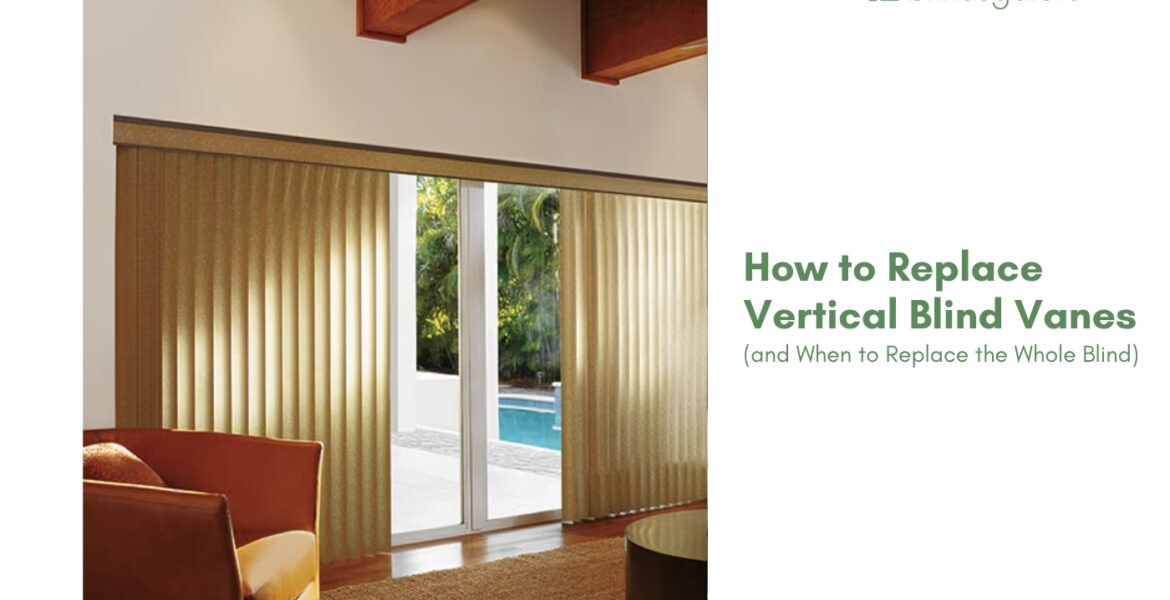
Vertical blind vanes break, crack, yellow, and warp. A single damaged vane can make an entire window look neglected. The good news is that individual vanes can be swapped out. The better news is that a full upgrade to new vertical blinds often costs less than expected and solves every problem at once.
Here’s how to handle vertical blind vane replacement, and how to decide when replacing the whole unit is the smarter call.
How to Replace a Single Vertical Blind Vane
Swapping out one or two damaged vanes is a straightforward DIY job. No special tools are required.
Step 1: Open the Vanes
Use the wand or cord to rotate the vanes to the fully open position, where the flat face points straight out from the window. Rotating them flat makes removal much easier and prevents bending.
Step 2: Disconnect the Bottom Chain
Most vertical blinds have a small chain or cord linking the vanes together near the bottom. Unclip or unthread the chain from the damaged vane and any vanes between it and the end of the row. If you don’t have this chain, skip to Step 3.
Step 3: Remove the Damaged Vane
Look at the top of the vane where it connects to the carrier clip on the headrail. A small plastic hook or tab holds the vane in place. Gently push the vane upward and slide it out of the clip. Avoid forcing it, as carrier clips can crack if handled roughly.
Step 4: Attach the New Vane
Hook the top of the replacement vane into the carrier clip. Push it upward until it clicks or seats securely. Rethread the bottom chain through the new vane and reconnect it to the neighboring vanes. Open and close the blinds a few times to confirm the new vane hangs straight and moves smoothly with the rest.
For guidance on removing an entire blind system, see How to Take Down Blinds.
Quick Repair Checklist
Before ordering replacement vanes, run through a quick assessment of the whole blind:
Check the headrail: Does the track operate smoothly, or do carrier clips stick and skip? A headrail that struggles to open and close is a sign that the whole mechanism is worn.
Inspect all vanes: Count how many are damaged, faded, or discolored. Replacing one or two vanes makes sense. Replacing five or six starts approaching the cost of a brand-new set of vertical blinds.
Look at the carrier clips: Cracked or broken clips mean vanes won’t hang properly even after replacement. Clip damage usually signals broader wear across the system.
Test the wand and cord: Stiff rotation, tangled cords, and sluggish traversing all point to hardware at the end of its useful life.
Check for color mismatch. New replacement vanes rarely match old ones perfectly. Sun exposure fades the original vanes over time, so fresh vanes can stand out noticeably against the rest.
When Replacement Beats Repair
Here’s the honest take: replacing individual vanes is a reasonably quick fix for one or two broken slats on an otherwise healthy blind. But when multiple issues stack up, repairing becomes a game of diminishing returns.
- Multiple damaged vanes. Once three or more vanes need replacing, the cost and effort start rivaling a new set of blinds. New blinds come with matching vanes, a fresh headrail, new hardware, and a clean warranty.
- Yellowing or fading across the entire set. UV damage affects every vane over time. Replacing a few vanes with bright new ones next to faded old ones creates an obvious mismatch that looks worse than the original problem.
- Headrail or mechanism issues. A worn headrail, broken carrier clips, or a sluggish wand mechanism cannot be fixed by replacing vanes alone. When the hardware is failing, the whole system needs to be replaced. For help choosing between different treatment types, see Shades vs. Blinds: What’s the Diff?.
Outdated style. Older vertical blinds with narrow, flimsy PVC vanes can look dated. Upgrading to modern vertical blinds with wider vanes, richer textures, and updated colors can take a room from tired to inspired.
Why Upgrading Often Makes More Sense
New vertical blinds solve every issue at once: fresh vanes, smooth hardware, uniform color, and modern style. At Blindsgalore, custom vertical blinds ship in as little as 5 to 7 business days, with free shipping across the continental U.S. A free 3-year warranty backs every order, with an optional upgrade to 5 years.
For sliding glass doors and wide openings, vertical blind alternatives like panel track systems offer a sleeker, more modern look while covering the same wide spans. For installation tips, check out How to Install Blinds on a Sliding Glass Door.
Cordless options are also worth considering for the upgrade. Since corded window coverings were banned for sale in the U.S. as of June 1, 2024, replacing older corded vertical blinds with cordless or wand-operated models improves both safety and compliance.
For a broader look at all window treatment options, see The Ultimate Guide to Window Treatments.
FAQs
Yes. Individual vanes can be unclipped from the carrier on the headrail and swapped for new ones. The process takes just a few minutes per vane.
Carrier clips (hangers) attach to the headrail and hold each vane. Replacement clips are available for some systems, but compatibility varies by manufacturer. If multiple clips are cracked or broken, replacing the entire headrail or the full blind is usually more practical.
Minor issues like a tangled cord can sometimes be fixed. Mechanical problems with the headrail, wand tilt, or traversing system are harder to repair and often signal that the unit has reached the end of its useful life. Replacement is typically the more reliable solution.
Replacing one or two vanes is cheaper than buying new blinds. Once three or more vanes need replacing, or if the headrail and clips are also worn, the total repair cost approaches the price of a new set of custom vertical blinds that come with a warranty and uniform appearance.
Some manufacturers sell replacement vanes, clips, chains, and wands. Availability depends on the brand and model. For older or discontinued models, finding matching parts can be difficult, making a full replacement the cleaner option.