
Yes, significantly. Plantation shutters cost more per window due to the solid construction, custom fitting, and heavier materials. Faux wood blinds offer a similar clean aesthetic at a fraction of the price.
Faux wood shutters resist moisture, humidity, and temperature changes better than real wood. Real wood offers a slightly richer grain and lighter weight. For bathrooms, kitchens, and coastal homes, faux wood is the more practical choice.
Yes. Faux wood blinds are more affordable than real wood blinds and offer better moisture resistance. Real wood blinds are lighter and show more natural grain variation, but faux wood holds up better in humid environments.
Plantation shutters are widely considered a value-adding upgrade. Real estate professionals often note that shutters create a polished, move-in-ready impression that appeals to buyers.
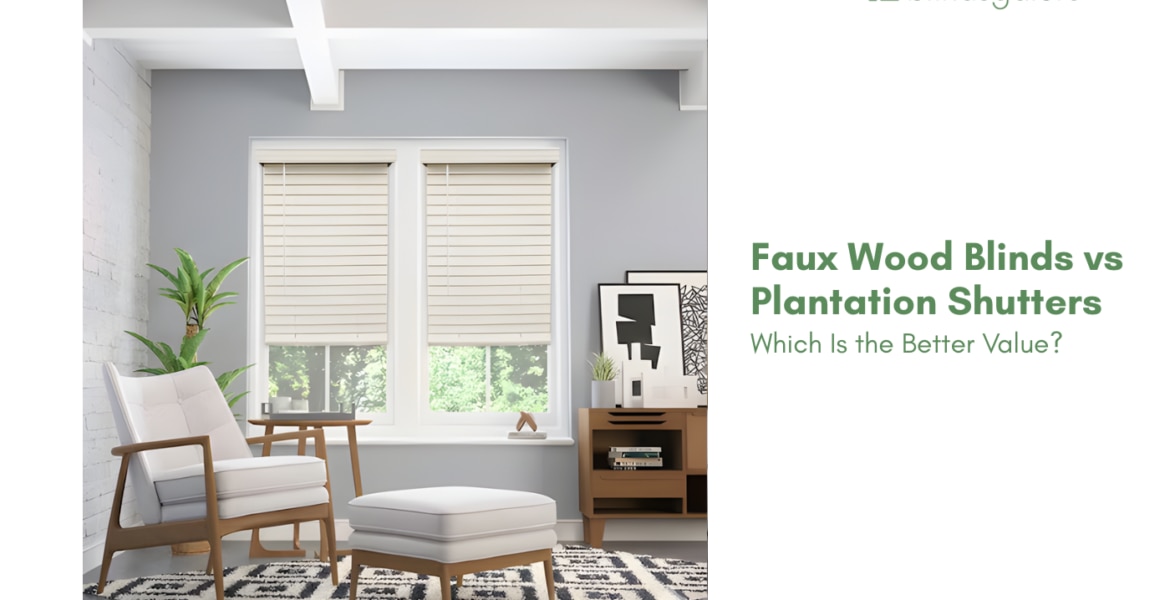
Faux wood blinds and plantation shutters both deliver a clean, polished look at the window. Both handle light control and privacy well. Both resist moisture better than real wood. But the two treatments differ significantly in cost, lifespan, installation, and overall feel.
An honest side-by-side comparison to help decide which one makes the most sense for your home, your budget, and your rooms.
Cost Analysis of Faux Wood Blinds and Plantation Shutters
Faux wood blinds are one of the most affordable window treatments available. Custom sizing, cordless lift, and quality construction come at a fraction of what most other treatments cost. For homeowners covering multiple windows on a budget, faux wood blinds stretch the dollar further.
Plantation shutters cost more per window. The solid panel construction, custom fitting, and heavier materials add up. A full house of shutters represents a significantly larger investment than the same number of faux wood blinds.
For budget-conscious projects or multi-room installations, faux wood blinds offer strong value without sacrificing style.
Durability and Lifespan
Plantation shutters are built to last. Quality faux wood shutters like the Blindsgalore Faux Wood Shutters: 3 1/2″ Louvers can hold up for 20 years or more with basic care. The solid panel construction resists warping, cracking, and sagging over time.
Faux wood blinds have a shorter but still respectable lifespan of roughly 5 to 10 years, depending on use and environment. The Blindsgalore Cordless Faux Wood Blinds are built to handle daily raising and lowering without the cord-related wear that shortens the life of older blind designs. Cordless operation also keeps things safer for homes with children and pets.
When factoring in the lower upfront cost, replacing faux wood blinds once or twice over 20 years can still come out comparable to or less than the one-time cost of shutters.
Style and Aesthetic
Plantation shutters have a permanent, architectural feel. The wide louvers, solid frame, and built-in appearance make them look like part of the home’s structure rather than an add-on. Shutters suit traditional, coastal, and transitional interiors particularly well. The Blindsgalore Faux Wood Shutters: 2 1/2″ Louvers offer a more classic, refined louver size for homes with smaller windows or traditional proportions.
Faux wood blinds deliver a crisp, clean look with horizontal slats that tilt for precise light control. The style is versatile enough for modern, transitional, or casual spaces. The Boutique Faux Wood Blinds elevate the standard faux wood look with premium finishes and refined detailing.
Both treatments come in white and neutral tones that coordinate with most interior color palettes. For a broader understanding of how blinds and shades differ, see Shades vs. Blinds: What’s the Diff?.
Light Control and Privacy
Both options offer excellent light control through adjustable slats or louvers.
Faux wood blinds tilt their slats to angle light up, down, or anywhere in between. The horizontal orientation gives fine-tuned control over glare and brightness throughout the day.
Plantation shutters provide similar tilt control through wider louvers. The wider surface area blocks more light per louver, and the solid frame construction reduces light gaps around the edges. For rooms where precise light blocking matters most, shutters generally edge ahead.
Both treatments provide strong daytime and nighttime privacy when fully closed.
Moisture Resistance
Both faux wood blinds and faux wood plantation shutters resist moisture far better than real wood. Neither will warp, crack, or swell in humid conditions the way natural wood can.
Faux wood blinds work well in kitchens, bathrooms, and laundry rooms where steam and splashes are common. Faux wood shutters handle these environments equally well. For more on treating moisture-heavy rooms, see Bathroom Window Treatment Ideas.
A quick care note: never submerge any blind or shutter in water. A damp cloth for spot cleaning and regular dusting are all that’s needed to keep either option looking sharp. For more cleaning guidance, see Easy Cleaning Hacks for Window Blinds.
Installation
Faux wood blinds are among the easiest window treatments to install. Standard mounting brackets, a few screws, and basic tools are all that’s needed. Most homeowners handle the job themselves in under an hour per window. For measuring help, visit our measuring guide.
Plantation shutters require more precise fitting. The frame needs to align perfectly with the window opening, and the weight of the panels demands secure mounting. Professional installation is more common with shutters, though DIY is still possible with careful measuring.
Home Value
Plantation shutters are often cited as a window treatment that can positively affect home resale value. Buyers perceive them as a permanent, high-end upgrade rather than a removable accessory.
Faux wood blinds don’t carry the same resale impact, but they keep a home looking clean, updated, and move-in ready at a much lower cost. For more ideas on dressing windows for both style and function, see 4 Living Room Window Treatment Ideas.
How to Decide between Faux Wood Blinds and Plantation Shutters
Choose faux wood blinds when:
- Budget matters and multiple windows need covering
- A modern, versatile look fits the room
- Quick DIY installation is preferred
- Rooms need moisture resistance at a lower price point
Choose plantation shutters when:
- Long-term investment and home value are priorities
- An architectural, permanent look is the goal
- Maximum light control with minimal light gaps matters
- The home is a long-term residence, not a rental or short-term stay
For a complete overview of all treatment options, see The Ultimate Guide to Window Treatments.