
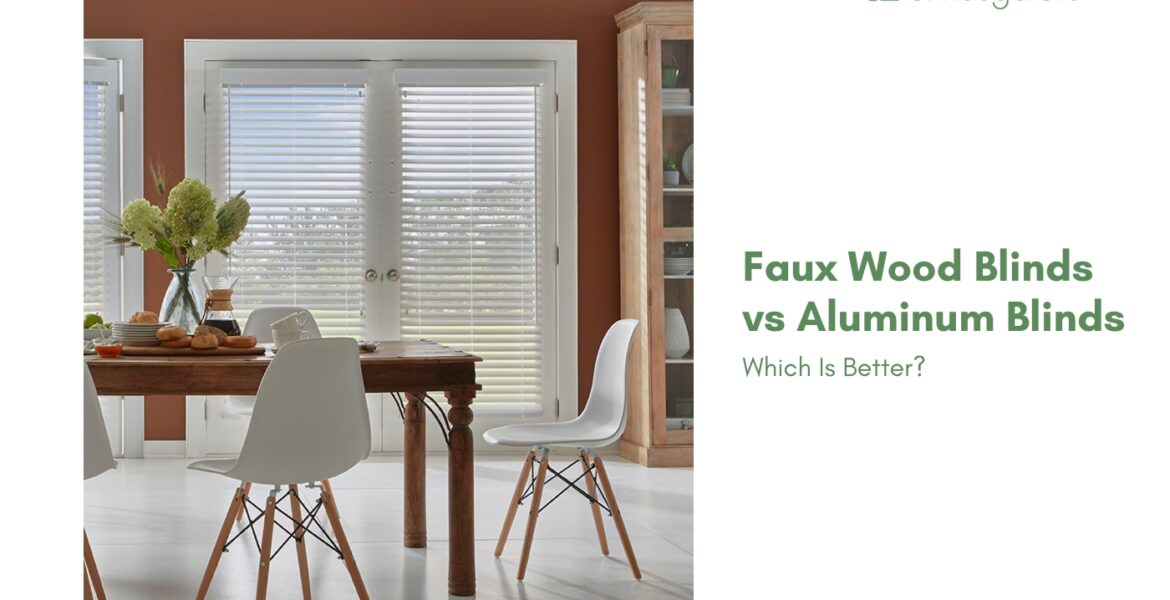
Faux wood blinds and aluminum blinds both use horizontal slats that tilt for light control and lift for a clear view. The similarity ends at the material. Faux wood brings wider slats, a warmer wood-grain texture, and a more designed feel.
Aluminum brings a slim, lightweight profile, a sleek modern finish, and a lower price per window. Choosing between faux wood blinds vs aluminum blinds comes down to how much the window contributes to the room’s design and how much the budget needs to stretch.
How do faux wood and aluminum blinds differ?
Both are slatted, both tilt, and both handle moisture. The differences show up in how each one looks, feels, and holds up over time.
Appearance and style
Faux wood blinds use wider slats, typically two inches, with a textured wood-grain finish that mimics real wood. The result is a warm, substantial look that suits traditional, transitional, and cozy rooms. The wider slat also means fewer slats per window, which gives a cleaner visual line.
Aluminum blinds use thinner slats, usually one inch, with a smooth metallic finish. The look is slim, minimal, and modern, with a range of matte and brushed tones that go well beyond the old generic silver. The Luxera aluminum blinds elevate that slim profile with a refined brushed finish that suits contemporary and minimalist interiors. The narrower slat also means a tighter stack when raised, which gives a cleaner top-of-window line on smaller windows. The guide on Hello Sunshine, Goodbye Glare covers how both handle light beautifully in different ways.
Durability and resilience
Faux wood slats are thicker, heavier, and harder to bend or dent. The composite material resists warping, cracking, and fading over years of daily use, which makes faux wood blinds a long-lasting investment for rooms that see regular traffic. The guide on How Long Do Custom Blinds Last walks through what affects lifespan across materials.
Aluminum slats are lighter and thinner, which makes them easier to dent or bend, especially in high-traffic rooms or homes with children and pets. A bent aluminum slat is difficult to repair and usually needs replacing, though the cost of a single replacement slat is low. For utility rooms and low-traffic windows, this is rarely an issue. For a busy living room with daily use, faux wood’s sturdier slats handle the wear more gracefully.
Moisture resistance
Both materials handle moisture well, which makes either one suitable for kitchens and bathrooms. Faux wood is fully moisture-proof and will not warp, swell, or crack in humid conditions. Aluminum is also moisture-resistant, though the metal finish can show water spots more visibly. For high-humidity rooms, both are solid choices, but faux wood holds its appearance more consistently over time.
Insulation and energy
Faux wood’s thicker slats provide better insulation than thin aluminum. The wider, denser material blocks more heat transfer across the window, which helps keep the room cooler in summer and warmer in winter. Aluminum is a conductive metal, so it does not buffer temperature the same way. For rooms where energy efficiency matters, faux wood has the edge.
Cost
Aluminum blinds vs faux wood blinds cost is one of the most straightforward differences. Aluminum blinds cost less per window, which adds up meaningfully when covering multiple rooms or outfitting a rental property. For a home with 10 or more windows, the savings on aluminum can redirect budget to upgrade the rooms that matter most with faux wood. Faux wood costs more per window, but the wider slat, richer finish, and longer lifespan balance the premium over years of daily use. Neither requires professional installation, and over 99% of Blindsgalore customers install their own treatments, so the total cost stays at the product price alone. The guide on the Best Blinds for Airbnb and Vacation Rentals shows how budget and durability trade off in multi-window projects.
How do they compare on maintenance?
Both faux wood blinds and aluminum blinds are low-maintenance treatments, but the cleaning experience differs slightly.
Faux wood slats are wider and sturdier, which makes them easy to wipe with a damp cloth without worrying about bending them. The textured finish also hides dust better than a smooth metallic surface, so the blinds look clean longer between wipe-downs. Aluminum slats wipe clean quickly, but the thinner metal requires a gentler touch to avoid denting or bending the slat during cleaning. A feather duster or a microfiber cloth on aluminum works best, and care should be taken not to press too hard.
Neither requires special cleaners, polishing, or refinishing. A quick wipe-and-go routine keeps both looking sharp for years.
Which rooms suit which blind?
The answer follows a simple pattern: faux wood where the window is part of the design, aluminum where function and budget lead.
Faux wood blinds belong in living rooms, dining rooms, bedrooms, and home offices where the window treatment shapes how the room feels. The Essential faux wood blinds deliver that rich texture at a comfortable price, while the Privacy faux wood blinds add tighter slat closure for rooms where privacy matters most.
Aluminum blinds belong in kitchens, bathrooms, laundry rooms, spare rooms, and rental units where lightweight operation, easy cleaning, and low cost matter more than a decorative finish. For a material comparison that goes deeper into natural versus engineered options, the guide on Bamboo vs Wood Blinds explores similar trade-offs.
Mixing both in the same home is the most practical approach, not a design compromise. Faux wood in the rooms people see and spend time in, aluminum in the rooms people pass through and clean quickly. The result is a curated home that puts the investment where it shows and saves where it does not. The Ultimate Guide to Window Treatments covers how different treatments work together across a full home.
The right blind for each window
Which is better, faux wood or aluminum blinds, depends entirely on the window and the room around it. Faux wood wins on warmth, privacy, durability, and insulation. Aluminum wins on budget, lightweight operation, and a slim modern profile. Both handle moisture, both tilt for precise light control, and both are custom-built to the exact measurements of the window.
All Blindsgalore brand blinds carry a 3-year limited warranty upgradeable to five years. Order free samples to see both finishes side by side in your own light, and call the in-house experts at (877) 702-5463 to find the right match for each room.
Frequently asked questions
Faux wood blinds are the better choice for rooms where appearance, durability, and insulation matter. Aluminum blinds are the better choice for rooms where lightweight operation, budget, and a slim modern profile are the priorities.
Yes. Faux wood blinds cost more per window than aluminum, but the wider slats, richer finish, and longer lifespan make them a stronger long-term value for rooms used daily.
Yes. Aluminum is moisture-resistant and handles bathroom humidity without warping. Faux wood also works well in bathrooms and tends to maintain its finish more consistently over time.
Faux wood blinds are the better choice for rooms where appearance, durability, and insulation matter. Aluminum blinds are the better choice for rooms where lightweight operation, budget, and a slim modern profile are the priorities.
Faux wood blinds are the better choice for rooms where appearance, durability, and insulation matter. Aluminum blinds are the better choice for rooms where lightweight operation, budget, and a slim modern profile are the priorities.
Faux wood blinds are the better choice for rooms where appearance, durability, and insulation matter. Aluminum blinds are the better choice for rooms where lightweight operation, budget, and a slim modern profile are the priorities.