
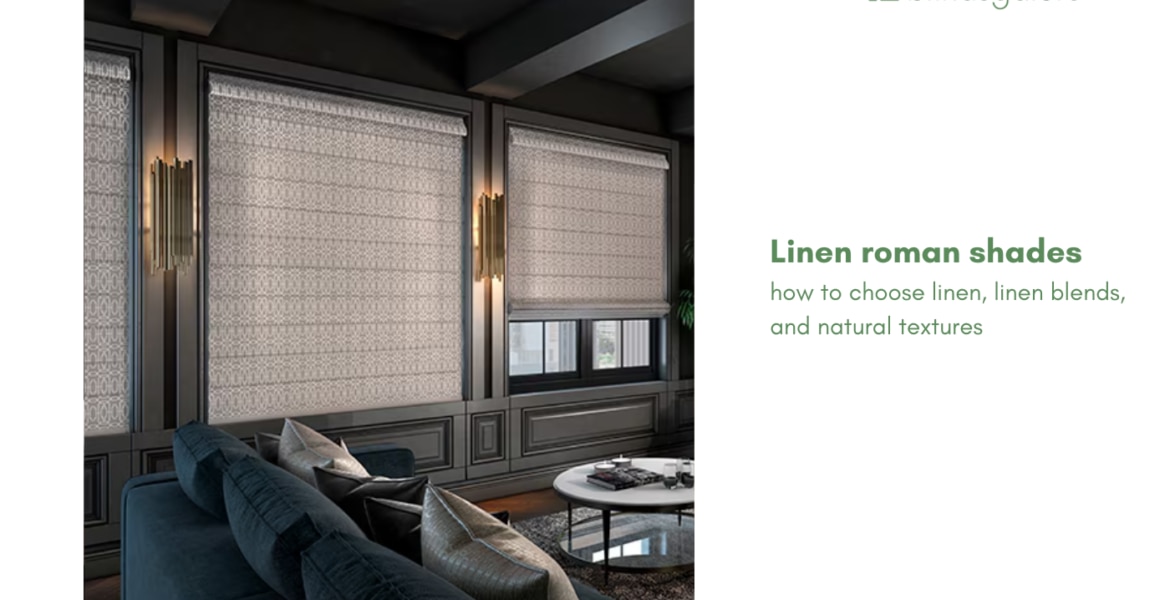
Linen roman shades give a window soft, natural texture and a gentle glow when the light comes through. Most linen-style roman shades, including ours, are linen blends or linen-look fabrics rather than 100% linen, so it pays to check the fiber content. Blends keep the relaxed, organic look of linen while holding their folds more neatly, and liners let you choose anything from filtered light to blackout.
Linen is one of the oldest and most prized natural fibers, spun from the stem of the flax plant. Linen has never really gone out of style, and today it anchors the organic, transitional, and coastal looks that design-forward renovators keep coming back to. Here’s how to choose the right linen roman shade, fold, and liner, and when a woven natural shade is the better fit.
Why is linen the go-to natural fabric for roman shades?
Linen earns its place at the window for a few reasons. According to the George Washington University Museum and The Textile Museum, linen is valued for:
- Strength. The fiber is strong both dry and wet.
- Moisture wicking. Linen absorbs and wicks moisture.
- Appearance. Its natural slubs and irregular weave read as elegant rather than flat.
On a roman shade, that texture does the design work. Light catches the weave, the fabric looks relaxed rather than stiff, and the shade suits casual, organic interiors with earthy tones.
The trade-off is structure. The same museum notes that linen fiber isn’t elastic, so pure linen tends to crease and can hang unevenly. Blending linen with cotton, viscose, or polyester adds drape and stability, so the shade folds evenly every time you raise it.
Linen, linen blend, or linen look: what are you actually buying?
“Linen” in a fabric or color name often describes the look, not the fiber. Many fabrics with linen in the name contain no linen at all, so check the fiber content on the product page before you order. Here’s how a few of our roman shade fabrics compare.
| Fabric (collection) | Fiber content | What it means |
|---|---|---|
| Twill Linen, most colors (Luxera) | 52% cotton, 48% linen | The highest linen content in our roman shade fabrics |
| Brushed Linen in Black (Luxera) | 70% viscose, 30% linen | Some real linen; the other Brushed Linen colors are cotton and polyester |
| Spectra (Luxera) | 85% cotton, 15% linen | Mostly cotton, with a small share of linen |
| A few embroidered fabrics (BG Boutique) | 4% to 30% linen in blends | Mostly polyester or viscose, with some linen |
| Linen Texture (Designer) | 100% polyester | A linen look, with no linen fiber |
| Vintage Linen (Designer) | 70% rayon, 30% polyester | A linen look, with no linen fiber |
None of these is better by default. A blend with real linen gives the most natural slub, while a linen-look polyester or rayon gives a similar appearance with a more uniform weave and easy care. The point is to know which one you’re choosing.
Which roman shade collection fits a linen look?
Every collection below can deliver a linen-style window. Here’s how they differ.
- Blindsgalore Luxera roman shades. Select fabrics, such as Twill Linen, include real linen in the blend. Also offers flat, knife pleat, slat, and hobbled folds.
- Blindsgalore Designer roman shades: Solids. Linen-look textures like Linen Texture and Vintage Linen, plus solids from faux silk to tailored weaves.
- Blindsgalore Designer roman shades: Patterns. Stripes and prints, including 100% cotton options, for a relaxed, natural feel with pattern.
- Boutique embroidered roman shades. Handmade in an American workroom, with embroidered fabrics, some of which blend in a small share of linen, for a statement window.
- Blindsgalore Essential magnetic roman shades. Our most affordable roman-style shade, with a wrinkle-resistant light-filtering fabric and a cord-free magnetic lift, which also suits French doors.
Linen vs. cotton vs. designer fabric: what’s the difference?
Linen and cotton are both plant fibers, but they look and behave differently at the window.
| Linen and linen blends | Cotton and cotton blends | Designer polyester and blends | |
|---|---|---|---|
| Look | Visible slub and irregular texture | Smooth, soft, even surface | Wide range, from linen-look to faux silk |
| Feel | Crisp, relaxed, organic | Soft and matte | Consistent and uniform |
| Folds | Relaxed; blends fold more neatly | Soft folds | Holds crisp, structured folds |
| Best for | Organic, coastal, transitional rooms | Casual and traditional rooms | Prints, bold color, formal rooms |
According to the GWU Textile Museum, cotton is soft, absorbent, and strong when wet, while polyester can be heat-set to hold permanent pleats or folds, which is why it’s so often blended with natural fibers. Our Designer Patterns collection includes 100% cotton stripes, and our Designer Solids cover everything from linen-look textures to faux silk.
Are linen roman shades in style?
Yes. Natural textures remain a staple in organic, transitional, and coastal interiors, and linen is one of the easiest ways to bring that texture to a window without adding pattern. Linen-blend roman shades also pair naturally with drapery, wood tones, and woven accents. For the bigger picture on fabrics, folds, and lifts, see our roman shades buying guide.
Which fold style suits a linen roman shade?
The fold changes how much of the linen texture you see. Fold names vary a little by collection, so here’s what each style looks like.
| Fold | What it looks like | Why choose it for linen |
|---|---|---|
| Flat | Smooth fabric face with no folds when lowered | Shows off linen texture and patterns uninterrupted |
| Plain | Structured pleats every 6 inches | A tailored, contemporary look that stacks efficiently |
| Knife pleat or slat | Crisp defined folds or raised horizontal bands | Adds architectural detail to a simple linen blend |
| Hobbled (soft) | Cascading folds that stay visible when lowered | Softens the window and suits traditional rooms |
| Relaxed | A gentle curve, or “smile,” at the bottom | Leans into linen’s casual, lived-in character |
A good rule of thumb: choose flat to highlight the fabric, hobbled or relaxed to soften the room, and plain or knife pleat for a crisp, modern line. Our post introducing the Classic and Luxera roman shade collections shows several of these folds in real rooms.
How much light do linen roman shades let in?
Light control is a choice you make at order time with the liner, not a fixed property of the fabric.
- Unlined. The most light comes through, and the weave glows. Best for living rooms and kitchens where privacy isn’t a concern.
- Light-filtering liner. Softens daylight and adds daytime privacy. Premium liners also give the shade more body.
- Blackout liner. Blocks light passing through the fabric. On an inside mount, a halo of light still shows around the edges, so choose an outside mount that overlaps the frame for the darkest room.
Liners also protect the face fabric. Our Boutique premium liner, for example, is stitched to the back of the shade to shield the fabric from the sun. That matters for natural fibers, because fading isn’t covered by our warranty. Weighing the darker options? Our guide to blackout vs. room-darkening shades breaks down the difference.
What about jute and grasscloth textures?
Jute and grass textures belong to a different product: woven wood shades. Instead of a fabric panel, a woven shade is made from natural stalks and fibers woven together, which gives a more textured, rustic look than linen.
- Jute. A plant fiber that appears in blended weaves with bamboo and grasses in our woven wood shades.
- Grasscloth look. Our grass and reed weaves deliver the fine, grasscloth-style texture people search for.
Choose linen roman shades when you want soft, tailored fabric. Choose woven wood shades when you want raw natural texture. Our post on why woven wood shades are a designer favorite covers the woven side in more depth.
How do you care for linen roman shades?
Linen roman shades need simple, regular care.
- Dust weekly with a microfiber cloth or a vacuum brush attachment, working top to bottom.
- Spot clean stains with mild soap and water, blotting rather than rubbing.
- Never submerge a roman shade in water. Soaking damages the fabric, the liner, and the lift.
- Some fabric roman shades can be removed and dry cleaned. Check the care instructions for your fabric first.
Frequently asked questions
Both, depending on the liner. Unlined and light-filtering linen roman shades let soft light through, and a blackout liner blocks light passing through the fabric. Light control is a choice at order time, not a fixed property of the linen.
No. Linen blends and linen-look fabrics hold up well with regular dusting and spot cleaning, and they aren’t more delicate than other designer roman shade fabrics. A liner adds extra protection from the sun.
Linen has a visible slub and a crisp, organic texture, while cotton has a smoother, softer surface. Many shades blend the two, pairing linen’s texture with cotton’s softness.
Not usually. Most linen-style roman shades are either blends that include some linen or linen-look fabrics made from cotton, polyester, or rayon. A fabric with linen in its name may contain no linen, so check the fiber content on the product page.
Linen roman shades are a woven fabric on a folding lift system. Jute and grass shades are woven from natural fibers and stalks, which gives a more textured, rustic look.
We don’t currently offer a no-drill roman shade, because the weight of the folds needs a bracket-mounted headrail. Our post on hanging roman shades without drilling explains the options and their limits.