
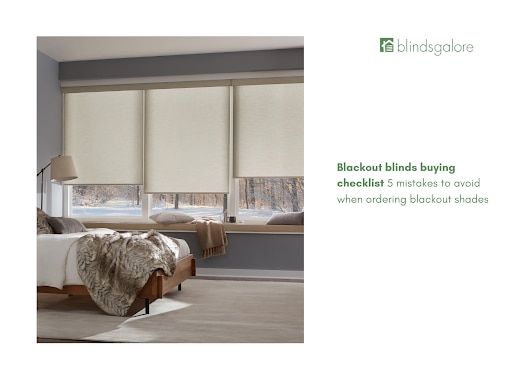
The most common mistakes with blackout blinds have little to do with the fabric. People order a true blackout shade and still wake up to a bright room, because light slips around the edges, the mount was wrong, or the shade was only room-darkening to begin with. Get the fit, the mount, and the lift right, and a blackout shade can make a room dark enough to sleep at noon.
The timing matters this time of year. Clocks fall back on November 1, 2026, so the sun rises an hour earlier by the clock, and early-waking toddlers and light sleepers notice it first. Here are the five mistakes we see most often, plus a quick checklist before you order.
What are the most common mistakes when ordering blackout shades?
Our in-house experts hear about the same five problems again and again:
- Assuming room-darkening and blackout are the same.
- Skipping side channels or an outside mount, which leaves light gaps.
- Choosing a corded lift for a nursery or kid’s room.
- Assuming every blackout shade is built the same way.
- Ordering the same light control for every room.
Each one is easy to avoid once you know what to look for.
Mistake 1: Assuming room-darkening and blackout are the same
Room-darkening and blackout sound interchangeable, but they’re different tiers of light control.
| Tier | What it does | Best for |
|---|---|---|
| Light-filtering | Softens daylight; the room stays bright | Living rooms, kitchens, offices |
| Room-darkening | Blocks most light; the room is dim, not dark | Guest rooms, living rooms with TV glare |
| Blackout | Blocks light through the fabric almost entirely | Bedrooms, nurseries, media rooms, day sleepers |
If you need a room dark for sleep, choose blackout shades, not room-darkening. Our guide to blackout vs. room-darkening shades goes deeper on the difference.
Mistake 2: Skipping side channels or an outside mount
Blackout fabric stops light passing through the shade, but not light going around it. An inside-mount shade sits within the window frame, and the fabric is made slightly narrower than the opening so it can move freely. That leaves a thin glow along each side, often called the halo effect.
Three fixes close the gap:
- Mount outside the frame. An outside mount covers the window trim and blocks the edges. Our measuring guide recommends adding width beyond the frame on both sides to cut light gaps.
- Add side channels where available. On select styles, such as the Bali blackout cellular shades, metal side channels mount inside the frame and seal the gap between the shade and the window. Side channels are only offered on certain fabrics and lifts, so check the product’s options before you order.
- Layer with drapery. Custom drapery with a blackout or thermal liner, hung over an inside-mount shade, covers the edges.
Mistake 3: Choosing a corded lift for a nursery or kid’s room
Any room a child uses should have a cordless or motorized lift. The U.S. Consumer Product Safety Commission reports that about nine children under age 5 die every year from strangulation on window covering cords, and it calls cordless window coverings the safest option.
The industry has moved the same way. The revised ANSI/WCMA safety standard, effective June 1, 2024, eliminated free-hanging cords on custom window coverings in the U.S., and Canada has limited cords since 2021. Some styles still offer a continuous cord loop with a tensioner, so don’t assume every blackout shade is cord-free by default.
For kids’ rooms, choose:
- A cordless lift for windows you can reach from the floor.
- A motorized lift for nurseries and tall windows, so you can lower the shade without walking in on a sleeping baby.
Mistake 4: Assuming every blackout shade is built the same way
Blackout is built differently depending on the style, and the construction affects how dark the room gets and how the shade looks from outside.
- Blackout roller shades use a solid blackout fabric. Because the fabric is narrower than the roller hardware, light can still show at the edges.
- Cellular shades block light with a lining inside the honeycomb cells. Our Classic cordless blackout cellular shades use an integrated blackout layer that blocks 99% of sun and glare.
- Roman shades and woven wood shades rely on a blackout liner sewn to the back of the shade. Some woven styles use a foam-backed blackout liner.
- Street-side color varies. Many blackout fabrics and liners have a white or off-white street side, which keeps the outside of the house uniform.
Before you order, confirm that the exact product offers a blackout option in the fabric you like. Not every color, collection, or lift comes in blackout.
Mistake 5: Ordering the same light control for every room
Blackout blinds in every room feel like a safe bet, but they can leave daytime rooms gloomy. Match the light control to how each room gets used.
| Room | Recommended light control |
|---|---|
| Bedroom | Blackout, with an outside mount or side channels for the darkest result |
| Nursery | Cordless or motorized blackout cellular shade |
| Media room | Blackout, layered with drapery for full darkness |
| Living room | Light-filtering or room-darkening |
| Home office | Light-filtering or solar shades to cut glare |
| Kitchen | Light-filtering |
Can’t decide for a bedroom you also use during the day? Our Day/Night cordless cellular shade combines light-filtering fabric on top and blackout fabric on the bottom in a single shade. For more room-by-room picks, see our guide to the best blackout shades for every room.
What blackout shade should you pick for a baby’s room?
A cordless or motorized blackout cellular shade is the best pick for most nurseries. The blackout lining handles daytime naps, the cordless or motorized lift keeps cords out of reach, and the honeycomb cells add insulation (our guide to energy-efficient window treatments explains why).
Darkness matters for sleep at any age. According to the National Institute of General Medical Sciences, light and dark have the biggest influence on the body’s circadian rhythms.
For the darkest nursery:
- Choose blackout, not room-darkening.
- Mount outside the frame, or choose a style with side channels.
- Pick a cordless or motorized lift.
- Move the crib away from the window.
Our guide to roller shades for kids’ rooms covers more child-friendly options.
Blackout shade checklist: what to confirm before you order
Run through this list before you order blackout blinds or shades:
- The light-control tier says blackout, not room-darkening.
- You’ve chosen an outside mount, side channels, or a drapery layer for the edges.
- The lift is cordless or motorized in any room a child uses.
- The exact fabric and color you like come in blackout.
- The street-side color works for your home and any HOA rules.
- You’ve measured with a steel tape measure, using our measuring guide.
- You’ve ordered samples and held them up to your window in daylight.
Frequently asked questions
Blackout fabric and liners block nearly all light passing through the shade, but light can still leak around the edges. An outside mount, side channels, or a drapery layer closes those gaps.
A cordless or motorized blackout cellular shade, which combines strong light blocking with a lift system that has no accessible cords.
People use the terms interchangeably. Strictly speaking, blinds have slats and shades are made of fabric, and most true blackout products are shades, because fabric and liners seal out light better than slats.
An outside mount is usually darker, because the shade overlaps the frame and blocks light at the edges. Choose an inside mount for a cleaner look, and add side channels or drapery if you need full darkness.
Yes. Many roman and woven wood shades offer a blackout liner on the back of the shade, which keeps the fabric or natural texture visible from inside the room.
Some custom styles still offer a continuous cord loop with a tensioner. For any room a child uses, the Consumer Product Safety Commission recommends cordless window coverings.