
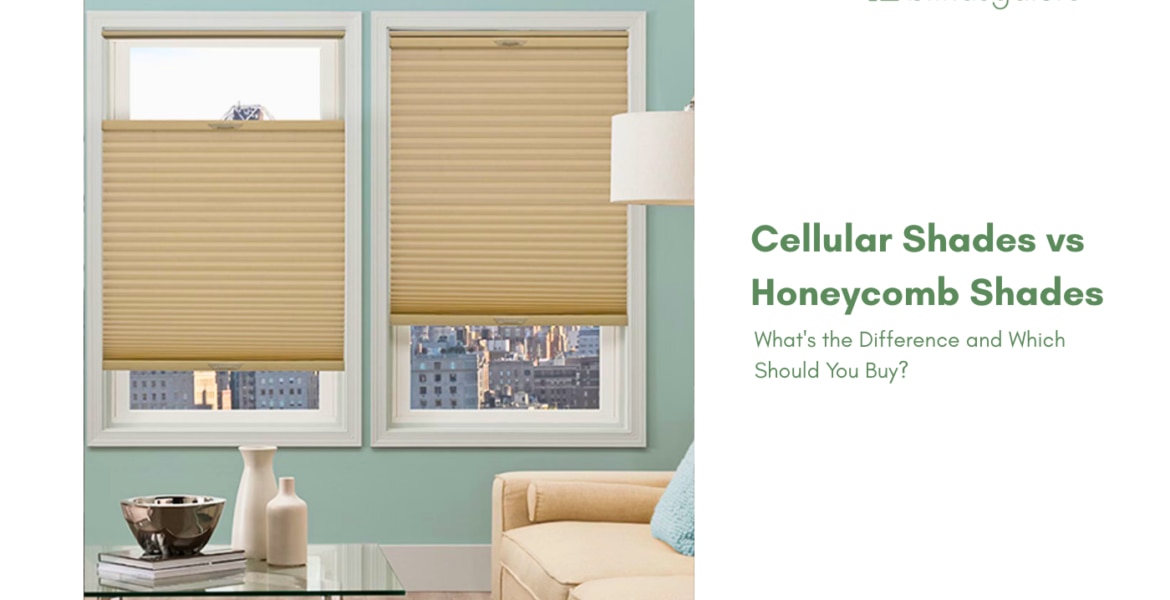
Cellular shades and honeycomb shades are the same product. There is no difference in construction, performance, or price between a shade labeled one way and a shade labeled the other. Two words, one window covering.
That settles the search. What it does not settle is the decision underneath it, because the specifications that genuinely change how a cellular shade performs are cell count, cell size, fabric opacity, and lift system. Those four choices produce measurably different outcomes in the same window. The naming does not.
Are cellular shades and honeycomb shades the same thing?
Yes, completely. The two terms describe the same construction from two different angles.
- Cellular describes how the shade is built. Layers of fabric are bonded into rows of sealed cells that trap air between the room and the glass.
- Honeycomb describes what that construction looks like. Viewed from the side, the cells form the hexagonal pattern of a beehive.
Manufacturers and spec sheets tend to say cellular. Retail listings and everyday conversation drifted toward honeycomb. Both have been in parallel use since the construction was commercialized in the mid-1980s, and neither term signals a quality tier, a cell count, or a manufacturer.
The practical consequence is a shopping one. Searching only “honeycomb shades” on a site that catalogs everything as cellular will hide inventory from you, and the reverse is equally true. Blindsgalore files the whole category under cellular and honeycomb shades for exactly this reason.
One clarification worth making, because it is the confusion that actually costs money: pleated shades are not the same thing. A pleated shade is a single folded layer of fabric with no sealed cells and no trapped air. From the front, the two look nearly identical. From the side, the difference is obvious, and it is the entire performance story.
What actually differs between cellular shades?
Four variables, and they matter in roughly this order.
Cell count
Single-cell shades have one row of air pockets. Double-cell shades stack two rows, and cell-in-cell designs nest one inside another. More cells means more trapped air and more insulation, with a slightly thicker stack at the top of the window when raised.
Cell size
Cell size is measured across the face of the cell, commonly from about 3/8 inch to 3/4 inch. Smaller cells suit shallow window frames and narrow windows, where a large cell looks out of proportion. Larger cells cover a tall window with fewer pleats and read cleaner on big glass.
Fabric opacity
Opacity determines light and privacy, and it is independent of cell count.
- Light filtering diffuses daylight into an even glow while blocking sightlines. The Select light filtering cellular shades and Classic cordless light filtering cellular shades both sit here.
- Blackout adds an opaque backing that blocks close to all light through the fabric itself. The Harmony blackout cellular shades are the bedroom and media room specification.
Lift system
Cordless is the default on custom cellular shades and the right baseline in any home with children. For rooms where glare rather than temperature is the complaint, the Hello Sunshine, Goodbye Glare guide covers the wider set of light-control options. Top-down/bottom-up is the option most people underuse: the shade lowers from the top for daylight while staying closed at the bottom for privacy. A cordless top-down/bottom-up cellular shade solves street-facing ground-floor windows better than any other configuration, and the full top-down/bottom-up range covers the same idea across other shade types.
How much energy do cellular shades actually save?
Cellular shades separate from every other soft window covering here, and most published numbers on the subject are manufacturer self-reporting rather than measurement. The independent data is better than the marketing.
Pacific Northwest National Laboratory ran cellular shades in its matched-pair Lab Homes, a controlled side-by-side test of two identical houses. The PNNL Lab Homes evaluation measured a 17.6% reduction in HVAC energy use during the heating experimental period against the baseline home with no window attachments. During the cooling period, the cellular shades reduced HVAC energy use by an estimated 10.4% compared with typical vinyl horizontal blinds.
Oak Ridge National Laboratory ran a parallel test in a two-story residential home in the Southeast and demonstrated that honeycomb-structure shades outperform generic venetian blinds on winter energy savings. The Department of Energy reports those ORNL studies found cellular shades can reduce heating energy needs by almost 25%.
Two things are worth reading into those figures.
- Both carry error margins, and both are climate-dependent. Heating-season savings are larger in heating-dominated climates, which is where the PNNL homes sit.
- The cooling comparison is against vinyl horizontal blinds rather than bare glass, which is the more honest benchmark, since most homes are replacing an existing covering rather than covering an uncovered window.
The policy signal matters as much as the numbers. In 2023, Minnesota became the first state to add certified cellular window shades to its Technical Reference Manual, the document states use to plan and evaluate energy-efficiency programs. A window covering entering a state TRM alongside insulation and HVAC measures is a meaningful shift in how the category is treated.
How do you compare cellular shades objectively?
Ask for the rating rather than the adjective. Every brand calls its shades energy efficient. Only some have been tested by a third party.
The Attachments Energy Rating Council is an independent nonprofit established with support from the Department of Energy’s Building Technologies Office, Lawrence Berkeley National Laboratory, and the window covering industry association. AERC certifies window attachments and publishes a label carrying four measured values plus climate ratings.
| Metric | What it tells you | Better direction |
|---|---|---|
| U-factor | Rate of heat flow through the assembly | Lower |
| SHGC | Share of solar heat that gets through | Lower in hot climates |
| VT | Visible light transmitted | Depends on the room |
| AL | Air leakage | Lower |
The DOE maintains its own overview of the AERC program. Cellular shades were among the first interior window coverings rated under it. Using the AERC certified product search is the only way to compare two shades on tested numbers rather than on claims, and it is a reasonable question to ask any retailer.
Which cellular shade specification fits which room?
Match the four variables to the room’s actual job.
- Bedrooms and nurseries: double-cell blackout, cordless. Darkness and thermal comfort in one specification.
- Living and dining rooms: single- or double-cell light filtering in a larger cell size. Even daylight, no glare.
- Street-facing ground-floor rooms: top-down/bottom-up light filtering. Daylight above, privacy below.
- Home offices: light filtering to kill screen glare without darkening the room into a cave.
- Drafty rooms and older single-pane windows: highest cell count available. Insulation is the entire point here, and the guide on how long custom blinds last covers what that investment returns over time.
- Shallow window frames: smaller cell size, and check the minimum mount depth before ordering.
For a wider view of how these fit alongside other treatments, the Ultimate Guide to Window Treatments covers the full category, and the energy-efficient collection filters for thermal performance across shade types.
Where are cellular shades the wrong choice?
Worth saying plainly, because the category gets recommended universally and should not be.
Kitchens and bathrooms are the weak spot. Cells are open at the sides, so airborne grease, steam, and dust settle inside them and cannot be wiped out the way a flat surface can. A faux wood blind or a roller shade handles those rooms better and cleans in seconds.
Cellular shades also should never be submerged in water. Not the light-filtering fabrics, not the blackout ones. Soaking collapses the cell structure, and the shade does not recover. The guide on cleaning honeycomb blinds without removing them covers the correct method, which is vacuuming with a brush attachment and spot cleaning only.
Very wide openings are the third limit. Past a certain width, the stack weight and deflection make a panel track or vertical treatment the better engineering answer.
How should you choose your cellular shades?
Stop weighing the two names against each other, because there is nothing there. Spend that attention on cell count and opacity instead, which are the two decisions that will still be affecting your comfort and your utility bill in ten years. If a room is cold, buy cells. If a room needs to be dark, buy blackout. If a room needs both, buy both, and expect the stack to sit slightly deeper at the top of the window.
Every Blindsgalore cellular shade is made to order to your exact window dimensions, and over 99% of our customers measure and install their own. Order up to 10 free samples to hold light-filtering and blackout fabrics against your own glass at the hour of day that actually matters to you, or call the in-house team at (877) 702-5463 to talk through a specific room. Every Blindsgalore product carries a 3-year limited warranty with the option to extend to five years, and shipping is free across the contiguous United States and Canada.
Browse the cellular and honeycomb collection or order free samples to compare fabrics in your own light.
Frequently asked questions
No. Cellular and honeycomb describe the same product. Cellular refers to the sealed cell construction; honeycomb refers to the hexagonal shape those cells form when viewed from the side. Neither term indicates quality or cell count.
In cold rooms, drafty rooms, and single-pane windows, yes. Double-cell shades trap more air and insulate better, at the cost of a slightly deeper stack when raised. In a temperate room where light control is the goal, single-cell is sufficient.
Independent testing supports the claim. PNNL’s Lab Homes study measured a 17.6% reduction in heating-season HVAC energy use versus uncovered windows, and DOE reports ORNL findings of heating energy reductions approaching 25%. Savings vary by climate and window type.
A pleated shade is a single folded layer of fabric with no sealed cells. A cellular shade bonds layers into air-trapping cells. Both look similar from the front, but only the cellular shade insulates.
Cellular shades are not the best choice there. Open cell ends collect steam, grease, and dust that cannot be cleaned out. Faux wood blinds or roller shades are more practical in high-moisture, high-residue rooms.
Vacuum with a brush attachment on low suction and spot clean gently. Never submerge cellular shades in water, since soaking collapses the cell structure permanently and the shade will not recover its shape.