
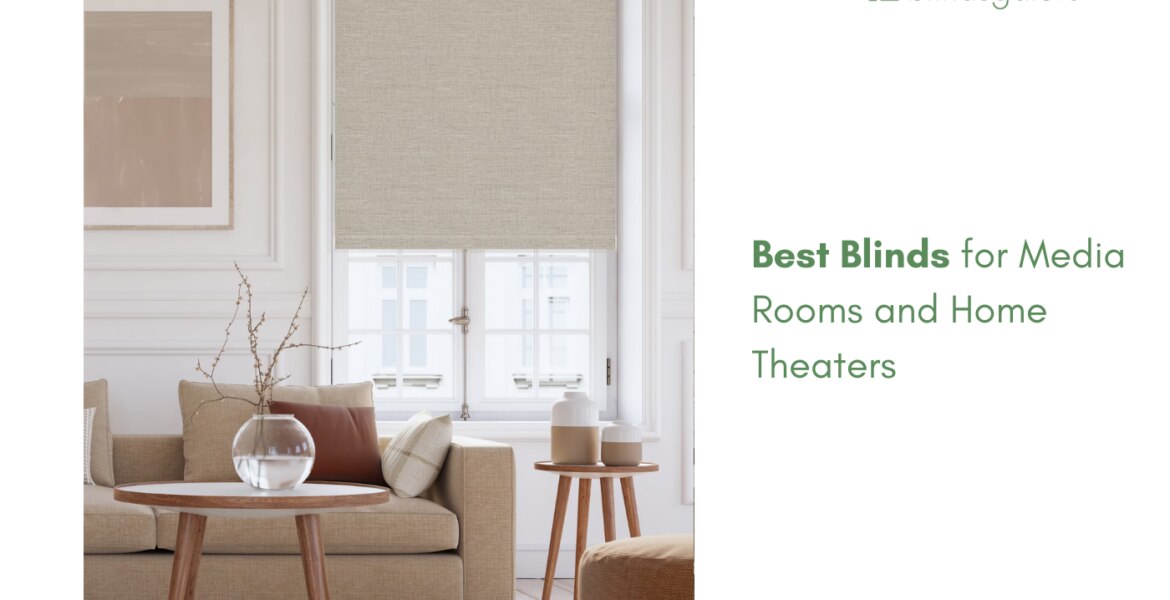
A home theater needs one thing from its windows: no light. Not dim, not mostly dark. None. Daylight washes out a projected image, and even a thin strip of it at the edge of the window reflects off the screen in a way the eye catches immediately.
Blackout fabric solves most of that. The rest comes down to where the shade meets the window, and that part is where most media room setups fall short.
What does full light block actually require?
Four leak paths, and blackout fabric only closes one of them.
Through the fabric
Blackout fabric carries an opaque backing that stops light passing through the panel itself. The Classic Blackout Roller Shades use polyester with an acrylic foam backing for exactly this. Fabric is the solved part of the problem.
Down the sides
The main leak. An inside-mount shade is deliberately built narrower than the window opening so it can roll without scraping the frame. On Blindsgalore’s motorized roller shades, that means a light gap of about 5/8 inch on each side without a valance and 11/16 inch with a cassette. In a dark theater, that reads as two bright vertical lines.
Over the top
Light enters above the roller, and an exposed roller also shows a white roll of fabric at the top of the window. A cassette valance covers the roll and closes the view of it. Choose the cassette in black for a theater, since a white or light cassette reflects screen light into the room.
Under the bottom
A gap between the hem bar and the sill. A weighted hem helps the fabric hang flat, and an outside mount that extends below the sill closes the gap completely.
What are the best blinds to fully block light in a home theater?
The best blackout blinds for a home theater are blackout roller shades, installed to seal the edges. Rollers suit a theater better than cellular or roman shades because the single flat panel sits close to the glass and has no folds or pleats to catch and reflect light.
Two ways to seal the sides:
- Side channels. Tracks on each side of the window that the fabric runs inside, closing the edge gaps completely. Blindsgalore offers side channels on some styles, and the Classic blackout rollers linked here do not list them, so call the in-house team to confirm availability on a specific product before ordering.
- Outside mount. The shade mounts on the wall above the window and extends past the frame. Overlap at least 2 inches on each side, and further for a darker result. Outside mount is the reliable route on any blackout roller and needs no extra hardware.
Four specification choices finish the job:
- Order a standard roll rather than a reverse roll, since a standard roll keeps the fabric close to the window where it blocks light best
- Add a cassette valance in black to cover the top and remove the white roll
- Choose a dark room-facing color, so the shade itself does not bounce projector light around the room
- Layer blackout custom drapery over the shade if the room must be completely dark, since drapery also dampens sound
For lower-cost light-blocking blinds, the Classic Vinyl Blackout Roller Shades use the same exposed-roll or cassette construction. The full blackout shades and roller shades collections cover every fabric and color, and the guide on how to choose roller shade fabric goes deeper on opacity.
Should a media room use motorized or manual shades?
Motorized, in most media rooms. The reasons are specific to how the room gets used.
- Nobody gets up mid-film. A remote closes every shade from the seat.
- Multiple windows move together. A multi-channel remote runs several shades on one channel, so a room of three windows closes in one press.
- Scenes are possible. The Smart Blinds hub connects shades to Alexa and Google Home, so the shades can close as part of a movie-night routine.
- No cords near the equipment, and no cords in reach of children.
The Classic Motorized Roller Shades come in blackout fabric with motorization included. A single-window media room that gets closed once and left that way works fine with a manual cordless lift, which keeps the cost down.
How should you order home theater blinds?
Decide the mount first. On a theater window, the mount decides whether the fabric can do its job. Then choose blackout fabric in a dark color, add a black cassette, and choose motorized if the room has more than one window.
Every Blindsgalore shade is made to your exact measurements, and over 99% of our customers measure and install their own. The measuring guide covers outside-mount overlap in detail. Every order carries a 3-year limited warranty with the option to extend to five years, and shipping is free across the contiguous United States and Canada.
Browse our full shades collection, or order up to 10 free samples to check fabric and color in the room before you buy.
Frequently Asked Questions
Blackout fabric blocks nearly all light through the panel, but a standard inside-mount blackout shade alone will not fully darken a room. Light still leaks around the edges. Side channels or an outside mount are needed to stop that edge-light leakage.
Seal the edges. Use side channels where available, or an outside mount overlapping the frame by at least 2 inches on each side. Add a cassette valance to cover the top and extend the shade below the sill to close the bottom gap.
A dark room-facing color, with a black cassette valance. Light colors and white rolls reflect screen and projector light into the room, which lowers picture contrast.
Roller shades. The flat panel sits close to the glass and has no folds to catch light, and blackout rollers pair easily with side channels, cassettes, and outside mounts. Cellular shades suit bedrooms where insulation matters more.
Outside-mounted, unless the product offers side channels. An inside mount is built narrower than the window so it can operate, which leaves a visible light gap on each side.
Yes. Blackout drapery over a blackout roller shade gives the darkest result and also absorbs sound, which helps room acoustics.