
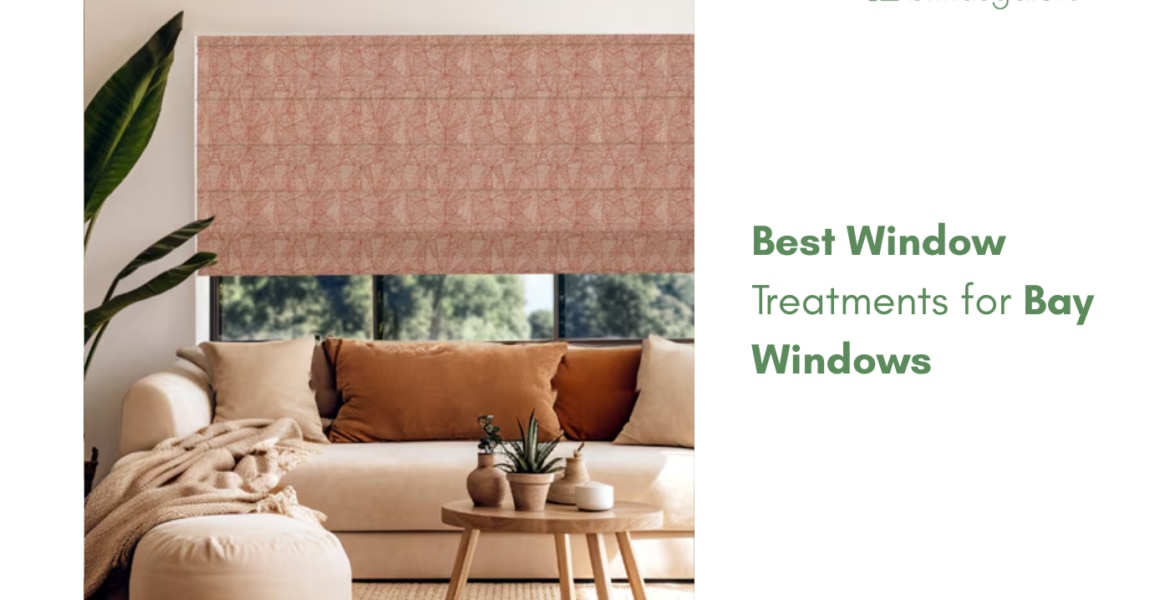
Choosing a style is the easy part of a bay window. The hard part is the corners.
A bay window is three or more windows set at angles to each other. Each one needs its own blind or shade, and every shade takes up space inside the frame. Where two panels meet at an angle, the shades can bump into each other, leave a gap of daylight, or stop each other from raising. Measure correctly, and the treatments meet neatly. Measure the way you would a flat window, and they collide.
How are bay windows different to measure and fit?
A standard window is one opening with one treatment. A bay window is a set of openings that share corners, and the corners are where the fitting problems start.
The three shapes
- Bay window: usually three panels, a large center window with two side windows angled out from the wall.
- Box bay: the side panels sit at close to 90 degrees to the center.
- Bow window: four or more narrower panels in a gentler curve, which means more corners to manage.
The corner problem
The shade in each panel has a headrail, and that headrail has depth, measured front to back. In a bay corner, two headrails approach each other at an angle. The deeper the headrails, the sooner they meet, and the larger the gap or collision.
The mullion check
Look at what separates the windows. If there is a thick section of wall or trim between each window, the shades will not reach each other, and each window can be measured like a regular window. If the glass meets at a narrow post, the corners need the measuring method below.
How do you measure blinds for a bay window?
Choose the product before you measure. Sizing custom bay window blinds depends on that product’s headrail depth, and it varies more than most people expect.
| Product | Headrail depth |
|---|---|
| Classic cordless light filtering cellular shades | 1 1/8″ |
| Bali tailored roman shades | 2 1/4″ |
| Faux wood blinds | 2 1/4″ |
Then use a simple template to find where each shade will end:
- Look up the headrail depth on the product page, under specifications.
- Cut two strips of cardboard to that depth. The strips stand in for the headrails.
- Place one strip against each side of a corner, both pressed to the glass, with their front edges touching.
- Mark the frame where each strip ends. The marks show where the shades will meet.
- Repeat for every corner.
- Measure each window’s width between its marks, and measure height in three places, recording the longest.
- Measure every panel separately to the nearest 1/8 inch with a steel tape. Bay panels that look identical are often not.
Record each window on its own line, labeled left, center, and right, so the order cannot mix up the sizes. The standard steps for inside and outside mounts are in the measuring guide. The bay-specific step is the template.
What is the best treatment for uniform bay window coverage?
Cellular shades, for most bay windows. Roman shades, when the frame allows.
Cellular shades
Cellular shades have the slimmest headrail of the common options, 1 1/8 inches on the Classic cordless cellular shade, about half the depth of a roman or faux wood blind. A slim headrail reaches the corner later, so the gap where two shades meet stays small. Cellular shades also insulate, which matters in a bay, since three windows is a lot of glass in one wall. The full cellular shade range comes in matching fabrics, so every panel reads as one treatment.
Roman shades
Roman shades give a bay the softest, most finished look, and a matching fabric across all three panels makes the bay read as one design feature. The trade-off is headrail depth: 2 1/4 inches on the Bali tailored roman, which makes corner gaps larger when the glass meets at a narrow post. Roman shades suit bay windows with wide mullions, or bays where the shades mount outside the frame. The full roman shade collection covers fold styles and fabrics.
Whichever you choose, order every panel in the same fabric, color, and lift system, at the same time. Separate orders can show slight dye-lot differences, and those differences show when three shades sit side by side.
What is the best option for controlling each panel separately?
Many bay windows need different settings on different panels: the center open for the view, the sides closed toward the neighbors. Any bay treatment ordered as separate shades already allows that. Three products make it work better.
- Cordless top-down/bottom-up cellular shades lower from the top and raise from the bottom. Street-facing side panels can stay covered at eye level while light comes in above.
- Faux wood blinds tilt slat by slat, so each panel can angle light differently without raising the blind. The 2 1/4 inch headrail needs wide mullions or an outside mount in a bay.
- Motorized shades can run each panel on its own or all three together from one remote, which helps when the bay sits behind a window seat or furniture that makes the shades hard to reach.
How do you mount blinds in a bay window corner?
With standard brackets, sized correctly. The corner is handled by measuring, not by special hardware.
When each shade is sized to end at the template mark, its standard brackets mount inside that panel’s frame, and the headrails meet at the corner without touching. None of the Blindsgalore products checked for this guide list a special corner bracket. If a bay has unusual angles or very narrow mullions, call the in-house team before ordering to confirm the fit.
Three mounting decisions matter more than hardware:
- Inside mount gives the cleanest look but leaves small light gaps at the corners and sides.
- Outside mount places each shade on the trim above its window, which overlaps the gaps and suits bays too shallow for an inside mount.
- Check window cranks and handles, which stick out into the depth the headrail needs. The shortest clear depth in the frame is the number that counts.
Can one treatment cover the whole bay?
A single shade cannot bend around a corner, so a true one-piece shade across all three panels is not possible. Two approaches give a continuous look:
- Matching shades in every panel, sized to meet at the corners, which reads as one treatment when lowered.
- One treatment across the mouth of the bay, mounted on the wall where the bay meets the room, if the bay is set back from the room. Shades have width limits (the Classic cordless cellular shade tops out at 84 inches), so a wide bay opening usually suits custom drapery instead.
How should you order bay window treatments?
Measure first: choose the product, cut the template to its headrail depth, and measure each panel between the marks. Then choose cellular for the smallest corner gaps, roman for the most finished look, and top-down/bottom-up or motorized if the panels need different settings. Order all panels together.
Every Blindsgalore treatment is made to your exact measurements, and over 99% of our customers measure and install their own. For a broader look at every product type, the Ultimate Guide to Window Treatments covers the full range, and the custom window blinds collection shows every blind made to measure. Every order carries a 3-year limited warranty with the option to extend to five years, and shipping is free across the contiguous United States and Canada.
Browse our full shades collection, or order up to 10 free samples to see the fabric in your bay’s light before you buy.
Frequently asked questions
Usually not without custom measuring per panel. Stock sizes rarely fit bay panels exactly, and at the corners each shade must be sized so its headrail stops short of the next one. Custom treatments are built to each panel’s exact measurements.
Either works. Most bays use one shade per panel in matching fabric, sized to meet at the corners. For a continuous look, a single treatment such as drapery can span the mouth of the bay where it meets the room.
Choose the product first, then cut two cardboard strips to its headrail depth. Hold them at each corner with front edges touching, mark where they end, and measure each panel between the marks. Measure every panel separately.
Cellular shades are the best blinds for bay windows and other angled windows, because their slim headrail leaves the smallest gap where two angled panels meet. Roman shades and faux wood blinds work on bays with wide mullions or with an outside mount.
Not for Blindsgalore products. Standard brackets work when each shade is sized to the template mark so the headrails meet without colliding. For unusual angles or very narrow mullions, confirm the fit with the in-house team first.
Inside mount looks cleanest where the frame has enough depth. Outside mount covers corner and side gaps better and suits shallow bay frames. Check the product’s minimum mount depth, and measure the shallowest point after allowing for cranks and handles.