
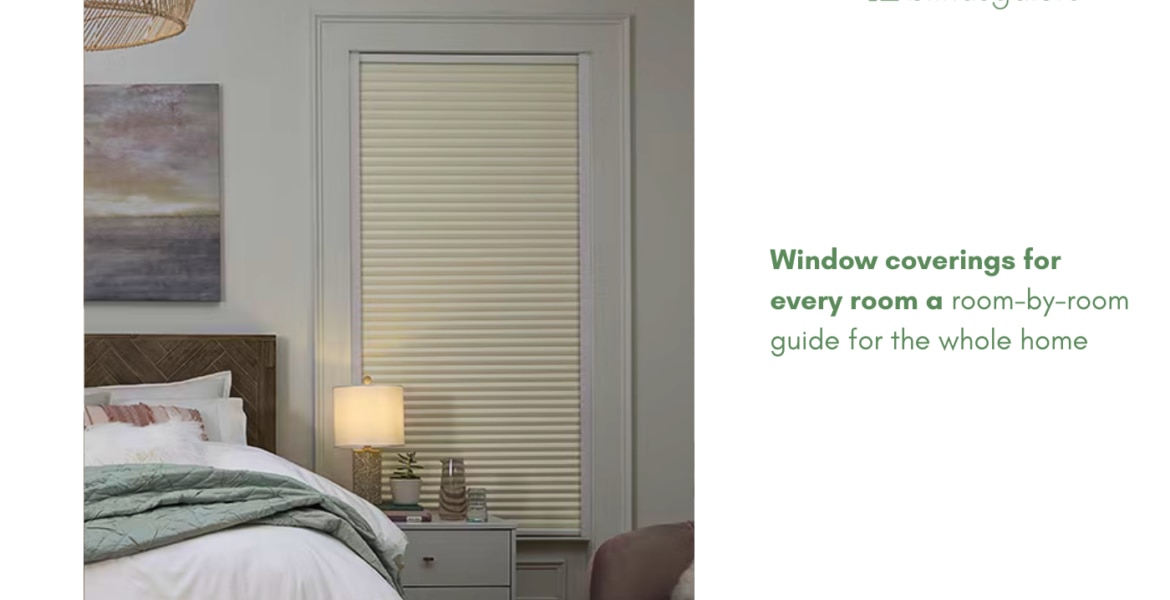
The best window coverings for each room match that room’s job. Kitchens need easy-clean, moisture-resistant materials like faux wood blinds or roller shades. Bedrooms need blackout fabric and a cordless lift. Bathrooms need moisture resistance and privacy, living rooms need soft light and style, and home offices need glare control without going dark.
Whether you’ve just moved in or you’re finally replacing the blinds that came with the house, choosing window coverings for every room one at a time beats choosing one product for every window. Here’s what works in each room, and why.
What window coverings work best in different rooms of a house?
Here’s a quick answer for each room, with a closer look at each one below.
| Room | Top pick | Also great | What matters most |
|---|---|---|---|
| Kitchen | Faux wood blinds | Roller shades, cellular shades | Moisture resistance and easy cleaning |
| Living room | Roman or woven wood shades | Light-filtering cellular or roller shades, drapery | Soft light, view, and style |
| Bedroom | Blackout cellular shades | Day/night cellular, blackout roller shades | Darkness, privacy, and a cordless lift |
| Bathroom | Privacy faux wood blinds | Top-down/bottom-up cellular shades | Moisture resistance and privacy |
| Dining room | Roman shades | Woven wood shades, drapery, shutters, sheer shades | Style, glare on the table, and layering |
| Home office | Solar shades | Light-filtering shades, dual shades | Glare control without blackout |
| Sliding doors | Vertical blinds | Panel track blinds, vertical cellular shades | Side-to-side operation |
How should you choose window coverings room by room?
Five questions narrow the choice in any room.
- Moisture. Will the window face steam, splashes, or humidity? Choose PVC faux wood or easy-clean fabrics.
- Light. Do you want soft daylight, glare control, or full darkness?
- Privacy. Do you need it during the day, at night, or both?
- Safety. Will children use the room? Choose a cordless or motorized lift.
- Reach. Is the window high, wide, or behind furniture? Motorization makes hard-to-reach windows easy.
What are modern window covering ideas for a kitchen?
Kitchens need window coverings that handle heat, steam, and splatters, and still look clean and current. Five modern ideas work well, and you can compare them all in our kitchen window treatments collection:
- White or wood-tone faux wood blinds. Solid PVC slats are the most moisture-resistant faux wood option, and they wipe clean in seconds.
- Cordless roller shades with a cassette valance. The cassette hides the roller for a sleek, built-in look, and the flat fabric is simple to keep clean.
- Solar shades over the sink. A low-openness solar shade cuts glare while you keep your view of the yard.
- Top-down/bottom-up shades. Cover the lower window from neighbors and let light in from the top.
- Cordless or motorized lifts above the sink. Hanging cords are awkward over a counter, and motorization means no leaning across the sink.
Mount kitchen shades inside the window frame where you can, which keeps them clear of counters and the sink. For more ideas by style and color, see our guide to choosing kitchen window treatments.
What window coverings work best in a living room?
Living rooms are where window coverings make a statement, and where you usually want light rather than darkness. Browse every option in our living room window treatments collection.
- Roman shades bring soft folds and tailored fabric, and their fabrics coordinate with our drapery collection.
- Woven wood shades add natural texture, with an optional liner when you want more privacy.
- Light-filtering cellular shades or roller shades diffuse daylight and add privacy without darkening the room.
- Dual shades switch between an open view and privacy as the day changes.
- Floor-length drapery layered over any shade adds height and warmth.
Our post on why woven wood shades are a designer favorite has styling ideas for living spaces.
What are the best window coverings for a bedroom?
Bedrooms need darkness for sleep, privacy at night, and a cordless lift. Our bedroom window treatments collection gathers the best options.
- Blackout cellular shades block nearly all light through the fabric and add insulation.
- The Day/Night cordless cellular shade combines light-filtering fabric on top and blackout fabric on the bottom in one shade.
- Blackout roller shades give the same darkness in a minimal profile.
- Blackout top-down/bottom-up shades keep the room dark at night and let morning light in from the top.
For the darkest room, mount outside the frame so the shade covers the edges. Cordless lifts matter in any room a child may use, and the U.S. Consumer Product Safety Commission recommends cordless window coverings wherever young children are present. Our guide to the best blackout shades for every room covers bedrooms and nurseries in depth.
What are the best window coverings for a bathroom?
Bathrooms combine steam, splashes, and a need for privacy at every hour. The U.S. Environmental Protection Agency recommends keeping indoor humidity below 60%, ideally between 30% and 50%, and a hot shower can push a bathroom well past that. So moisture resistance comes first. Our bathroom window treatments collection focuses on moisture-resistant styles.
- Privacy faux wood blinds use PVC slats that won’t warp, peel, or crack, with routeless slats for better privacy.
- Top-down/bottom-up cellular shades cover the window at eye level while daylight comes in from the top.
- Run the exhaust fan during and after showers to help any window covering last longer.
Never submerge blinds or shades in water to clean them. Dust them regularly and spot clean with a damp cloth.
What window coverings work best in a dining room?
Dining rooms are built for gathering, so window coverings can lean into style while softening glare on the table. Our dining room window treatments collection covers every look.
- Roman shades are the elegant, formal choice. Flat folds read modern, while hobbled folds read traditional.
- Woven wood shades add warm, organic texture for coastal, transitional, and casual dining rooms.
- Custom drapery frames the window and adds height for a formal room. Layer it over a roman or cellular shade to adjust light and privacy separately.
- Shutters bring a built-in, architectural look, and sheer shades diffuse harsh glare while keeping the view.
Near a table, easy care matters too. Faux wood shutters and woven woods dust and wipe easily, while fabric shades respond well to spot cleaning.
What window coverings reduce glare in a home office?
Home offices need light to work by, without glare across a monitor. See all our office window treatments for more options.
- Solar shades are the top pick. A 1% to 3% openness cuts screen glare and still keeps your view outside.
- Light-filtering cellular or roller shades soften daylight evenly across the room.
- Dual shades let you shift between more light and less as the sun moves.
- Motorized shades on a schedule lower themselves when afternoon sun hits the desk.
Keep in mind that solar shades don’t give privacy at night. Our guide to blinds for media rooms and home theaters covers glare control for screens in more depth.
Do you need different window coverings in every room?
Not necessarily, but matching the light control and lift to each room’s function usually works better than one blanket choice. A few ways to keep a whole home consistent:
- Choose one color family for the street-facing side. Many cellular shades have a white street-side backing, so the outside of the house looks uniform even if the inside colors vary.
- Coordinate fabrics. Our roman shade fabrics coordinate with our drapery, and our Envision roller fabrics coordinate with matching sliding panels.
- Use one product line in different opacities, such as light-filtering cellular shades in living areas and blackout cellular shades in bedrooms.
For sliding glass doors, choose a treatment that opens side to side, like vertical blinds. See all our patio and sliding door options. For a full overview of window covering types, start with our new homeowner’s guide.
Frequently asked questions
Faux wood blinds or cordless roller shades with a cassette valance are modern, practical choices for kitchens, since both resist moisture and wipe clean, which matters as much as style in a room full of steam and splatters.
Not necessarily. Matching the light control and lift type to each room’s function, such as sleep, cooking, or work, usually gives better results than one blanket choice throughout the home.
Blackout cellular shades with a cordless lift, which block nearly all light, give full privacy at night, and add insulation.
Privacy faux wood blinds, because their PVC slats resist moisture. Top-down/bottom-up cellular shades are a good alternative when you want privacy and daylight at the same time.
Solar shades, because they cut glare on screens while keeping your view. Choose a low openness, such as 1% to 3%, for the strongest glare control.
No. Faux wood blinds, cellular shades, and roller shades remain staples in today’s homes, and cordless and motorized lifts have made them cleaner looking than ever.
A whole-home plan is easier with a second set of eyes. Contact our in-house team of design experts for a whole-home consultation, or order up to 10 free samples to compare options room by room. Ready to compare everything at once? Shop all window treatments.
Love your view.