
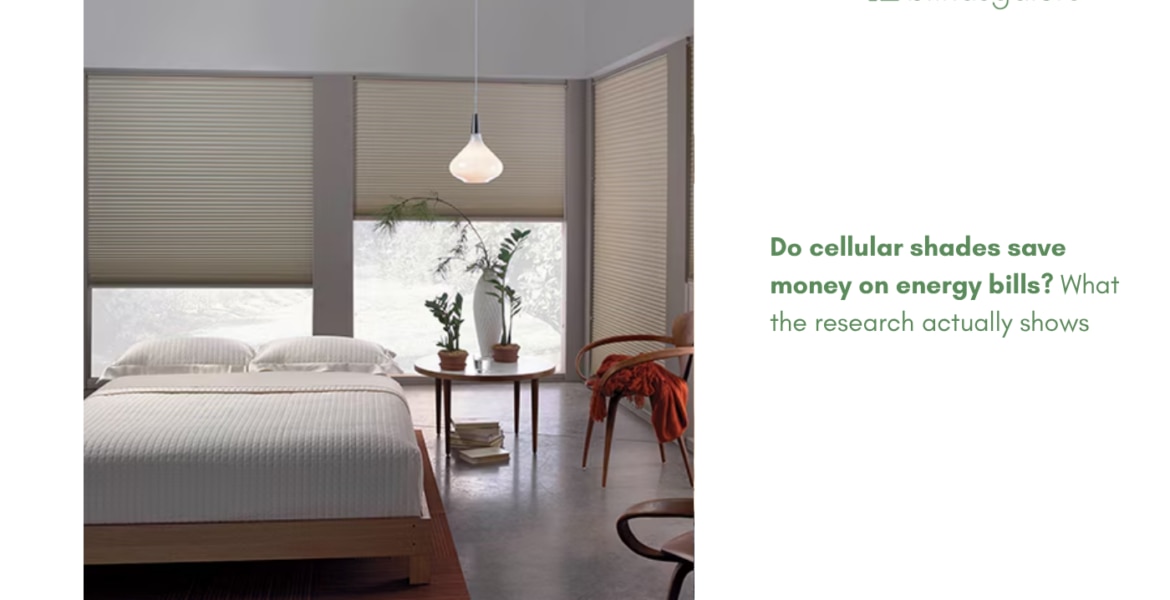
Yes, cellular shades can lower heating and cooling costs, and the best evidence comes from U.S. national laboratories rather than marketing claims. In a Department of Energy-backed test led by Oak Ridge National Laboratory, cellular shades saved up to 20% on heating energy and up to 15% on total heating and cooling energy compared with a home with no shades. Your own savings will depend on your climate, your windows, and how you use the shades.
The heating season is when windows show their weak spots. According to the Department of Energy, nearly 80% of U.S. homes have inefficient single- or double-pane windows, and replacing them is expensive. A well-fitted shade is one of the few upgrades that improves comfort the same week you install it.
How much can energy-saving window treatments lower your bills?
Every figure below comes from a named, published source. Each one was measured under specific conditions, so treat them as “up to” results, not a promise for every home.
| Source | What was measured | Result |
|---|---|---|
| South Carolina Energy Office | Windows’ share of home energy use | Windows account for 25% to 30% of residential heating and cooling energy use |
| U.S. Department of Energy fact sheet (Oak Ridge test home, 2019 to 2020) | Cellular shades vs. no shades | Up to 20% savings on heating energy and up to 15% on total heating and cooling energy |
| Same DOE fact sheet (Pacific Northwest National Laboratory research) | Window attachments vs. vinyl blinds | 15% of a household’s annual HVAC energy use |
| Oak Ridge National Laboratory (2023) | Cellular shades vs. venetian blinds, side-by-side rooms | Up to 24% heating energy savings |
A few things the numbers don’t mean:
- The results aren’t a guaranteed percentage off your utility bill. Your bill also covers water heating, appliances, and lighting.
- Each figure comes from specific test homes and climates. The DOE fact sheet notes the research focused on the heating season, and more study is needed on cooling.
- Savings depend on the shades being closed at the right times, which we cover below.
How do cellular shades reduce energy loss?
Cellular shades are made of pleated fabric folded into a honeycomb of cells. According to the DOE fact sheet, they trap air within each cell and between the shade and the glass, which:
- reduces nighttime heat loss through the window,
- cuts cold drafts near the window, and
- reduces unwanted solar heat gain in warm months.
That trapped air is why the DOE describes cellular shades as particularly beneficial in colder climates. Some cellular shades also have reflective, low-emissivity surfaces inside the cells, which the DOE says increases their insulating performance.
How cellular shades compare with other window treatments has been modeled too. According to the DOE fact sheet, simulations by Lawrence Berkeley National Laboratory show cellular shades achieving higher energy savings than all other types of shading devices. You can explore the lab’s window attachment research by climate. Our cellular shades come in single-cell and double-cell constructions, with light-filtering and blackout fabrics. For a primer on the terminology, see cellular vs. honeycomb shades.
Single-cell vs. double-cell: which saves more?
Double-cell shades insulate better than single-cell shades because they stack two layers of air pockets instead of one.
| Features | Single-cell | Double-cell |
|---|---|---|
| Construction | One layer of honeycomb pockets | Two layers of honeycomb pockets |
| Insulation | Solid | Better, with a higher R-value |
| Profile | Slimmer; fits shallow window frames | Slightly deeper stack |
| Best for | Moderate climates, smaller windows | Cold winters, hot summers, drafty or older windows |
Choose double-cell for bedrooms on exterior walls, large glass, and climates with big seasonal swings. Single-cell is a strong choice where a slim profile matters more than maximum insulation. Our Gallery light-filtering cellular shades come in a 1/2-inch double cell as well as two single-cell sizes, so you can compare both in one line.
Want a verified rating for a specific product? The Attachments Energy Rating Council (AERC) independently rates window attachments for heating and cooling performance by climate. The DOE recognizes AERC-certified cellular shades as an energy-saving measure, and Minnesota became the first state to add them to its Technical Reference Manual of energy-saving measures.
Do blackout liners and drapery help with winter heat loss?
Layers help, as long as each one closes off the window rather than just covering it.
- Blackout cellular shades. Our blackout cellular fabrics use a lining inside the cells to block light, and that lining adds another layer between the room and the glass. Our Classic cordless blackout cellular shades pair blackout with a child-safe cordless lift.
- Drapery with a thermal liner. Custom drapery with a thermal or blackout liner adds a fabric layer over the window. Panels that overlap at the center and extend past the frame leave fewer gaps for air to move.
- Woven wood shades with a liner. A light-filtering or blackout liner on our woven wood shades adds privacy and light control to natural materials. For maximum insulation, though, cellular construction remains the stronger choice.
What affects your real-world savings?
Two homes with identical shades can see very different results. Six factors make the difference.
- Climate. Lawrence Berkeley National Laboratory found results are climate-dependent. Window attachments save energy in cooling-dominated climates, while in colder regions, insulation plus balanced solar control saves the most.
- Your existing windows. The DOE fact sheet notes that nearly 80% of U.S. homes have inefficient single- or double-pane windows, which leave more room for a shade to help.
- Fit and mount. Gaps around the edges let air move past the shade. A custom shade sized to the opening, ideally mounted inside the frame with enough depth for a flush fit, seals best.
- How you use them. Savings depend on the shades being closed at the right times. LBNL’s research shows that how often people actually lower their shades has a large effect on performance.
- Your heating system. The DOE fact sheet reports different savings for homes heated by heat pumps and by gas furnaces.
- Automation. Motorized shades on a schedule close at sunset and open for winter sun without anyone remembering to do it. Our motorized blinds breakdown covers the cost side, and our guide on how to schedule motorized blinds shows how.
A simple routine gets most of the benefit. In winter, open south-facing shades on sunny days and close every shade at dusk. In summer, close shades on sun-facing windows during the hottest hours.
Are cellular shades worth it for energy savings?
For most homes, yes, especially where winters are cold, the windows are older, and the shades fit well. They’re the best-performing shade in the national lab research, and they cost a fraction of replacement windows.
They’re less of a standout in hot, sunny climates, where blocking solar heat matters more than insulation. There, cellular shades still help, and solar shades or other sun-blocking treatments are worth comparing. Our guide to energy-efficient window treatments compares every category, and our energy-efficient collection gathers the options in one place. For sliding doors, vertical cellular shades bring the same honeycomb insulation to your largest pane of glass.
Frequently asked questions
Yes, they can. Cellular shades reduce heat transfer through the window by trapping air in their honeycomb cells. In a DOE-backed Oak Ridge National Laboratory test, they saved up to 20% on heating energy and up to 15% on total heating and cooling energy compared with no shades. Actual savings depend on window size, climate, and how well the rest of the home is insulated.
Double-cell shades provide better insulation than single-cell shades because the second layer of cells adds another pocket of trapped air.
No single figure fits every home. National lab tests have measured heating energy savings of up to 20% compared with no shades and up to 24% compared with venetian blinds. Your utility bill savings will be smaller than those energy figures, because heating and cooling are only part of what you pay for.
Yes. Closed cellular shades reduce unwanted solar heat gain through the window, according to the DOE. Close them on sun-facing windows during the hottest part of the day.
The Attachments Energy Rating Council rates window attachments for their heating and cooling performance. The rating lets you compare products by climate using independent data rather than marketing claims.
An inside mount sized to fit the opening closely usually seals best, because there’s less room for air to move around the shade. If your frame is too shallow, an outside mount that overlaps the frame generously is the next best option.