
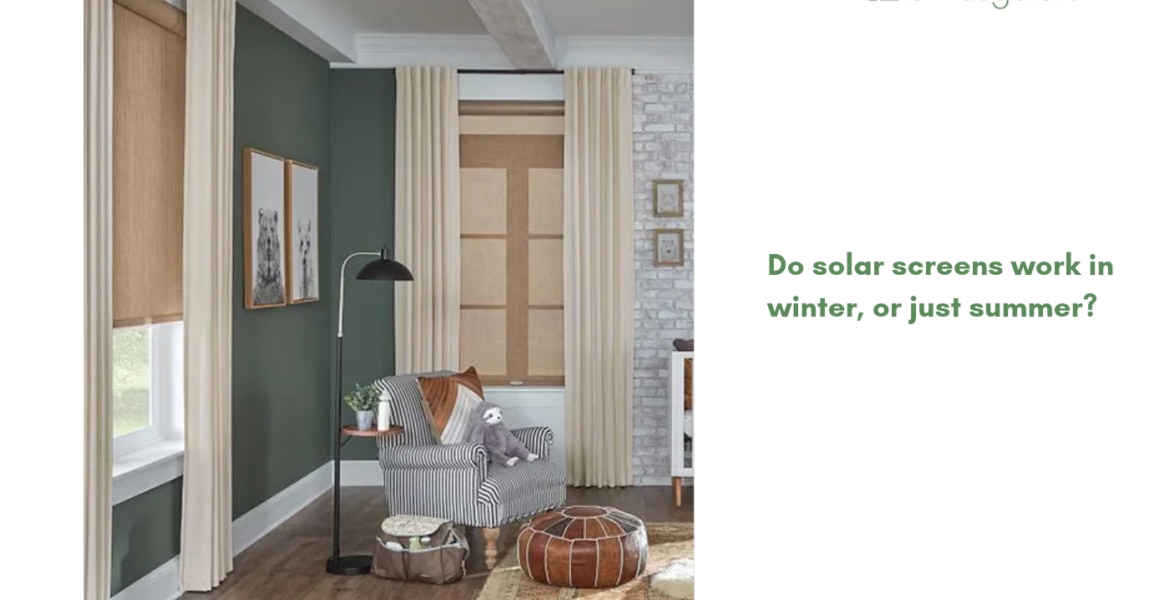
Solar screens keep working in winter, just not for warmth. In the cold months, they still cut glare, block UV rays that fade floors and furniture, and give you daytime privacy while keeping your view. What they don’t do is hold heat in. Solar screens are built to block the sun’s heat, and in winter that sunshine is free warmth you usually want. So keep them, but raise them on sunny winter days, especially on south-facing windows, and lower them when glare gets in the way.
Plenty of homeowners think of solar screens as a summer product and wonder whether they should come down in the fall. For most screens that roll up and down, the answer is no. You just use them differently.
Do solar screens only work in summer?
No. Solar screens do three things, and two of them matter all year.
| What solar screens do | Summer | Winter |
|---|---|---|
| Cut glare | Helpful | Often more helpful, since the sun sits lower in the sky |
| Block UV rays | Helpful | Still helpful |
| Block solar heat | A big plus | Usually a drawback on cold, sunny days |
| Keep your view | Yes | Yes |
The trick in winter is timing. Lower the screen when glare is a problem, and raise it when you want the sun’s warmth.
Our solar shades for indoor use come in openness levels from 1% to 10%, and our outdoor shades range from 3% to 15%.
How does openness factor affect winter performance?
Openness is the percentage of the fabric that’s open weave. Openness decides how much light, heat, and view come through.
- Lower openness, like 1% to 3%, blocks the most light, glare, and solar heat. You get more privacy but a dimmer room and less winter warmth from the sun.
- Higher openness, like 10% to 15%, lets in more light and more of the view, along with more of the sun’s heat.
What openness doesn’t change much is insulation. Solar fabric is a screen with tiny openings, not a sealed layer of trapped air, so it does little to keep warm room air from losing heat through the glass at night.
National lab research backs up this winter trade-off. When Lawrence Berkeley National Laboratory modeled window attachments for the U.S. Department of Energy, exterior solar screens saved cooling energy but added a heating penalty in central climates. In heating-dominated northern climates, most shades used the least energy when left open, with cellular shades as the exception. In hot southern climates, solar screens were among the most effective options.
For keeping heat in on winter nights, a cellular shade does far more. If winter comfort matters most in a room, our cellular shades are the better fit there, and drapery over a solar shade adds a warmer layer at night.
Should you remove solar screens for winter?
For roll-up solar shades, there’s no need. Raise them instead.
Indoor solar shades:
- Raise them on sunny winter days, especially on south-facing windows, to let the sun warm the room.
- Lower them when glare hits a TV, a computer screen, or your eyes.
- Close a warmer treatment, like a cellular shade or drapery, at night. Solar shades don’t provide nighttime privacy on their own, because a lit room is visible from outside.
Outdoor solar shades:
- Roll them up in strong winds. Our Signature Outdoor Solar Shades include a bungee tie-down for light winds up to 12 mph, and the shade should be rolled up when winds get stronger.
- Roll them up before snow or ice storms so the fabric isn’t weighed down or frozen in place.
- Let wet fabric dry before you roll it up for long stretches.
- Check the brackets and hardware after winter weather, and tighten anything that’s shifted.
Do solar screens protect against UV and glare year-round?
Yes, and winter is when many people notice the glare most. The sun sits lower in the sky in winter, so it shines deeper into rooms and straight into eyes and screens for more of the day.
Year-round benefits include:
- Glare control for home offices, TV rooms, and kitchens with low winter sun.
- UV protection for floors, rugs, and furniture, since UV rays reach through the glass in every season.
- Daytime privacy without giving up the view, which matters on gray winter days when you want every bit of daylight.
Lighter fabric colors reflect more heat, while darker colors give a clearer view out. In winter, a darker solar fabric can be a nice choice for rooms where the view and glare control matter more than blocking heat. For a closer look at how solar shades differ from standard rollers, see our comparison of solar shades vs. roller shades.
How do you care for solar screens through cold and wet months?
A little seasonal care keeps solar screens working for years.
Indoor solar shades:
- Dust regularly with a soft cloth or the brush attachment on your vacuum.
- Spot clean with a soft cloth, warm water, and a mild detergent, then let the fabric dry completely.
- Never submerge them in water.
Outdoor solar shades:
- Our Blindsgalore Outdoor Solar Screens can be wiped with a damp cloth or gently vacuumed.
- Coolaroo fabrics can be hosed down and cleaned with mild soap and a non-abrasive cleaner, then air-dried. Skip bleach, machine washing, and tumble drying.
- Let the fabric dry fully before rolling it up, especially after rain or snowmelt.
- Check hardware for loosening or corrosion when the weather turns.
Planning new shades before spring? Our measuring guide covers indoor and outdoor mounts. Have questions about the right openness for your windows and climate? Contact our in-house team of design experts and we’ll help you choose.
Frequently asked questions
Yes, for glare, UV protection, and daytime privacy. Solar screens don’t help keep heat in, and they block some of the sun’s free warmth, so raise them on sunny winter days, especially on south-facing windows.
Not if they roll up. Raise indoor solar shades on sunny days and lower them for glare. Roll outdoor solar shades up during strong winds and before snow or ice storms.
No. Solar fabric has tiny openings and doesn’t trap air, so it does little to stop heat loss through the glass. For winter insulation, use a cellular shade or lined drapery.
A higher openness lets in more light and winter sun, while a lower openness blocks more glare. If you keep solar shades down in winter mainly for glare control, a moderate openness balances daylight and comfort.
No. When the lights are on inside, people can see in through solar fabric. Pair solar shades with a light-filtering or blackout shade, or drapery, for nighttime privacy.
Outdoor solar shades can stay installed, but roll them up in strong winds and before snow or ice. Let the fabric dry before rolling it up, and check the hardware after storms.