
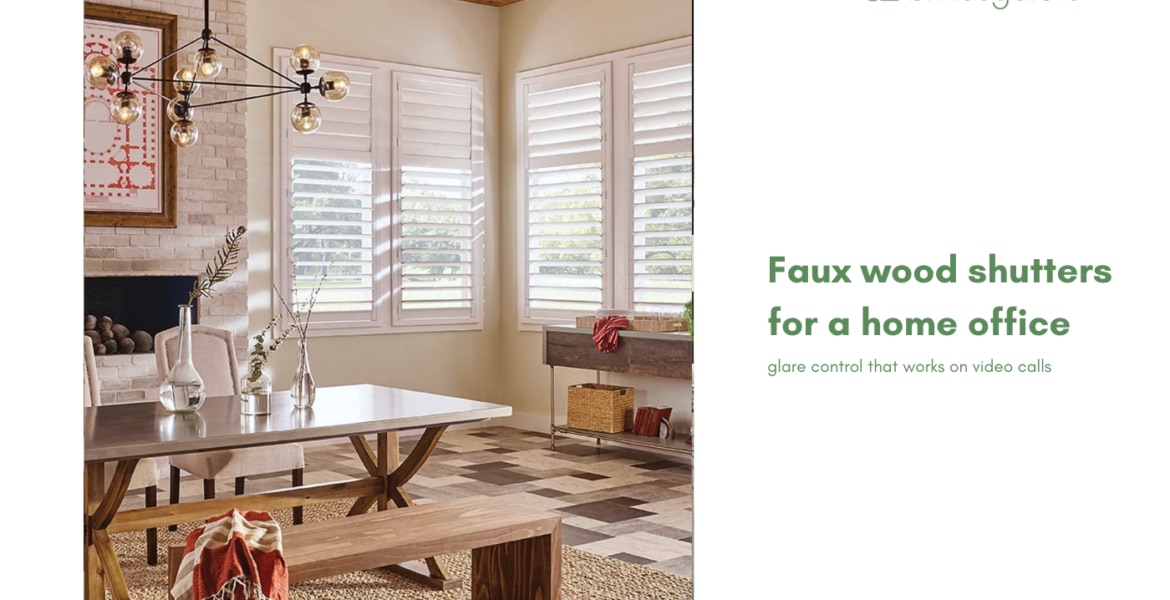
For a home office with daily video calls, the best window treatment is one that redirects light instead of blocking it, and faux wood plantation shutters do that well. Adjustable louvers bounce direct sun toward the ceiling, keep glare off your monitor, and let you dim a bright window behind you so the camera exposes for your face. A divider rail adds separate control over the top and bottom of the window.
A home office asks more of a window than any other room. You need daylight to stay alert, a readable screen, a backdrop that looks tidy on camera, and some privacy from the street. Few window treatments handle all four at once.
Why does a home office need adjustable light, not just blocked light?
Closing everything solves glare and creates new problems. A dark room means more lamps, harsher contrast between screen and surroundings, and a flat, shadowy look on camera. The goal is light you can aim.
According to the Occupational Safety and Health Administration, windows and other direct light sources that reflect on a monitor make the screen harder to see, leading to eye strain and fatigue. OSHA’s guidance is to use blinds or drapes so light enters the room but not your direct field of view, and to place the screen at right angles to windows. Adjustable louvers are built for exactly that balance.
Here’s what a home office window needs to do over a workday:
- Let in soft daylight without direct sun on the screen.
- Change with the sun, since the light at 9 am looks nothing like the light at 3 pm.
- Balance the window’s brightness so you don’t turn into a silhouette on camera.
- Keep passersby from seeing your desk while daylight still comes in.
How do shutter louvers handle video-call glare?
Louvers work by angle. Tilt them so the edge closest to you points up, and direct sun hits the louver face and bounces toward the ceiling. The ceiling then spreads that light softly across the room, which keeps the screen readable and your face evenly lit.
The camera is the other half of the problem. When a bright window sits behind you, the camera exposes for the window, and your face goes dark. Close the louvers partway on that window, and the camera can balance the scene without you moving your desk.
Horizontal blinds tilt too, and they handle glare well in plenty of offices (our comparison of shutters vs. horizontal blinds covers the trade-offs). Shutters bring a few extras that matter in a room you sit in all day:
- Top and bottom control. A divider rail splits each panel into two louver sections you tilt independently. Keep the lower half closed for privacy and glare, and open the top half for daylight.
- A cleaner backdrop. Rigid panels sit in a frame with no lift cords or stacked slats. A hidden tilt, which uses a gear system inside the panel’s side frame, removes the front tilt bar for an even cleaner look behind you.
- Full access to the glass. Panels swing open on hinges when you want the whole view or fresh air.
- Built to stay straight. Our faux wood shutters add aluminum inserts to the louvers when the panel width calls for extra support.
One honest note: shutters aren’t blackout. Expect thin light lines of up to 1/16 inch around the panels, which is normal for the construction.
How should you position louvers for morning vs. afternoon light?
The direction your window faces sets the schedule. East-facing windows get direct morning sun, and west-facing windows get it in the afternoon. North-facing windows give steadier light, while south-facing windows get longer sun exposure. (see our guide to covering windows by direction for the full breakdown).
| Time of day | East-facing window | West-facing window |
|---|---|---|
| Morning | Tilt louvers up to bounce low sun off the ceiling | Open louvers for soft, indirect daylight |
| Midday | Open louvers as the sun moves overhead | Open louvers, or angle slightly up if light reaches the desk |
| Afternoon | Open louvers for even light | Tilt louvers up, and close the lower section if you have a divider rail |
| Video calls | Close louvers partway on any window behind you | Close louvers partway on any window behind you |
| End of day | Close fully for privacy | Close fully for privacy |
A few setup habits make the routine easier:
- Put your desk at a right angle to the window when the room allows it. Side light causes the least glare.
- Do a test call at the time you take most meetings, then adjust the louver angle until your face is the brightest thing on screen.
- Use the divider rail as your midday control. The top louvers handle daylight, and the bottom louvers handle glare and privacy.
Faux wood vs. real wood shutters: which is better for a daily-use room?
Faux wood is the practical pick for most home offices, especially sunny ones. Real wood shutters are lighter and look slightly more refined up close, and they’re a fine fit for a dry, shaded room. Sun and heat are where they struggle, because real wood can warp, crack, or fade when it takes direct light day after day.
| Features | Faux wood shutters | Real wood shutters |
|---|---|---|
| Material | Composite or engineered materials made to look like painted wood | Genuine hardwood |
| Sun and heat | Resists warping and yellowing | Can warp, crack, or fade with heavy sun |
| Moisture | Handles humidity well | Best kept out of damp rooms |
| Weight | Heavier | Lighter |
| Finish | Painted look in whites and off-whites | Paint or stain |
Our faux wood shutters are handcrafted to order from hollow-core poly resin vinyl with a painted-wood look, in three louver sizes:
- 2 1/2-inch louvers for smaller windows and a traditional look.
- 3 1/2-inch louvers for a clean middle ground with a clearer view out.
- 4 1/2-inch louvers for larger windows and the most open view-through.
On camera, white and off-white finishes look the cleanest, and they reflect bounced daylight back into the room. For more on how faux wood compares with other shutter materials, read Wood Shutters vs Vinyl Shutters: Which Is Better?
How do you measure for home office shutters?
Shutters reward careful measuring. Each one is built to your exact window, and shutters aren’t part of our 30-day exchange guarantee, so take your time and measure twice. Our measuring guide walks you through inside and outside mounts step by step.
Keep these points in mind:
- Check your window depth. Frame style depends on how much depth the window has and whether it has trim.
- Plan the divider rail. Panels 66 inches tall or taller need at least one, and you can place it where it lines up with your sightline at the desk.
- Pick the panel layout. A single panel works on windows up to 36 inches wide, and wider windows use two or more panels.
Over 99% of our customers measure and install their own window coverings, and shutters ship with the hardware and instructions you need. If you’d like a second pair of eyes on your numbers, our in-house experts are a call away at (877) 702-5463.
Frequently Asked Questions
Window treatments with adjustable louvers or slats work best, because they redirect light rather than block it. Faux wood shutters are a strong pick: you can bounce sun toward the ceiling, dim a window behind you for the camera, and use a divider rail to control the top and bottom of the window separately.
Yes. Tilting the louvers sends direct sun toward the ceiling instead of onto your screen, and partly closing them on the brightest window cuts reflections further. For the best results, also set your desk so the screen sits at a right angle to the window.
Yes. Faux wood shutters give you the same adjustable light control in a study as in a home office, and the material resists the warping and yellowing that sunny rooms can cause.
Match the louver to the window. Larger louvers (3 1/2 or 4 1/2 inches) give a clearer view and a more modern look on standard and large windows, while 2 1/2-inch louvers suit smaller windows.
No. Closed shutters darken a room well, but small light lines up to 1/16 inch around the panels are normal. If you need full darkness for recording or a nap room, pair shutters with drapery.
Dust the louvers regularly with a soft cloth or a vacuum brush, tilting them to reach both sides. Spot clean with a barely damp cloth and mild soap, and never submerge any part of a shutter in water. Our faux wood shutters maintenance guide covers the details.