
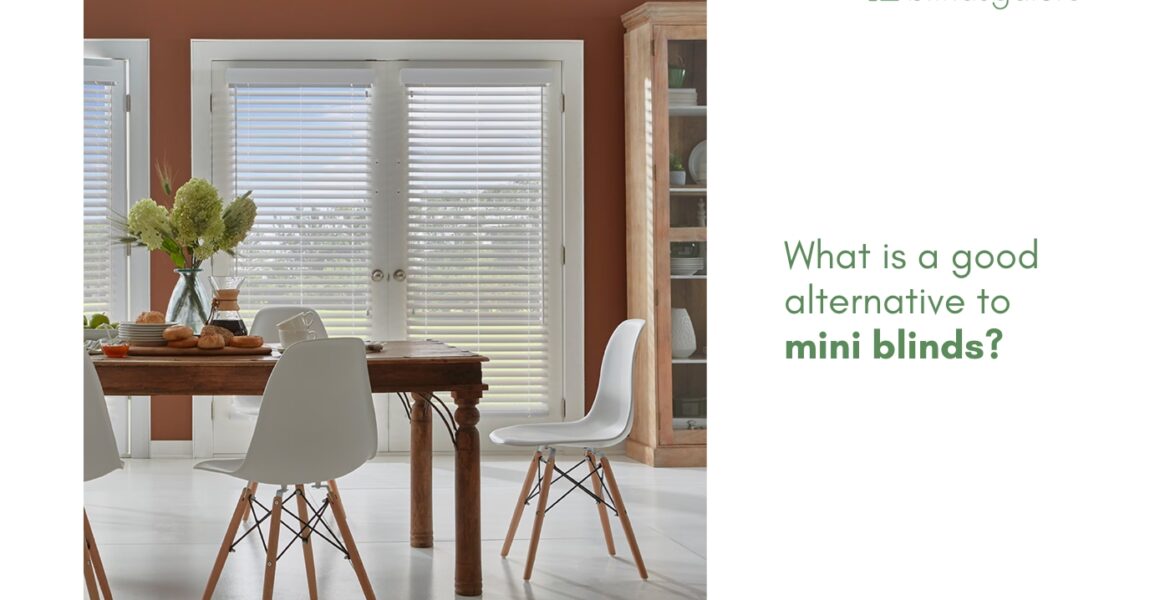
You already know what’s wrong with your mini blinds. The question is which replacement actually fixes it. The fix for “this room looks like a rental” is different from the fix for “the bedroom’s too bright at 5 am.” Most articles dump every alternative on the market and let you sort it out. That wastes your time.
Match the complaint below to what’s actually bothering you, and the right upgrade is sitting underneath it.
If your mini blinds just look cheap
The most direct fix is faux wood blinds. Same operation as what you have now (raise, lower, tilt), but the slats are 2 or 2.5 inches wide and come in painted whites, soft greys, and wood-stained finishes that read as part of the room rather than something hanging in front of it. No retraining your hand on a new mechanism. You install them the same way you’d install mini blinds, and the room looks noticeably more finished within an hour.
If you want a bigger departure from the slatted look, roman shades move the room toward fabric instead of plastic. The aesthetic shifts from “office” to “home” immediately, which is why romans show up in living rooms and dining rooms where the wrong window treatment can drag the whole space down. Our Dual Sheer Shades piece covers a related fabric-forward option that lets more natural light through.
If you’re tired of cleaning every slat
A typical mini blind has dozens of slats. Each one is a ledge. Each one collects dust. There’s no version of “wiping them down” that takes less than 20 minutes per window, and the dust comes back in three days.
The clean fix is to ditch the slats. Roller shades are one continuous panel of fabric that rolls up into a tube at the top of the window, so a microfiber pass handles months of buildup. Cellular shades work on the same principle: smooth fabric exterior, nothing to dust between. Either drops cleaning time from “Sunday afternoon” to thirty seconds per window. Our How to Clean Honeycomb Blinds walkthrough covers the technique for both.
One cleaning rule worth flagging: never submerge any blind or shade in water. Spot-clean with a damp cloth or use a vacuum brush attachment. Submerging warps the lift mechanism, and no warranty covers that.
If light leaks are wrecking your sleep
Mini blind slats never fully close. There’s a sliver where each slat meets the next, more light around the edges where the blind doesn’t reach the frame, and cord holes punched through every slat. If your bedroom faces east and the room is bright before your alarm goes off, no version of mini blinds will fix that.
Honeycomb shades in a blackout fabric are the strongest answer. The fabric is fully opaque, side channels block edge light, and the honeycomb construction adds insulation, which helps with the temperature spikes that often come with bright morning sun. Blackout roller shades deliver the same opacity with a flatter, more modern profile.
Both are dramatically darker than any mini blind has ever been, and both come standard with cordless lift, which makes them safer in bedrooms with kids or pets. If glare during the day is also part of the problem, our Hello, Sunshine, Goodbye, Glare post walks through how different opacity levels affect what you see and feel.
If your window is the wrong shape for them
Mini blinds were designed for standard double-hung windows. On anything wider or taller (sliding patio doors, picture windows, French doors), they sag in the middle, look stretched out, and rattle every time the heat kicks on.
For patio doors, vertical blinds and panel track blinds are built for side-to-side movement and wider openings. Verticals are the traditional pick, with rotating vanes for light adjustment. Panel tracks are the contemporary cousin, with wider fabric panels that slide on an overhead track and stack neatly to one side. For very wide windows where you want a softer look, custom drapery handles the scale and reads as deliberate design rather than oversized hardware. Our Ultimate Guide to Window Treatments walks through which treatments suit which shapes.
A quick note on cord safety
If your current mini blinds still have pull cords, an upgrade is also a chance to go cordless. Updated ANSI/WCMA safety standards (effective June 2024) require all new window coverings sold in the United States to be either cordless or have inaccessible cords, a measure designed to reduce strangulation risk for young children. Every option above is available cordless, and most are available motorized, too. Our Smart Home, Stylish Home post shows what a motorized lift actually looks like in everyday use, including scheduling and voice control for hard-to-reach windows.
Start with samples before you commit
Window treatments look different in your house than they do in catalog photos. Order up to 10 free samples, tape them to your window frame, and check them at sunrise, noon, and 8 pm. The right answer usually picks itself once you can see the fabric or finish in your own light.
Our in-house experts are at (877) 702-5463 if you want to talk through your specific windows. Most of the team has been doing this for 20-plus years and can usually narrow your options down in one conversation. Custom orders ship free across the contiguous United States and Canada, and most ship within 5 to 7 business days.
Frequently Asked Questions
Faux wood blinds, because the operation is identical to mini blinds and the visual upgrade is immediate. Cellular shades are the next most common pick, especially in bedrooms where the priorities shift to light control and insulation over slat-style adjustability.
In design-conscious spaces, mostly yes. Over the last decade, cordless fabric shades, faux wood blinds, and motorized options have steadily replaced them in homes that are being updated or built new. Mini blinds still hold up fine in rentals, garages, and utility rooms where function matters more than look.
Roller shades, woven wood shades, and roman shades are dominating current design trends. Anything that emphasizes texture, fabric, and clean lines over visible hardware. Motorized lift is the other major shift, especially for tall, oversized, or hard-to-reach windows where a remote or app beats a wand or cord.
In nearly every room, yes. Cellular shades fit the same window openings (inside or outside mount), come standard with cordless lift, and outperform mini blinds on insulation, light control, and cleaning. The one thing cellulars cannot do is tilt for partial light, but a light-filtering fabric gives you a similar soft-glow effect without needing the slat adjustment.
A basic light-filtering roller shade is usually the most affordable step up while still delivering a cleaner look and much easier cleaning. Faux wood blinds sit in a similar price range if you want the slatted-blind operation in a substantially nicer material.
Start with the room’s biggest annoyance. Cleaning headache, go with roller or cellular. Light leaks ruining sleep, go with blackout cellular or blackout roller. Cheap-looking, go with faux wood or roman. Wrong-shape window, go with vertical, panel track, or drapery. Our team at (877) 702-5463 can usually narrow this down in one phone call if you have several rooms to handle at once.