
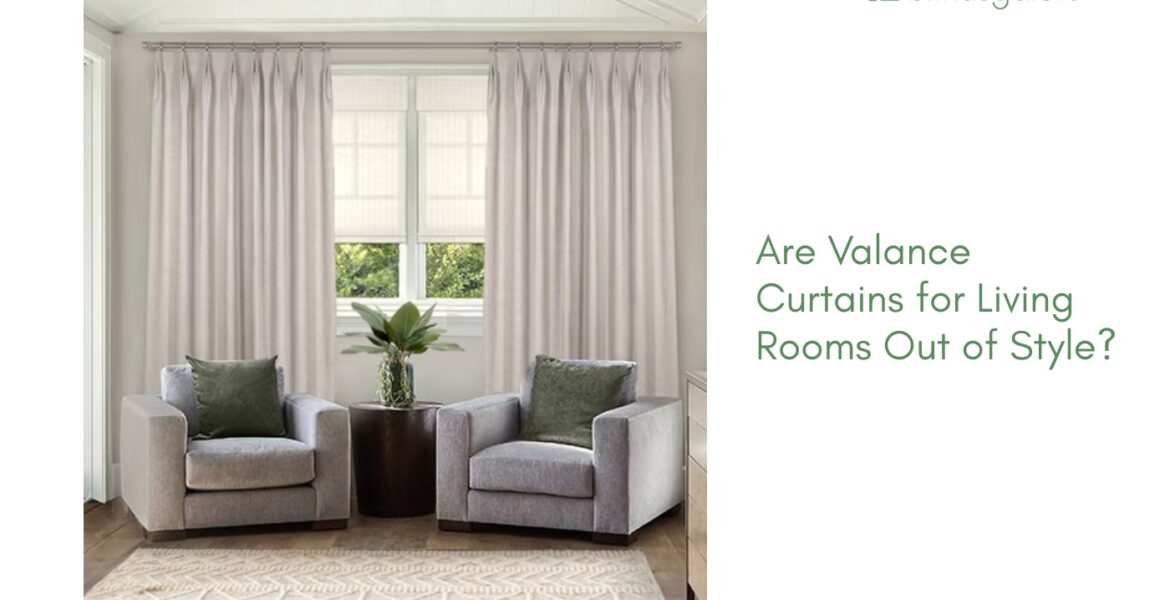
Valance curtains for living rooms are not out of style. The dated versions are: the heavy swags, ruffled polyester, cabbage-rose prints, and fussy fringe that dressed living rooms in the 1990s. The valance itself, used with restraint and current proportions, still belongs in plenty of living rooms in 2026.
What has changed is the design vocabulary. Today’s valance is short, structured, and made from a fabric that looks intentional rather than ornamental. Used right, it frames the window, hides the hardware on a functional shade, and gives the top a finished line. Used incorrectly, it instantly dates the whole room.
Shop Custom Valances and Cornices
Are valances out of style in 2026?
No. Valances are not out of style in living rooms or anywhere else. The category has simply moved on. Modern valances are tailored, restrained, and proportioned to the window, while the heavy gathered, swagged, and fringed versions from a generation ago do read as dated.
The distinction in one sentence: a valance that looks deliberate reads current, a valance that looks decorative for decoration’s sake reads dated.
Three things separate the two:
- Construction: Tailored, board-mounted, and lightly pleated styles feel modern. Gathered, ruffled, and rod-pocket-with-cascades styles feel old.
- Fabric: Linen-look weaves, clean solids, and subtle textures read current. Heavy polyester florals and shiny synthetics do not.
- Proportion: A valance sized to the window and the room reads intentional. One overscaled with fringe and trim overwhelms the space.
Used as a thoughtful finishing layer over a functional treatment, a valance still has a place in a modern living room. Used as the main event, piled with embellishment, it does not.
What modern living-room valances look like
The current version is a quieter, more architectural take on the idea. Designers reach for it as a top trim rather than a centerpiece.
A modern valance is short, usually 12 to 18 inches deep, and either flat, lightly pleated, or board-mounted with a clean edge. The fabric leans into texture rather than pattern: linen weaves, woven cotton, simple solids, or restrained geometric prints. Mounted slightly above the window frame (high mounting), the valance draws the eye up and makes the ceiling feel taller, the kind of small structural move that helps a living room look more designed.
Cornices, the rigid cousins of soft valances, are also making a comeback. A clean upholstered cornice or a sleek wooden one adds architectural presence without bulk and works beautifully over a Roman shade or a flat panel of custom drapery. The valance and cornice collection covers both soft fabric tops and structured cornice boards in current styles, so the choice is not between old-fashioned and nothing.
When a living room valance still works
A valance earns its place when it does a specific job, not when it is added for its own sake.
Three cases where a living-room valance still makes sense:
- To hide the headrail of a functional treatment. A valance softens the top of a Roman, roller shade, or cellular shade and turns the window into a finished composition rather than a piece of hardware on the wall.
- To add height and proportion. High-mounted above the frame, a valance visually lengthens the window and lifts the ceiling line, which helps in a low-ceilinged room.
- To layer with full-length drapery for a tailored, dressed feel. A simple board-mounted valance above floor-to-ceiling panels gives a living room a layered, designed look without piling on fabric.
In all three, the valance is supporting the rest of the window, not competing with it.
When to skip the valance entirely
There are living rooms where a valance is the wrong call, no matter how cleanly it is styled.
Skip it in a minimal or contemporary room where every horizontal line should be deliberate, since an extra band at the top fights the simplicity. Skip it where the window itself is the architecture, like a beautiful arched or oversized opening worth showing off as is.
Worth flagging: Blindsgalore currently covers perfect arches only, so for arched living rooms, a valance may not be the right add-on anyway. And skip it any time the temptation is to dress up a window that is otherwise unfinished. A naked window calls for a real treatment, not a decorative band over nothing.
For living rooms going for an open, light-forward feel, full-length living-room window treatments like drapery or a clean Roman shade often do the work better on their own.
How to make a valance feel current
A few small choices separate a valance that looks fresh from one that looks tired.
Choose a tailored construction (flat panel, box pleat, board-mounted) over a gathered or swagged one. Lean into texture (linen, basket weave, cotton) and away from heavy polyester or chintz. Keep the depth proportional, roughly one-fifth of the window height. Stick to one or two design features (a clean trim or a subtle pleat, not both plus fringe). Coordinate with the room’s palette rather than introducing a contrasting color at the top of the window. Layered correctly, a modern valance becomes the quiet finish that pulls the whole window together.
The honest verdict for living rooms
Valance curtains for living rooms are not out of style; the bad ones are. A clean, tailored, well-proportioned valance still belongs in plenty of homes in 2026, and a heavy ornate one belongs in none.
Ordering up to 10 free swatches makes the fabric and texture real against the wall before any commitment, and the in-house experts at (877) 702-5463 can help decide whether a valance, a cornice, or a clean stand-alone treatment is the right finish for the room. All Blindsgalore brand treatments carry a 3-year limited warranty, upgradeable to five years, against defects in materials and workmanship when properly installed.
Frequently Asked Questions
No. Modern valances, tailored, lightly structured, and made from current fabrics, are still in style. The heavy gathered, ruffled, and swagged versions from a generation ago are out of style, which is the version most people picture when they ask the question.
Valances are not out of style in living rooms, but the right room matters. Tailored, transitional, and traditional spaces wear them well, especially over full-length drapery or a functional shade. Strictly minimal or contemporary rooms usually look better without one.
A modern valance is tailored, board-mounted, or flat, made from a linen-look or woven cotton fabric, and proportioned to the window. Clean lines, subtle texture, and restraint are the markers. Skip gathered ruffles, heavy swags, and busy floral prints.
Let a full-length drapery panel, a Roman shade, or a clean roller shade carry the window on its own. A structured cornice board is also a current alternative to a soft valance for hiding hardware while adding architectural presence.
A valance mounted slightly above the window frame, called high mounting, makes the window look taller, and the ceiling feel higher. A poorly proportioned valance mounted inside the frame can do the opposite and visually shorten the window.
Blindsgalore brand treatments carry a 3-year limited warranty with a free upgrade to a 5-year warranty, covering defects in materials and workmanship when the product is properly installed and operated. Boutique products include a free 5-year extended warranty. Fading is not covered.