
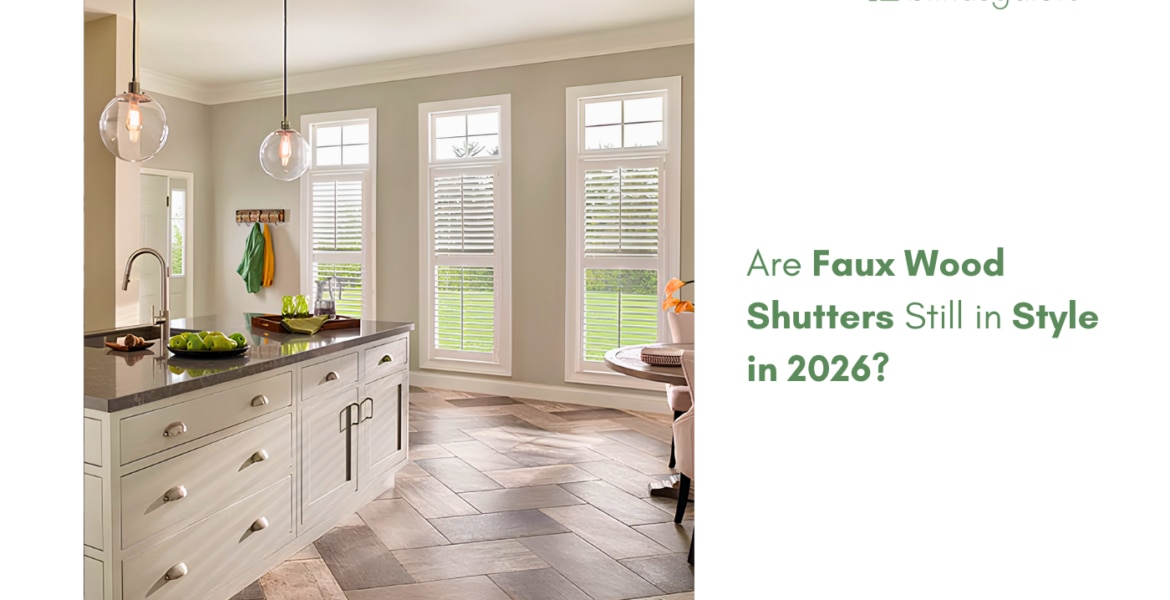
Designers are genuinely split on shutters right now, and pretending otherwise would be useless to anyone actually deciding. Some call them timeless. Others say slatted panels read heavy against the lighter, more layered interiors that define 2026.
Both camps are describing real things, and the disagreement resolves once you separate the two questions hiding inside the one everybody asks. Is the shutter silhouette dated? That depends almost entirely on louver width and finish. Is faux wood as a material dated? That is not a style question at all.
Are faux wood shutters out of style in 2026?
No, but a specific version of them is.
What reads dated in 2026 is the narrow-louver, high-gloss white shutter that was specified across builder-grade housing through the 2000s. Narrow louvers create more horizontal lines across the glass, which chops up the view and makes a window feel busy. A high-gloss white finish reflects light in a way that draws attention to the shutter rather than the room.
What reads as current is the opposite specification. Wider louvers, fewer lines, matte or satin finish, and a color pulled from the trim or wall rather than defaulting to bright white. Same product category, different result.
The critique from designers who find shutters heavy is fair when aimed at the first version. That critique stops applying once the proportion changes.
What makes a shutter look dated?
Four failure modes, and every one of them is a specification choice rather than a flaw in the category.
- Louvers are too narrow for the window. More slats across the same glass read as busier and more dated.
- High-gloss white on every window regardless of trim color. Gloss dates faster than any other finish.
- Shutters installed on windows that should have stayed open. A wall of glass in an open-plan room usually wants something lighter.
- Mismatched frame styles across a single sightline, so two adjacent windows read as separate projects.
None of those are arguments against shutters. All four are arguments for specifying them deliberately.
Which louver width should you choose?
Louver width is the single most consequential style decision in the category, and it is the one most buyers make by accident.
2 1/2 inch louvers
Traditional proportion. The narrower louver suits cottage-style homes, older architecture with smaller window openings, and rooms where the shutter should read as period-appropriate rather than contemporary. Faux wood shutters with 2 1/2 inch louvers are the right call on genuinely small windows, where a wide louver would look oversized and awkward.
3 1/2 inch louvers
The current default, and the safest choice on most standard residential windows. Faux wood shutters with 3 1/2 inch louvers give noticeably cleaner sightlines than the traditional width while still suiting transitional and traditional rooms. For anyone unsure, this is the width that ages best.
4 1/2 inch louvers
The contemporary specification. Fewest lines across the glass, most view when open, and the most architectural presence. Faux wood shutters with 4 1/2 inch louvers belong on larger windows and in rooms where the shutter should read as built-in millwork. On a small window, this width overwhelms the opening, so scale matters in both directions.
For how these proportions hold up over years of use, the guide on how long custom blinds last covers what to expect from a permanent treatment. The practical rule: larger windows and more modern rooms take wider louvers. Smaller windows and older architecture take narrower ones. Matching louver width to window size is what separates a shutter that looks specified from one that looks defaulted.
Is faux wood a style compromise or a performance choice?
Performance, and this is where the “still in style” framing misleads people most.
Faux wood is a composite or polymer panel engineered to handle conditions that damage hardwood. The relevant comparison is not appearance, because a well-made faux wood shutter and a painted hardwood shutter are difficult to tell apart on a painted finish. The relevant comparison is moisture.
- Bathrooms, kitchens, laundry rooms, and coastal homes: faux wood, without hesitation. Humidity swells and warps wood over time.
- Dry living rooms, dining rooms, and bedrooms where you want visible wood grain and a stain rather than paint: hardwood earns its premium.
- Mixed homes: specifying faux wood in wet rooms and hardwood elsewhere is normal practice, not a compromise.
Where faux wood genuinely differs is weight. Composite panels are heavier than hardwood, which matters on very wide openings where panel sag becomes a consideration. On standard windows, it is not a factor. The full faux wood shutters range covers the three louver widths, and the wider shutters collection covers configuration options across window types.
Why is “in style” the wrong question for shutters?
Shutters are not decor. Being attached to the window frame changes their category in a way most style commentary misses.
The distinction shows up in real estate paperwork. Standard purchase agreements carry a fixtures checklist precisely because it is often unclear what stays with a property and what a seller may remove. The Georgia Association of REALTORS® Seller’s Property Disclosure Statement includes exactly such a checklist, introduced with the note that it exists to avoid disputes over fixtures versus personal property. Window treatments sit on that list.
Curtains move with you. Shutters generally do not. That places them closer to cabinetry than to soft furnishings, and it explains why the style question deserves a different standard. Nobody asks whether kitchen cabinets are in style this year. The question is whether the proportions are right and the finish has aged well. Shutters deserve the same test.
A related point on performance: federal energy guidance lists shutters among the operable coverings worth managing seasonally, and notes that tight-fitting insulating window treatments matter most on windows that feel drafty. A shutter that seals well against the frame does real thermal work, which is a durable argument that does not depend on trend cycles at all.
For the broader picture on how permanent treatments affect a property, Blindsgalore covers this in How the Right Window Treatments Can Increase Your Home’s Resale Value.
Where do faux wood shutters not belong?
Worth stating plainly, since most coverage of this topic recommends shutters universally.
Large uninterrupted glass walls and open-plan rooms designed around light are the clearest case against. Panels and stiles introduce vertical breaks across a view that was the point of the window. A roller or cellular shade disappears; a shutter does not.
Sliding and patio doors need a different configuration entirely. Standard hinged panels do not clear the opening, so sliding door shutters on a track are the correct specification there.
Arched windows carry a specific limit worth knowing before you plan a whole room. Blindsgalore covers perfect arches only, so an irregular or eyebrow arch will not be a fit and is better solved another way.
Rooms where you want the window treatment to recede are also a poor match. Shutters announce themselves by design. If the goal is for the window to disappear, the guide on Hello Sunshine, Goodbye Glare covers lighter approaches, and the Ultimate Guide to Window Treatments maps the full set of alternatives.
How should you specify faux wood shutters?
Decide louver width from window size first, finish second, and material from the room’s humidity. Those three choices, made deliberately, produce a shutter that will look considered in ten years. Made by default, they produce the exact builder-grade look that started the “are shutters dated” conversation.
The honest summary for 2026: shutters are not out of style, but they are no longer a safe default. The category rewards specification and punishes autopilot, which is a reasonable trade for a treatment that stays with the house.
Every Blindsgalore shutter is made to order to your exact window dimensions, and over 99% of our customers measure and install their own. Order up to 10 free samples to see louver width and finish against your own trim before committing, or call the in-house team at (877) 702-5463 to talk through proportions on a specific window. Every Blindsgalore product carries a 3-year limited warranty with the option to extend to five years, and shipping is free across the contiguous United States and Canada.
Browse the faux wood shutter collection or order free samples to compare louver widths in your own light.
Frequently asked questions
No. Narrow-louver, high-gloss white shutters read dated. Wider louvers in matte or satin finishes, sized to the window, remain current. The material is not what dates a shutter; the proportion and finish are.
Four and a half inch louvers read most contemporary, with the fewest horizontal lines and the most view when open. Three and a half inch is the safest all-round choice. Two and a half inch suits small windows and cottage-style architecture.
On a painted finish, the two are difficult to distinguish. The visible difference appears with stains, where real hardwood shows natural grain that composite cannot fully replicate. For painted white or neutral shutters, faux wood is not a visual compromise.
Yes, and they are the correct choice there. Composite panels resist the humidity and steam that swell and warp hardwood over time. Kitchens, laundry rooms, and coastal homes are the same case.
Generally yes, because they are attached to the window frame and treated as fixtures rather than personal property. Standard real estate disclosure forms include fixtures checklists specifically to prevent disputes on this point.
Large uninterrupted glass walls, open-plan rooms designed around light, and any window where the treatment should visually disappear. Sliding doors need track-mounted shutters rather than hinged panels.