
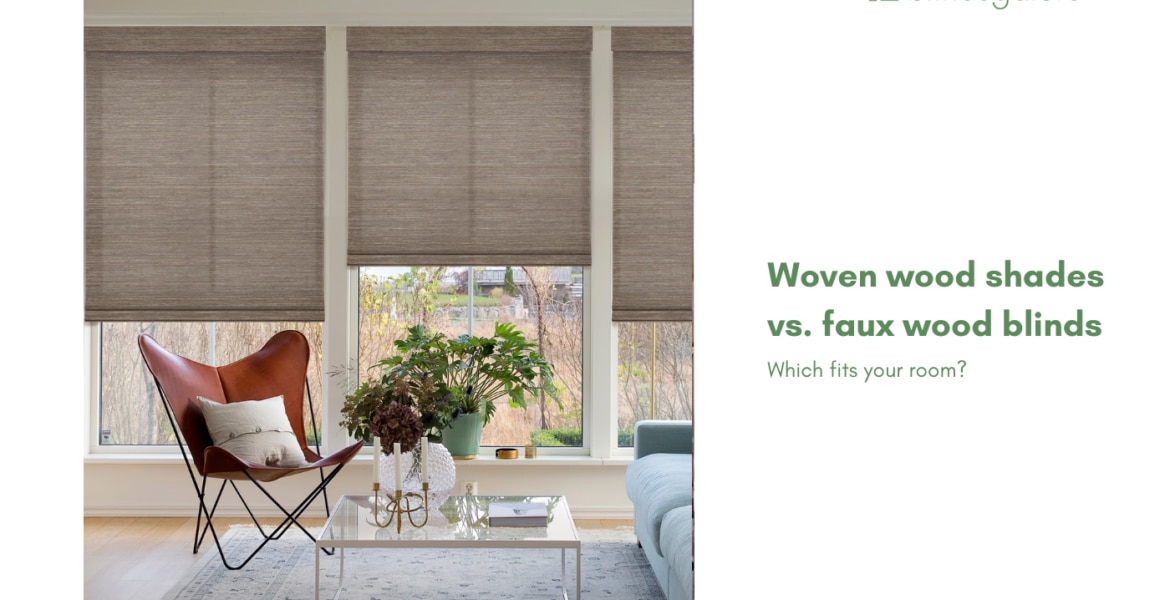
Choose woven wood shades when you want natural texture and soft, filtered light in a living room, bedroom, or sunroom. Choose faux wood blinds when the room gets steam or splashes, or when you want to tilt for privacy without raising anything. Neither is better everywhere. Woven wood is the design-forward pick, and faux wood is the moisture-resistant, low-maintenance pick.
Plenty of homeowners land on this exact fork because both bring warmth to a window. The difference is how they get there. Woven wood shades use real plant fibers. Faux wood blinds imitate painted or stained wood in PVC or composite slats.
What is the core difference between woven wood shades and faux wood blinds?
Woven wood shades are a fabric-style shade woven from natural materials and raised or lowered as one piece. Faux wood blinds are a set of horizontal slats you tilt open and closed, then raise when you want the full view.
| Features | Woven wood shades | Faux wood blinds |
|---|---|---|
| Material | Natural fibers such as bamboo, reeds, jute, and grasses | PVC or composite slats |
| How it works | Raises and lowers as one piece | Slats tilt, and the blind raises and lowers |
| Look | Textured, organic, one-of-a-kind | Clean lines in white, neutrals, and wood tones |
| Light when lowered | Filtered light; see-through unless you add a liner | Adjustable by tilting the slats |
| Moisture | Best in dry or lightly humid rooms | Resists moisture, humidity, and warping |
| Cleaning | Dry dusting and a vacuum brush only | Dusting, plus a damp cloth with mild soap |
| Best rooms | Living rooms, bedrooms, sunrooms, dining rooms | Bathrooms, kitchens, laundry rooms, kids’ rooms |
Which looks more natural and design-forward?
Woven wood wins on texture. Every shade is woven from organic materials, so the color, grain, and weave vary slightly from one shade to the next. That variation is what designers love about them, and it pairs naturally with coastal, bohemian, and modern farmhouse rooms.
Our woven wood shades range from open weaves that glow in the sun to tight weaves with more privacy. You can also choose how they fold. Standard styles stack into neat flat folds, while waterfall styles drape in soft, cascading loops. Edge banding adds a fabric border in a coordinating color for a more tailored finish.
Faux wood blinds take a different route to warmth. Wood-tone finishes in honey, walnut, and espresso mimic real hardwood, while crisp whites and neutrals read clean and classic. They’re the more versatile choice if your style leans traditional or you want the window treatment to blend in rather than stand out.
One practical note on woven wood: Because the materials are natural, colors can vary slightly from your sample. Order every shade for a room at the same time so they match.
Which holds up better in moisture-prone rooms?
Faux wood blinds, by a wide margin. PVC and composite slats resist moisture, humidity, and warping, which is why our faux wood blinds are a go-to for bathrooms, kitchens, and laundry rooms. Solid PVC slats are the most moisture-resistant option of all.
Woven wood shades are a different story. According to the USDA Forest Products Laboratory’s Wood Handbook, wood and many other natural materials are hygroscopic, meaning they take on and release moisture depending on the humidity in the air. Repeated steam and splashes can cause natural fibers to swell, warp, or lose their shape over time.
Here’s how we’d match each one to wet rooms:
- Full bathroom with a shower or tub: Faux wood blinds. Steam hits the window daily.
- Half bath or powder room: Either works. Woven wood handles moderate moisture well, and a liner adds privacy.
- Kitchen: Faux wood blinds near the sink or stove. Woven wood suits a breakfast nook or a window away from splashes.
- Laundry room or basement: Faux wood blinds.
For more room-by-room guidance, see our picks for bathroom window treatments.
Which is more durable, woven wood or faux wood?
Faux wood blinds are more durable in demanding rooms. The slats resist warping, cracking, and fading, and they stand up to busy households and frequent cleaning. Our Privacy Faux Wood Blinds use PVC slats built for high-humidity areas, with a cordless lift standard.
Woven wood shades last for years in the right room with proper care. Keep them out of steam, dust them gently, and they’ll hold their shape and texture. Natural fibers are more delicate than PVC, though, and can snag if you clean them roughly.
Weight is the one place where faux wood can lose. Faux wood slats are heavier than real wood, so on very wide windows (over about 6 feet), a faux wood blind can get too heavy to operate smoothly. If you’re covering a wide span, our in-house experts can recommend real wood blinds or another style that suits your size.
How do maintenance and cleaning compare?
Faux wood blinds are easier to keep clean. Woven wood shades need a lighter touch. Never submerge either one in water.
Cleaning faux wood blinds:
- Tilt the slats closed in one direction and dust with a soft cloth, feather duster, or vacuum brush.
- Tilt them closed the other way and repeat.
- Spot clean with a damp cloth and mild soap. Avoid soaking, since water can seep into the headrail and damage the lift.
Cleaning woven wood shades:
- Dust with a feather duster or dry microfiber cloth.
- For bamboo and wood weaves, wipe with a dry cloth using long, even strokes.
- For grass and textured weaves, use the soft brush attachment on your vacuum so nothing snags.
- Skip water and cleaning sprays on the weave itself.
Our guide on How to Clean Blinds: The Complete Material-by-Material Guide covers more materials.
What light control options does each offer?
Faux wood blinds control light by angle. Woven wood shades control it by liner and lift.
With faux wood blinds, a twist of the tilt wand takes you from open view to closed privacy in seconds, with no need to raise the blind. Slat size changes the look and the view-through. Two-inch slats are the most popular, and larger slats suit bigger windows. Routeless slats, like those on our Privacy Faux Wood Blinds, skip the cord holes for better light blocking.
With woven wood shades, the liner decides how much light and privacy you get:
- No liner: The most natural glow, but the shade can be see-through depending on the time of day and your lighting.
- Light-filtering liner: Softens sunlight and adds daytime privacy.
- Blackout liner: Blocks the most light, which makes it a strong pick for bedrooms and nurseries.
Liners are stitched to the back of the shade, and blackout liners on our Luxera and Boutique styles have an off-white street side for a uniform look from outside. Lift choices include cordless, continuous cord loop, top-down/bottom-up on select styles, and motorized. Our post on privacy liners vs. blackout liners explains the difference in detail.
Which should you choose for your room?
Pick by room first, then by style. Here are a few of our favorites from each line.
Woven wood shades:
- Essential Woven Wood Shades: Unlined bamboo, reeds, jute, and grasses with a cordless lift, for a relaxed, sunlit look.
- Classic Natural Woven Shades: Bamboo, jute, and grass weaves with light-filtering or blackout liner options.
- Boutique Serenity Natural Woven Shades: Our premium line, with a fabric-wrapped bottom bar and a matching valance.
Faux wood blinds:
- Essential Faux Wood Blinds: Foamed PVC slats that resist heat and humidity, at our value price point.
- Cordless Faux Wood Blinds: 2-inch PVC slats with a wand tilt and a valance included.
Torn between two looks for one room? Order up to 10 free samples and hold each one up in your own window, in morning light and at night. Love your view.
Frequently Asked Questions
Get woven wood shades for natural texture and filtered light in dry rooms like living rooms, bedrooms, and sunrooms. Get faux wood blinds for bathrooms, kitchens, and laundry rooms, or anywhere you want to tilt for privacy and light without raising the blind.
Faux wood blinds are more durable in humid, high-traffic rooms because PVC and composite slats resist moisture, warping, and cracking. Woven wood shades hold up well for years in dry rooms with gentle care, but their natural fibers are more delicate.
Yes, in a half bath or powder room with moderate moisture. In a full bathroom with a shower or tub, faux wood blinds are the better choice, since steam can cause natural fibers to swell and warp over time.
Not on their own. Unlined woven wood can be see-through when lights are on inside. Add a light-filtering liner for more privacy or a blackout liner for the most.
Quality faux wood blinds look close to real wood, especially composite slats with an embossed grain. Wood-tone finishes such as honey, walnut, and espresso mimic hardwood, and our comparison of real wood vs. faux wood blinds covers the differences.
Yes. Many homes use woven wood shades in living spaces and bedrooms and faux wood blinds in bathrooms and the kitchen. Matching the wood tone of the blinds to the woven shades keeps the look consistent from room to room.