
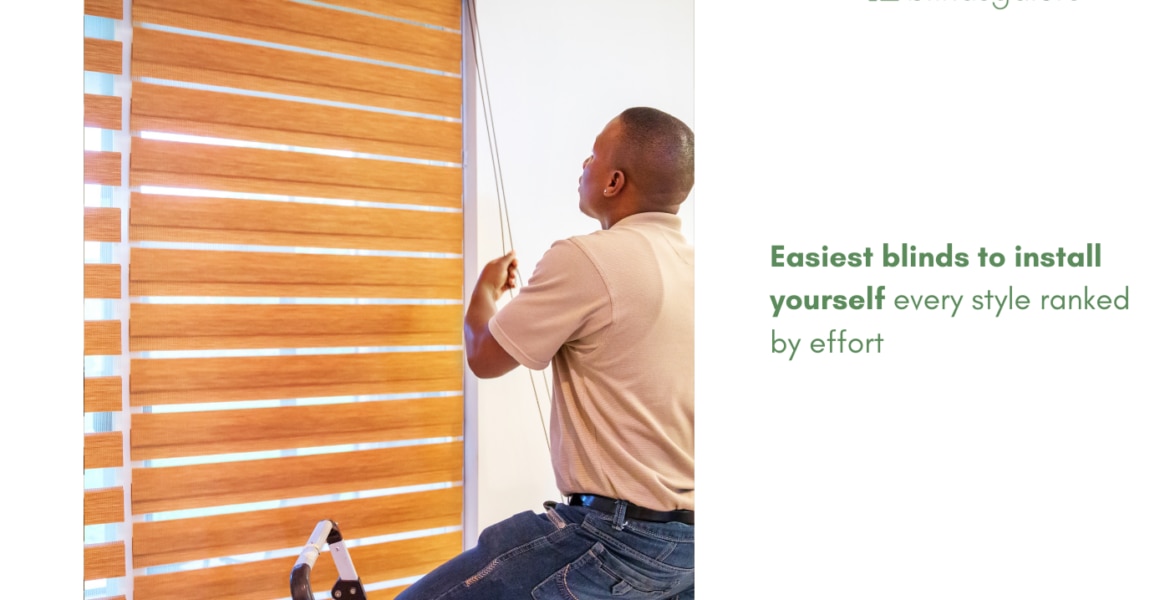
The easiest blinds to install yourself are no-drill shades, which hold inside the window frame with spring tension and need no tools at all. Next come cordless cellular and roller shades, which take two brackets and a few screws. Faux wood blinds and vertical blinds are still very doable for a first-timer, and shutters ask for the most patience.
Hanging blinds has a reputation as a job for the handy neighbor with the good drill. The numbers say otherwise. Over 99% of our customers measure and install their own window treatments. What separates an easy Saturday from a frustrating one is picking the right product for your skill level, your walls, and your window.
Why do 99% of Blindsgalore customers install their own blinds?
Custom window treatments are built to do most of the hard work before the box reaches your door. Here’s what makes self-install the norm rather than the exception.
- Measuring takes one tool. A steel tape measure is all you need to measure your windows, and our factory handles the sizing deductions for inside mounts.
- Hardware comes in the box. Brackets and mounting screws ship with your order, so there’s no trip to the hardware store for parts.
- Every product has its own guide. Our installation guides are organized by product type and brand, from cellular shades to panel track blinds.
- A real safety net. If you measure wrong, the Blindsgalore Guarantee covers mis-measured products with a 30-day exchange (up to four window coverings per household, excluding shutters and custom graphic shades).
What are the easiest blinds to install yourself?
Installation effort comes down to four things: how many brackets go up, how heavy the headrail is, how wide the window is, and whether you need a second set of hands. Here’s how the main styles rank, from easiest to most involved.
| Rank | Style | Tools needed | What goes up | Helper needed? |
|---|---|---|---|---|
| 1 | No-drill shades | None | Tension headrail, then the shade snaps in | No |
| 2 | Cordless cellular shades | Drill, screwdriver | Snap-in metal brackets | No |
| 3 | Cordless roller and solar shades | Drill, screwdriver | End brackets or snap-in cassette brackets | Only on large shades |
| 4 | Faux wood and mini blinds | Drill, screwdriver | Metal box brackets, plus center supports on wider blinds | Helpful on wide windows |
| 5 | Vertical blinds | Drill, screwdriver | Headrail with track clips or L-brackets | Yes |
| 6 | Panel track blinds and shutters | Drill, screwdriver, level | Track or frame, then panels | Yes |
Best picks for a first-time installer
If you’ve never hung a window treatment, start near the top of the list.
- Cellular shades are among the easiest to install. The headrail is compact, the snap-in metal brackets go up quickly, and the shade clicks into place.
- Roller shades are a few screws away from finished. Cordless lifts skip the cord tensioner, which removes a step.
- Faux wood blinds are our most popular window covering and a confident second project. Expect metal box brackets and, on blinds wider than 38 inches, a center support bracket.
Where it takes a little more effort
Vertical blinds aren’t hard, but they’re wide, so a second person makes the job faster. Panel track blinds and shutters involve more parts and more precise alignment, so read the guide start to finish before you open the box.
Can you install blinds without drilling?
Yes. Our no-drill shades use a tension-mounted headrail that presses against the sides of the window opening. You set the headrail, then the shade snaps onto it. No screws, no adhesive strips, and no tools. Our guide to no-drill blinds and shades shows the three-step install.
That matters to a lot of households. The U.S. Census Bureau counted 44.6 million rented homes in its 2019–2023 estimates, and plenty of leases discourage holes in the trim.
The no-drill lineup covers four styles:
- No-drill light-filtering cellular shades
- No-drill blackout cellular shades
- No-drill roller shades, in light-filtering or blackout
- No-drill solar shades
Check these requirements before you order:
- Inside mount only. The headrail has to sit within the window opening.
- Enough depth. Cellular styles need at least 1 1/2 inches; the roller shades need at least 2 inches.
- Width up to 84 inches, depending on the style and lift.
- Skip PVC window frames. Tension mounts aren’t recommended for them.
- A square opening. For the roller shades, the top, middle, and bottom widths can’t differ by more than 1/4 inch.
Roman shades are the exception. We don’t currently offer a no-drill roman shade, and our post on hanging roman shades without drilling explains why tension rods and adhesive struggle with their weight.
What tools do you need to install blinds?
Less than you’d think. The kit depends on the job.
For measuring:
- A steel tape measure
- A pencil
For a standard bracket install:
- A power drill
- A screwdriver
- A pencil for marking bracket holes
- A step ladder
For a no-drill install:
- Nothing beyond your hands
Two additions are worth keeping nearby. The renovation pros at This Old House also list a level and drywall anchors. A level keeps outside-mount brackets straight, and anchors give screws a solid grip when you’re mounting into drywall rather than wood trim.
A quick safety note: if you choose a continuous cord loop, mount the cord tensioner that ships with it. The U.S. Consumer Product Safety Commission calls cordless window coverings the safest option for homes with young children, which is one more reason cordless lifts sit at the top of our easy-install list.
When should you call our in-house experts instead?
Most installs are a straight line from box to window. A few situations are worth a quick call first.
- Your window is out of square. If the width varies by more than a fraction of an inch top to bottom, the mount type matters.
- You’re short on mounting depth. Our experts can confirm whether an inside mount will work or an outside mount is the better call.
- You’re ordering shutters. Shutters take more measuring effort than any other style, and a second look helps.
- You’re wiring up a smart home. Motorized shades with a hub add an app-pairing step.
- You’re doing a whole house. A quick plan for mount types and lift options across rooms saves reorders.
Our team is in-house and knows every product we sell. Call (877) 702-5463, text (858) 550-4750, or book a virtual consultation. Moving into a new place? Our new homeowner’s guide covers which rooms to tackle first.
Frequently asked questions
No special tools. A steel tape measure is the only tool you need for measuring. For a standard install, you’ll also want a power drill, a screwdriver, a pencil, and a step ladder. Brackets and mounting screws come with your order. No-drill shades need no tools at all.
Yes. Our no-drill cellular, roller, and solar shades use a tension-mounted headrail that fits inside the window opening. Check the minimum depth and width limits for your style, and avoid PVC frames.
Not much. The headrail mounts with track clips or L-brackets, and the vanes hang independently from carriers on the track. Vertical blinds usually cover wide windows and sliding doors, so a second person to hold the headrail is the main difference. For more on choosing between the two, see our comparison of vertical vs. horizontal blinds.
No-drill shades are the easiest, since they need no tools. If you’re drilling, cordless cellular shades are the simplest bracket install, followed closely by cordless roller shades.
Mis-measured products are covered by the Blindsgalore Guarantee. You can exchange up to four window coverings per household within 30 days of receiving your order. Shutters and custom graphic shades are excluded.
Yes. Mini blinds take very little effort to hang, which makes them a perfect starting point if you’ve never installed a window covering. If your lease rules out drilling, compare them with no-drill shades. Our guide to budget-friendly mini blinds for apartments has more.