
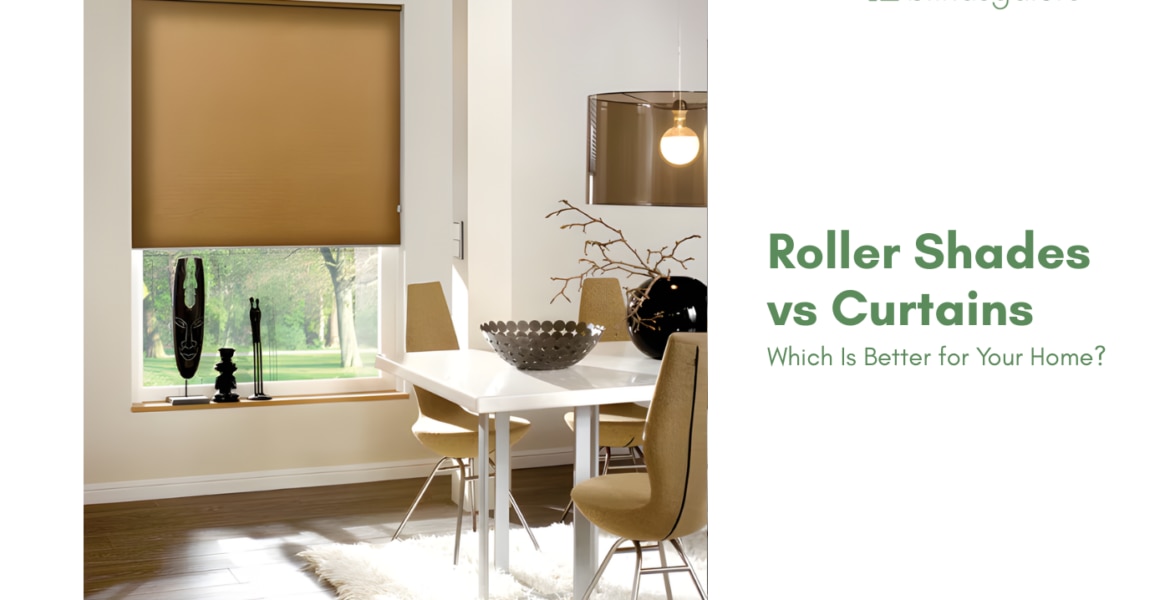
Roller shades and curtains solve the same basic problem, covering a window, but they do it in very different ways. Roller shades deliver clean lines, easy maintenance, and precise light control. Curtains bring softness, warmth, and a layered design element that shades alone cannot replicate.
Neither option is universally better. The right choice depends on the room, the look you want, and how much daily effort you’re willing to put into your window treatments.
Light Control between Roller Shades vs. Curtains
Roller shades offer simple, effective light control. A single panel of fabric rolls up or down to cover the window. Light-filtering fabrics soften incoming sunlight while still allowing a gentle glow. Blackout fabrics block nearly all light, making them ideal for bedrooms and media rooms.
The Blindsgalore Envision Light Filtering Roller Shades create a soft glow while providing privacy and glare control. All components, including the cord loop, cassette, and bracket covers, come color coordinated with the selected fabric for a seamless look.
For rooms that need darkness, the Blindsgalore Envision Blackout Roller Shades block most incoming light, making them a strong choice for bedrooms, nurseries, bathrooms, and media rooms.
Curtains provide excellent light blocking when fully closed, especially with a blackout liner. Where curtains gain an edge is in layering. Pairing a sheer curtain panel with a heavier lined panel gives you multiple levels of light control in one window. For more on layered window treatment ideas, see Modern Window Curtains for Your Living Room.
Privacy for Roller Shades vs. Curtains
Both options provide solid daytime privacy. Roller shades in light-filtering fabric obscure the view from outside while still letting light through. Blackout roller shades provide complete privacy at any hour.
Curtains offer strong privacy when fully drawn, particularly heavier fabrics with liners. Sheer curtain panels on their own reduce visibility from outside during the day, but can allow silhouettes to show at night when interior lights are on.
For the strongest nighttime privacy, blackout roller shades or lined curtain panels are the most reliable options.
Style and Aesthetic for Roller Shades vs. Curtains
Roller shades suit modern, minimalist, and contemporary interiors. The single clean panel creates an uncluttered look that lets other design elements in the room take the spotlight. Neutral fabrics in subtle woven textures or smooth finishes keep the window treatment quiet and understated.
Curtains add softness, volume, and visual warmth. Fabric panels frame the window, add height, and bring color, pattern, or texture into a room. The Blindsgalore Pinch Pleat Curtain Panels deliver classic elegance with structured folds, while the Blindsgalore Back Tab Curtain Panels hide the curtain rod for a modern, streamlined drape.
Curtains generally work better in traditional, transitional, and formal interiors. Roller shades are the natural pick for clean-lined contemporary spaces. For more on combining both styles in one room, see 4 Living Room Window Treatment Ideas.
Space and Room Size
Roller shades sit flush against the window frame (inside mount) or just beyond it (outside mount), taking up almost no visual space. A small room feels more open when the window treatment stays close to the glass rather than projecting into the room.
Curtains need space for fabric to hang, gather, and stack when open. In a larger room, that flowing fabric adds drama and proportion. In a compact room, heavy curtains can make the space feel smaller and more closed in. If curtains are the preference in a small room, mounting the rod high and wide creates the illusion of a taller, wider window without overwhelming the space.
Maintenance
Roller shades are among the lowest-maintenance window treatments available. A quick pass with a feather duster or a damp cloth keeps them looking fresh. Never submerge any shade in water, and skip harsh chemicals that can damage the fabric. For more cleaning tips, see Easy Cleaning Hacks for Window Blinds.
Curtains require more upkeep. Fabric collects dust, pet hair, and allergens over time. Most curtain panels need periodic washing or dry cleaning to stay looking their best. The trade-off is that curtains offer a richness and texture that low-maintenance shades do not.
Energy Efficiency
Curtains, especially heavier-lined fabrics, provide better insulation than a single-layer roller shade. Thick curtain panels trap air between the fabric and the window, reducing heat transfer in both summer and winter.
Roller shades offer modest insulation on their own. For stronger energy performance, cellular shades outperform both roller shades and curtains. For a deeper comparison of shade and blind types, see Shades vs. Blinds: What’s the Diff?.
The Best of Both Worlds: Layering
Many designers combine roller shades with curtains for full flexibility. Mount a roller shade inside the window frame for light and privacy control, then hang curtain panels on a rod above the frame for softness and style. The shade handles function, the curtains handle design, and both layers work together beautifully.
For a complete overview of all window treatment options, see The Ultimate Guide to Window Treatments.
FAQs
Neither is universally better. Roller shades win on maintenance, space efficiency, and modern aesthetics. Curtains win on warmth, texture, insulation, and design versatility. The best choice depends on the room and personal preference.
Roller shades provide less insulation than heavy curtains. Adding a cassette or choosing an outside mount minimizes those gaps.
Yes. Light-filtering roller shades provide good daytime privacy. Blackout roller shades offer complete privacy at any time of day or night.
Roller shades generally make small rooms feel more open because they sit close to the window and take up minimal visual space. Curtains can make a room look bigger if mounted high and wide, drawing the eye upward and creating the illusion of taller windows.