
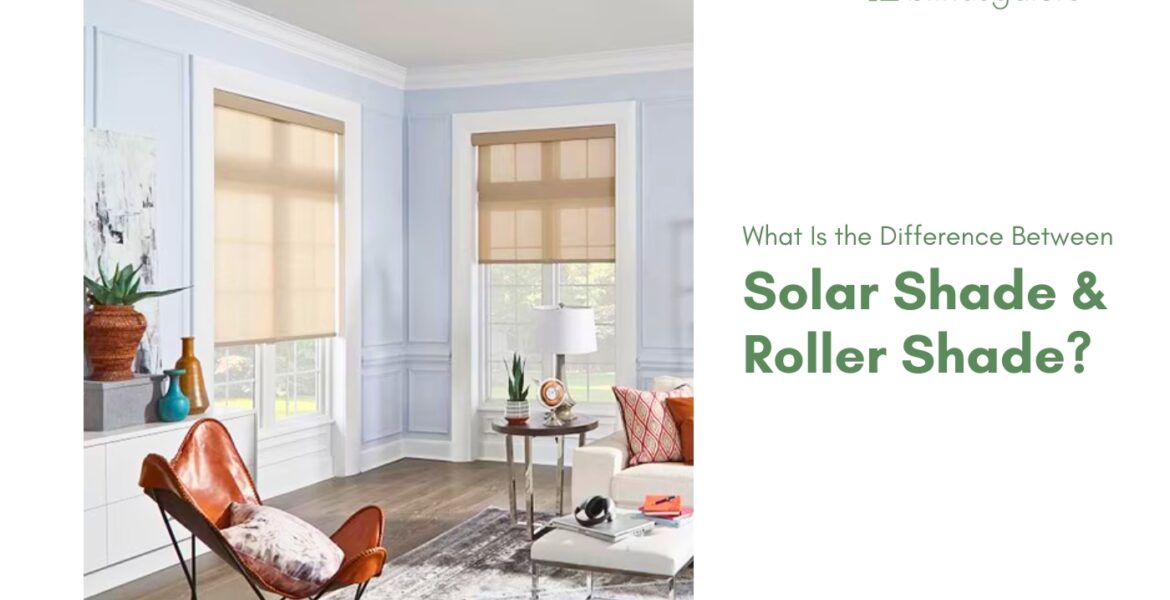
Solar shades and roller shades look alike, operate alike, and mount the same way. Both use a single panel of fabric that rolls up into a tube at the top of the window. The difference between solar and roller shades is the fabric itself and the job each one is built to do.
A solar shade uses an open-weave fabric designed to reduce heat and glare while preserving the view through the window. A roller shade uses a solid fabric designed to filter or block light entirely for privacy and darkness.
Same mechanism, different fabric, different purpose. Here is how to choose.
What is a solar shade?
A solar shade is a roller-style shade made from a mesh or open-weave fabric that filters sunlight without blocking the view. The weave reduces glare and UV exposure while still letting you see through the window to the outside. The tighter the weave, the more light and heat it blocks. The more open the weave, the more view and daylight it preserves.
Solar shades are the right choice for rooms where the view matters as much as the light control. Living rooms with a garden view, home offices with screen glare, sunrooms, and any window facing south or west where heat gain is a problem all benefit from a solar shade. The Classic solar shades cover a range of openness levels from tight-weave for maximum heat reduction to open-weave for maximum view, while the Harmony solar shades add a refined texture and broader color palette.
One honest note: solar shades do not provide full privacy at night. When the room is lit and the outside is dark, people can see in through the open weave. For rooms that need nighttime privacy, a solar shade works during the day but needs a complementary treatment for after dark. The guide on Hello Sunshine, Goodbye Glare covers how solar fabric manages heat and glare across different window orientations.
What is a roller shade?
A roller shade uses a solid, non-see-through fabric in one of several opacity levels: light-filtering, room-darkening, or blackout. The fabric rolls up and down on the same mechanism as a solar shade, but the solid weave blocks the view in both directions, which provides full privacy when the shade is lowered.
Roller shades suit bedrooms, bathrooms, nurseries, and any room where privacy and light blocking matter more than preserving the outside view. The Harmony light-filtering roller shades soften daylight into a warm, even glow without the glare, while blackout roller fabrics block close to 100% of the light for rooms that need true darkness.
Roller shades deliver full privacy day and night, which solar shades do not. For bedrooms and bathrooms, that distinction is often the deciding factor.
How do solar and roller shades compare?
The two share the same clean profile and simple operation but differ in four key areas.
View through the window.
Solar shades preserve the view. When lowered, you can still see the yard, the street, or the sky through the open-weave fabric. Roller shades block the view entirely when lowered, creating a private interior.
Heat and UV reduction
Solar shades are specifically engineered to reduce heat gain and block UV rays while still letting light through. Roller shades in lighter fabrics reduce some heat, but they are not designed for the same targeted UV and heat management that solar fabric provides. For west-facing windows where afternoon heat is the main problem, a solar shade is the stronger tool.
Privacy
Roller shades provide full privacy in both directions, day and night. Solar shades provide daytime privacy (people outside have trouble seeing in against the bright sky) but lose that privacy at night when the room is lit. For any room where nighttime privacy matters, roller shades are the right choice.
Light control range
Roller shades span the full light-control spectrum, from sheer to blackout. Solar shades operate within a narrower band, from light-filtering to moderate reduction, and never reach blackout. For the broadest flexibility across a home, the guide on Dual Sheer Shades covers treatments that combine multiple opacity levels in one shade.
Which rooms suit each shade?
The choice follows the room’s priority: view or privacy.
Solar shades belong on west- and south-facing windows where heat and glare are the main problems, in living rooms and dining rooms where the view is part of the design, in home offices where screen glare needs managing, and in sunrooms where the goal is to stay connected to the outside while staying comfortable inside. For a broader look at how solar and roller shades fit alongside other treatments, the Ultimate Guide to Window Treatments covers the full picture.
Roller shades belong in bedrooms, bathrooms, nurseries, and any room where full privacy and strong light control matter most. Mixing solar shades on the sun-facing windows and roller shades in the private rooms is a practical whole-home approach. The guide on How Long Do Custom Blinds Last covers how both types hold up over time, and the guide on Window Treatments for New Construction walks through planning both from the start.
Same mechanism, different rooms
Are solar shades the same as roller shades? Mechanically, yes; functionally, no. Solar shades reduce heat and glare while keeping the view. Roller shades block light and provide privacy while covering the view. Both are custom-built to the exact measurements of the window and backed by a 3-year limited warranty upgradeable to five years.
Order free samples to see both fabrics side by side in your own light, and call the in-house experts at (877) 702-5463 to match the right shade to each window.
Solar shades and roller shades use the same rolling mechanism but different fabrics. Solar shades use an open-weave mesh that preserves the view while reducing heat. Roller shades use a solid fabric that blocks the view for privacy and light control.
No. Solar shades allow people outside to see in at night when interior lights are on. For rooms that need nighttime privacy, a roller shade or a layered treatment is the better choice.
Roller shades are better for bedrooms because they provide full privacy and can be ordered in blackout fabric for true darkness. Solar shades are designed for daytime glare reduction, not sleeping conditions.
Yes. Solar shades are specifically engineered to reduce heat gain and block UV rays through the open-weave fabric. The tighter the weave (lower openness percentage), the more heat the shade blocks.
Absolutely. Solar shades on sun-facing living area windows and roller shades in bedrooms and bathrooms are one of the most practical whole-home combinations.
Blindsgalore brand shades carry a 3-year limited warranty with an upgrade to a 5-year warranty, covering defects in materials and workmanship when properly installed. Boutique products include a 5-year extended warranty. Fading is not covered.